Mathematical Connections Seminar
“Coloring Graphs with a q-Twist: From Chromatic Polynomials to Polyhedral Geometry”
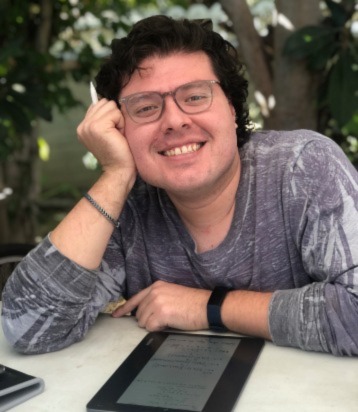
Andrés Vindas Meléndez is an Assistant Professor of Mathematics at Harvey Mudd College.
This lecture took place on April 23, 2026 at 4:15p.m., in HMC’s Shanahan Center 3481.
Abstract
How many ways can you color the vertices of a graph so that no two connected vertices share the same color? This classic question is answered by the chromatic polynomial, a fundamental tool in combinatorics that counts “proper colorings”.
In this talk, we introduce a new “weighted” version of this concept: the q-chromatic polynomial. Instead of simply counting colorings, this invariant assigns weights to them, producing a richer algebraic/combinatorial object that recovers the classical chromatic polynomial when q=1.
A key theme of the talk is the connection between graph coloring and polyhedral geometry. We will explain how proper colorings can be interpreted as lattice points inside geometric objects called polytopes, and how tools from polyhedral geometry (such as Ehrhart theory) help us understand these polynomials. This perspective leads to new formulas, structural insights, and a concrete bridge between combinatorics and geometry.
No background necessary… just a willingness to stare at graphs and polytopes.
Spring 2026
“Careers in Data Science for Human Health”
Panelists:
- Nadia Abuelezam ’09 (Math Bio) – Michigan State University
- Christine Lee ’11 (Math Bio) – Brightside Health
- Kyle Suver ’18 (CS/Math) – Modern Health
- Kenneth Mitchell ’24 (Math Comp Bio) – Axiom Bio
This panel took place on April 16, 2026 at 4:15p.m., in HMC’s Platt Green Room.
Abstract
Join us for an engaging career panel discussion exploring how data science is transforming the future of human health. Hear from professionals working across academia and industry, as they share their career paths, discuss how they apply technical and analytical skills to real-world health challenges, and offer advice for students interested in this rapidly growing field. This event will provide insight into the many ways data science can make a meaningful impact on human well-being.
In collaboration with the Innovation Accelerator Lab for Emerging Health Technologies, and the Innovation Accelerator Lab for Data Science and Social Impact.
“The Finite and the Infinite”
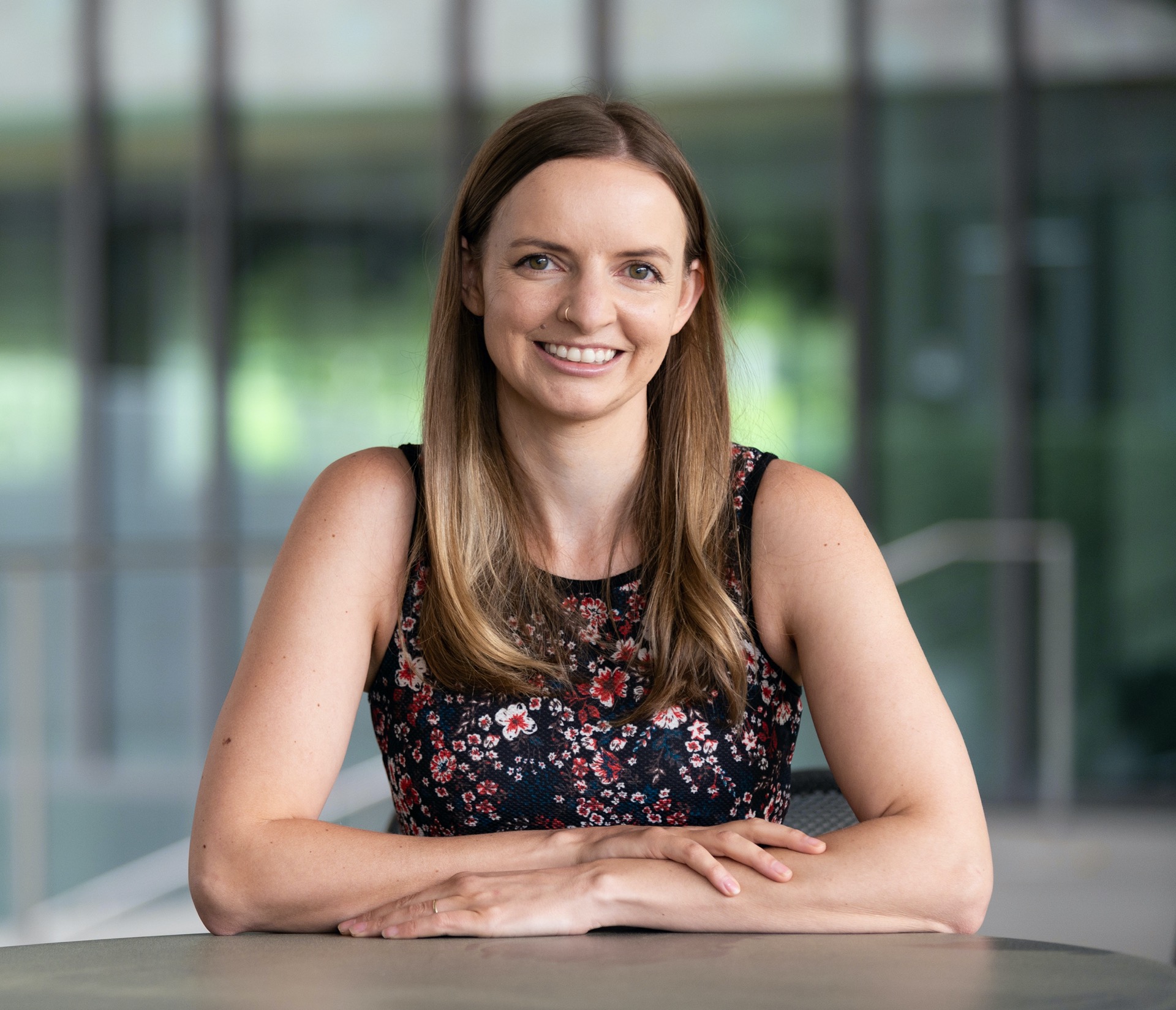
Heather Brooks is an Assistant Professor of Mathematics at Harvey Mudd College.
This lecture took place on April 9, 2026 at 4:15p.m., in HMC’s Shanahan Center 3481.
Abstract
Convergence is the language through which the finite and the infinite converse with each other. This conversation can go both ways: we can understand the infinite by studying the finite (part 1), and the finite by studying the infinite (part 2).
Part 1: We’ll see a situation where the finite accurately describes the infinite. I’ll introduce a classical model of opinion dynamics that’s difficult to analyze. It turns out this model can be thought of as the limit of a family of models as a certain parameter approaches infinity. We’re able to show that our model captures important dynamics of the “infinite” model — for finite parameter values!
Part 2: We’ll see how dynamics on infinite networks tell us about dynamics on finite networks. Studying large networks of interacting agents can be challenging. A convenient strategy is to use infinitely large networks (the “continuum limit”). We do this with functions called graphons which are the limits of sequences of graphs. Under suitable conditions, the solutions of the graphon continuum limit model converge to the solutions of the equivalent models on finite-size networks.
Do you feel like you have to choose between applied or theoretical math? Between loving graph theory or differential equations? After this talk, I hope you’ll see that with convergence we can bridge the gaps.
“An Unlikely of Events: My Journey to Batch Means Estimators”
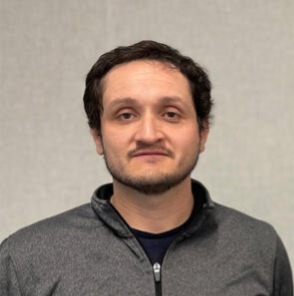
Noé Vidales is an Assistant Professor of Mathematics at Cal Poly Pomona.
This lecture took place on March 26, 2026 at 4:15p.m., in HMC’s Shanahan Center 3481.
Abstract
In this talk I will introduce my research on efficient multivariate variance estimators
for serially correlated data. A family of partial-overlapping batch means estimators is introduced, which offers a tradeoff between computational and variance efficiency. The family is indexed by a shift parameter which determines the overlap between batches and is a generalization of non-overlapping batch means and overlapping batch means. Through the talk I aim to connect my research to my journey to statistics with two goals: clarifying abstract concepts and showcasing a non-traditional path to academia.
“Why is quantum mechanics so hard to describe?: A Computational lens on the problem”
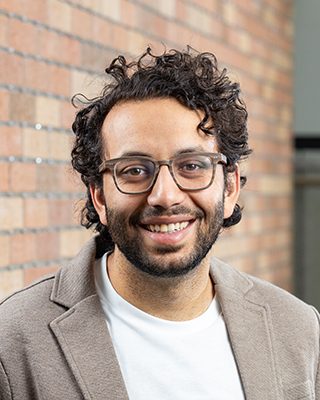
Chinmay Nirkhe is an Assistant Professor at the School of Computer Science and Engineering at the University of Washington.
This lecture took place on March 5, 2026 at 4:15 p.m., in HMC’s Shanahan Center 3481.
Abstract
Why is quantum mechanics so hard to describe? In this talk, I’ll argue that this mystery can be explained through a computational lens. I’ll introduce a perspective on quantum mechanics inspired by theoretical computer science and complexity theory, asking questions like: How hard is it to describe a quantum state? How hard is it for a (quantum) computer to certify properties of physical systems like local Hamiltonians? These questions naturally lead to QMA, the quantum analogue of NP (from complexity theory), where proofs themselves are quantum states and familiar ideas like verification and efficiency take on surprising new meanings.
I’ll sketch recent research ideas (by myself and the community) showing how quantum states can hide information in ways that defeat classical reasoning, how circuit depth and query complexity limit what we can learn about them, and what differentiates quantum proofs and states from their classical counterparts. The goal of this seminar is to invite you into thinking about quantum mechanics and physics from a new computational vantage point.
“Finite-dimensionality in fluids and applications”
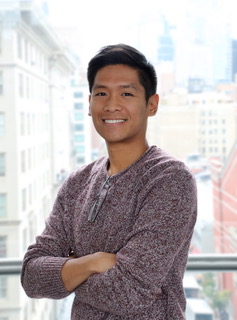
Vincent Martinez is an Associate Professor of Mathematics at City University of New York Hunter College.
This lecture took place on February 19, 2026 at 4:15 p.m., in HMC’s Shanahan Center 3481.
Abstract
Fluids can be described by partial differential equations (PDEs). As such, their solutions are typically given by functions of several variables. In the modern theory of PDEs, solutions are viewed as belonging to vector spaces whose elements are functions; these spaces are typically infinite-dimensional. For instance, if one insists on solutions having “finite energy,” then it is often natural to assume that solutions should be elements of the vector space of square-integrable functions. This talk will present the fundamental equations of incompressible fluids in a simplified setting that allows one to see its infinite-dimensional nature, but nevertheless demonstrate that their long-time behavior is, in some sense, finite-dimensional. We will then discuss the importance of this property in the context of turbulence and weather prediction.
“Tilings on Polyhedra and Polyhedra on Tilings”
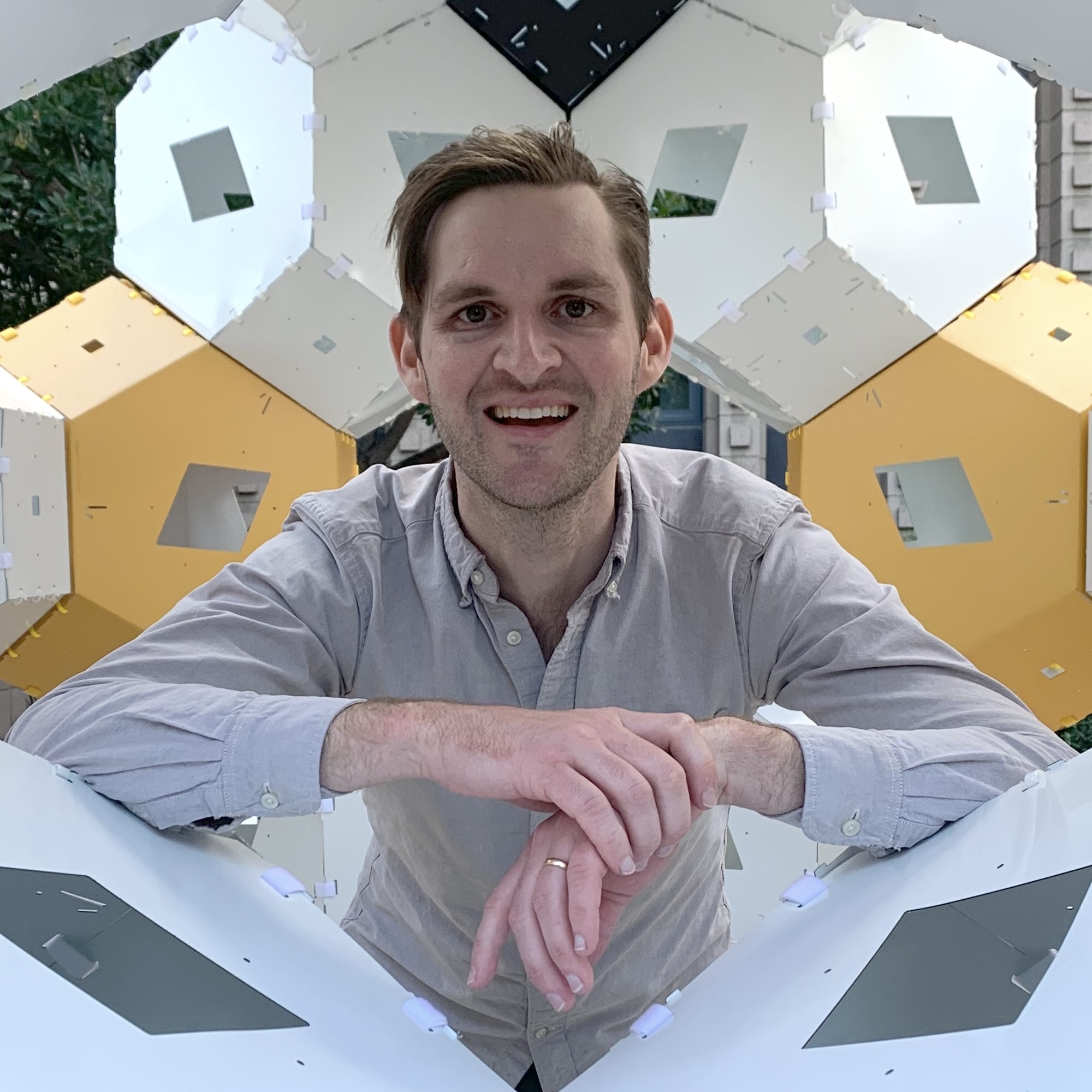
Peter Kagey is an Assistant Professor of Mathematics at Cal Poly Pomona.
This lecture took place on February 12, 2026 at 4:15 p.m., in HMC’s Shanahan Center 3481.
Abstract
A talk in two acts. In the first act, Tilings on Polyhedra, we count a family of tilings first enumerated by the artist M. C. Escher, and then lift these questions into three dimensions. This allows us to answer questions such as: How many ways can we arrange panels on a soccer ball?
The second act, Polyhedra on Tilings, focuses on joint work with Prof. Andrés, describing an algorithm to count “generalized polyforms.” This algorithm counts objects such as the number of pieces in the (166 + 4)-piece 3D puzzle Hexacube, donated to the HMC Math Department by HMC alum Andy Niedermaier (’04), or the number of ways to arrange the building blocks of TOWARD, a temporary sculpture built in 2024 outside of Jacobs.
Fall 2025
“Analyzing blocked randomized experiments”
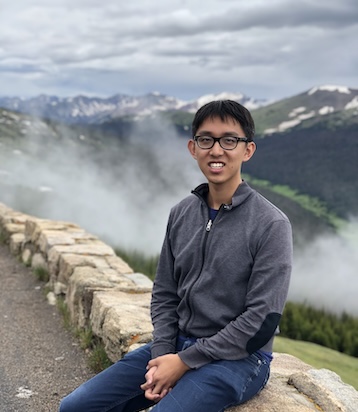
Harrison Li is an Assistant Professor of Mathematics at Harvey Mudd College
The lecture took place on November 20, 2025 at 4:15 p.m., in HMC’s Shanahan Center 3481.
Abstract
I recently finished a multi-year project with collaborators analyzing an experiment to evaluate the effectiveness of a government job training program for unemployment insurance (UI) recipients in Rhode Island. In presenting the results, I will talk about some methodological considerations that arose organically in this context. Specifically, I will provide an introduction to the potential outcomes framework and show how it enables us to formulate a precise mathematical description of what exactly it is we want to estimate when running a randomized experiment. Then, we will see some principled and less principled methods for performing this estimation. Some directions for future research, including opportunities for students to get involved, will be discussed at the end.
“Enumerative Geometry, Tropical Geometry, and Matroids”
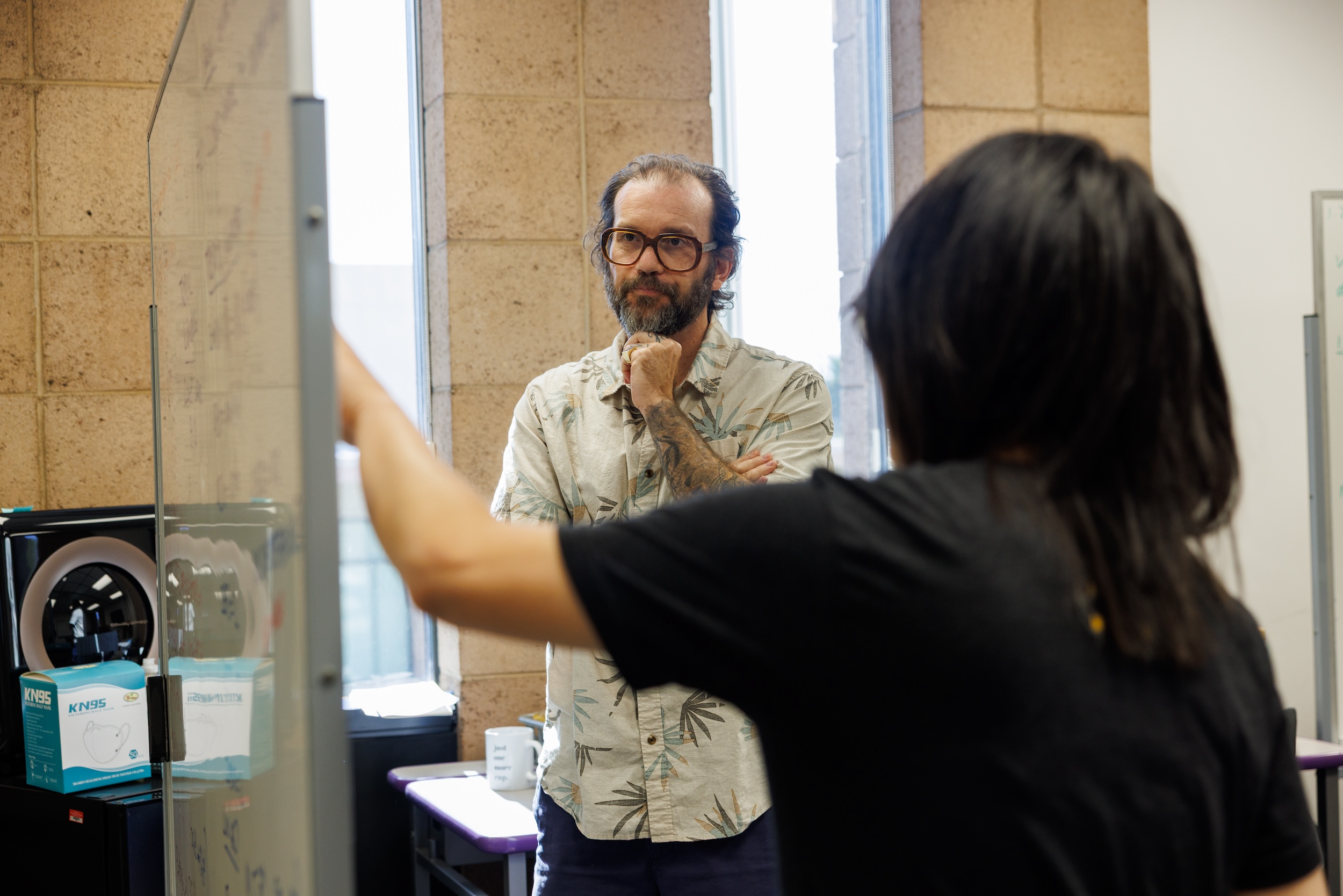
Dagan Karp is a Professor of Mathematics at Harvey Mudd College
The lecture took place on November 6, 2025 at 4:15 p.m., in HMC’s Shanahan Center 3481.
Abstract
In this talk I’ll attempt to give a friendly introduction to enumerative geometry as revolutionized by ideas from theoretical physics, discover how tropical geometry arises rather naturally in this context, and explore how matroids are inexorably involved.
“Voting and Linear Algebra: Connections and Questions”
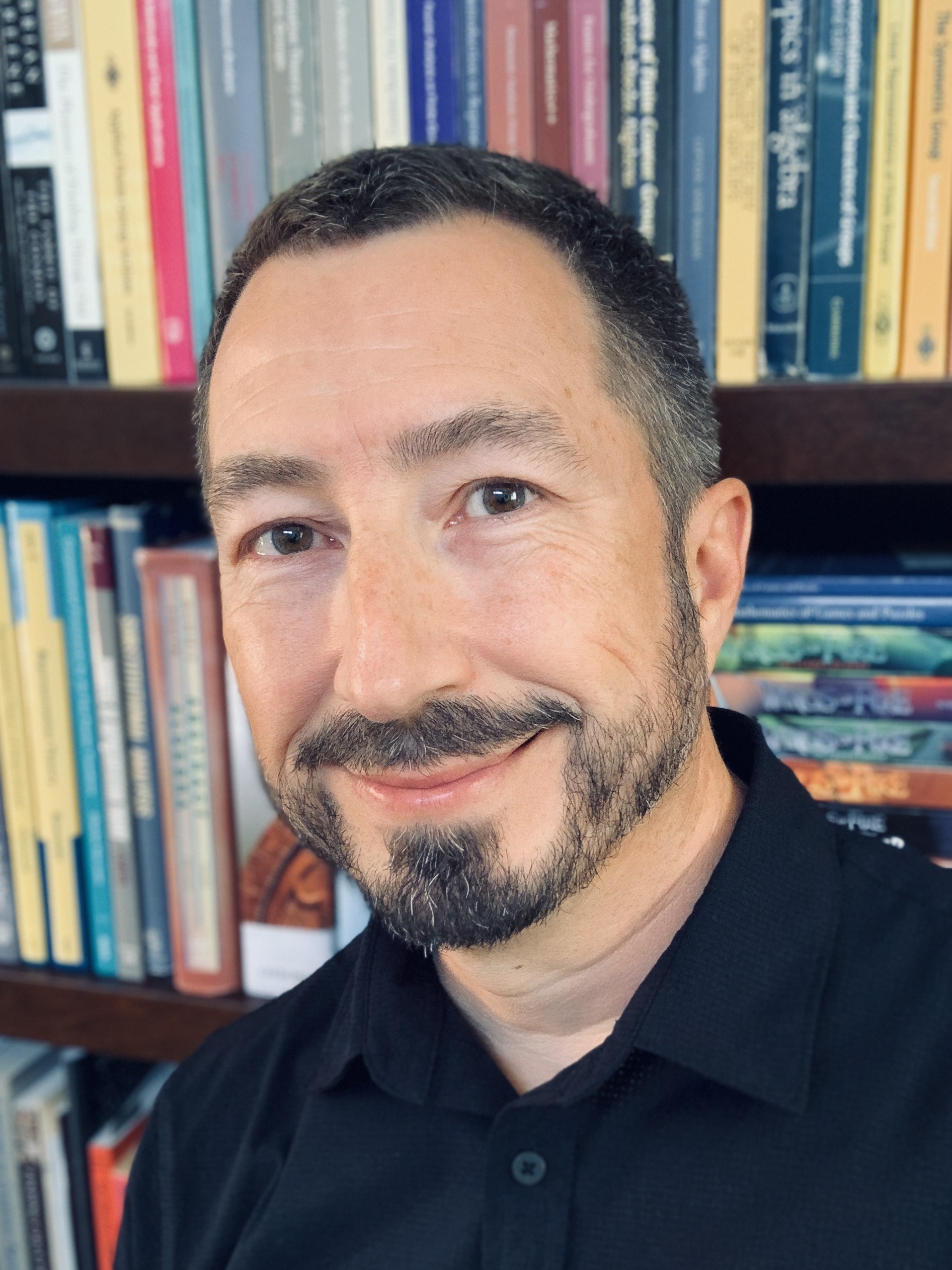
Michael Orrison is a Professor of Mathematics at Harvey Mudd College
The lecture took place on October 23, 2025 at 4:15 p.m., in HMC’s Shanahan Center 3481.
Abstract
Voting is something we do in a variety of settings and in a variety of ways, but it can often be difficult to see relationships between the different voting procedures we use. In this talk, I will discuss how simple ideas from linear algebra and discrete mathematics can sometimes be used to unify different voting procedures, and how doing so leads to new insights and new questions in voting theory.
“Applying to Graduate Programs in Mathematics or Computer Science”
Lucas Bang is an Associate Professor of Computer Science, Heather Brooks is an Assistant Professor of Mathematics, and Andrés R. Vindas Meléndez is an Assistant Professor of Mathematics.
The lecture took place on September 4, 2025 at 7 p.m., in HMC’s Shanahan Center 3481.
Abstract
Are you considering graduate school in mathematics or computer science? Thinking of applying this Fall? Are you unsure where to start? This seminar will provide an overview of the application process, from deciding whether graduate school is the right path for you to preparing strong applications. We will discuss how to choose programs, request letters of recommendation, write personal statements, and more. The session will also highlight differences between master’s and Ph.D. programs, funding opportunities, and what to expect once admitted. The goal is to demystify the process and equip you with practical strategies to navigate applications with confidence.
Spring 2025
“Solving the Race in Backgammon”
Art Benjamin is a Professor of Mathematics at Harvey Mudd College
The lecture took place on April 28, 2025 at 4:15 p.m., in HMC’s Shanahan Center 3481.
Abstract
Backgammon is perhaps the oldest game that is still played today. It is a game that combines luck with skill, where two players take turns rolling dice and decide how to move their checkers in the best possible way. It is the ultimate math game, where players who possess a little bit of mathematical knowledge can have a big advantage over their opponents. Players also have the opportunity to double the stakes of a game using something called the doubling cube, which—when used optimally—leads to players winning more in the long run. Optimal use of the doubling cube relies on a player’s ability to estimate their winning chances at any stage of the game.
When played to completion, every game of backgammon eventually becomes a race, where each player attempts to remove all of their checkers before their opponent does. The goal of our research is to be able to determine the optimal doubling cube action for any racing position, and approximate the game winning chances for both sides. By calculating the Effective Pip Count for both players and identifying the positions’ Variance Types, we arrive at a reasonably simple method for achieving this which is demonstrably superior to other popular methods. This method is currently being used by some of the best players in the world.
“As Flat as Possible”

Jon Jacobsen is a Professor of Mathematics at Harvey Mudd College
The lecture took place on April 14, 2025 at 4:15 p.m., in HMC’s Shanahan Center 3481.
Abstract
Imagine you’re tasked with creating the flattest possible surface spanning a curved wire loop. Where would you begin? Nature solves this problem efficiently with soap films, so perhaps they are the flattest. Or are they? What does it mean to be as flat as possible? If a surface is not initially flat, how can we evolve it over time to become flatter, and in the most efficient way? Join us as we straighten out these questions and take a mathematical approach to discovering what it truly means to be as flat as possible.
“The Intermediate Value Theorem”
Alfonso Castro is a Professor of Mathematics at Harvey Mudd College
The lecture took place on March 31, 2025 at 4:15 p.m., in HMC’s Shanahan Center 3481.
Abstract
This talk will be a tour spanning from The Mean Value Theorem to the Lefschetz fixed point formula. Generalizations, equivalences, and applications of the Intermediate Value Theorem will be discussed in the context of establishing the existence of solutions to boundary value problems for differential equations.
“A Tour of Randomized Iterative Methods for Solving Large-Scale Linear Systems“
Jamie Haddock is an Assistant Professor of Mathematics at Harvey Mudd College
The lecture took place on March 10, 2025 at 4:15 p.m., in HMC’s Shanahan Center 3481.
Abstract
Solving a large-scale linear system Ax=b, just like the problem we meet in Math 73, is a fundamental problem encountered all over the sciences, engineering, and more recently, data science and machine learning. Recently, randomized iterative methods have gained popularity for this type of problem as they can be implemented using only pieces of the problem data (e.g., rows or columns of A) in each iteration and can be easily implemented in parallel computing environments. This talk will give a tour of some popular families of methods which focus on using randomly sampled rows and columns of the matrix A in each iteration, and will give insights into how randomization actually makes the analysis of these methods easier.
“Biologically motivated sorting problems, and their connections to permutations and regular graphs“

Miklós Bóna is a Professor of Mathematics and Distinguished Teaching Scholar at the University of Florida.
The lecture took place on February 20, 2025 at 4:15 p.m., in HMC’s Shanahan Center 3460.
Abstract
We will survey some sorting algorithms whose original motivation came from evolutionary biology, more precisely from research attempting to measure the distance between various genomes. Some questions related to these algorithms are very easy to understand, but very hard to solve. They can, unsurprisingly, be translated into the language of permutations, and then to the language of regular graphs. Much more surprisingly, permutations that are the products of maximal cycles play a major role in this area, and that makes sophisticated tools from algebraic combinatorics applicable.
Mathematical Connections Seminar
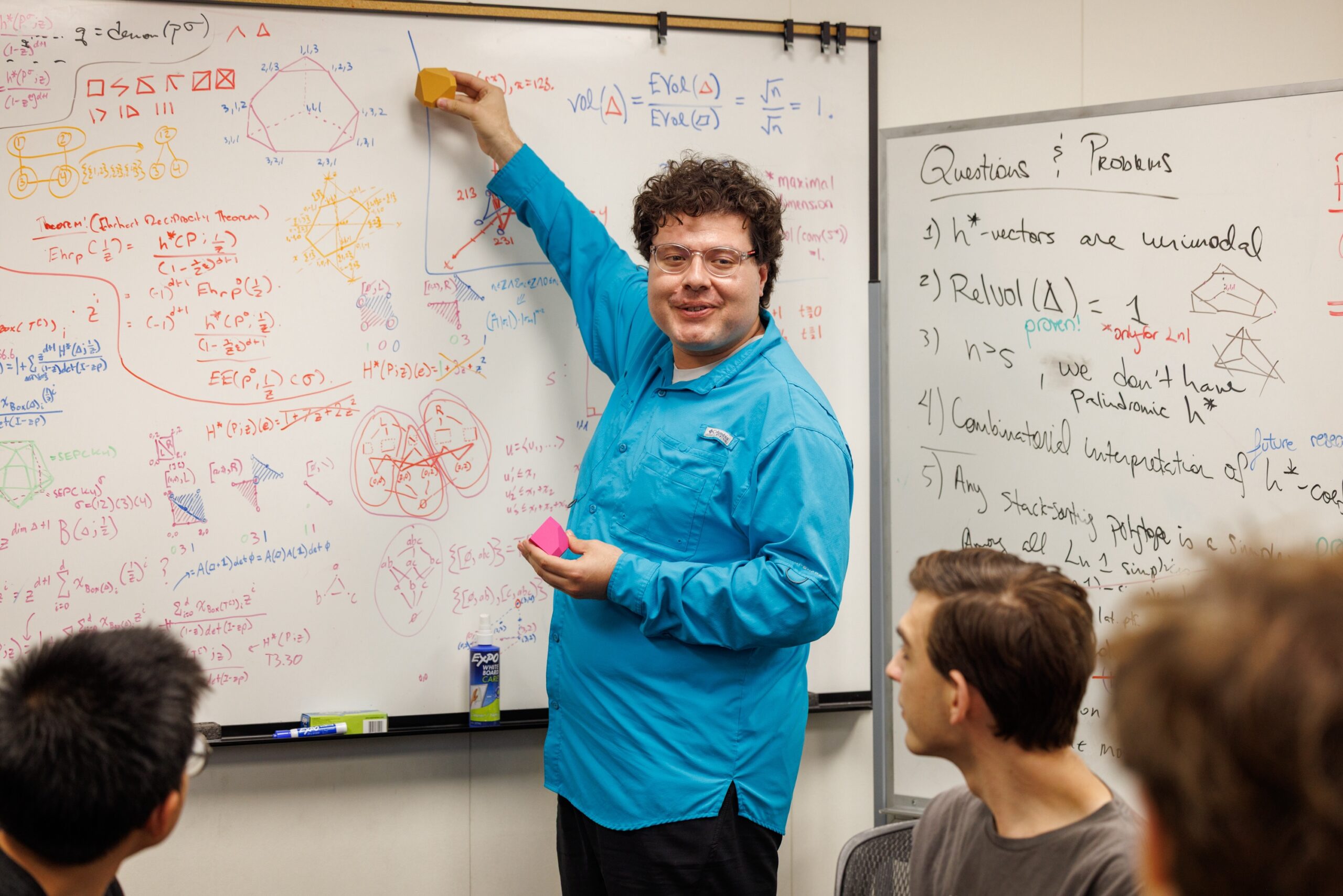
The Mathematical Connections Seminar plays a pivotal role in fostering a research community among the Department of
Mathematics faculty and undergraduate students. The seminar will feature speakers whose talks are accessible to undergraduates. Each speaker is encouraged to share not only an introduction to their research area, but also a personal account of their journey in mathematics. The goal of including both internal and external speakers is twofold:
1. To provide students with insight into the active research being conducted by current Harvey Mudd faculty, potentially leading to collaborations between faculty and students.
2. To foster research connections and networking opportunities, particularly with external faculty members who may be seeking future graduate students.
If you’re interested in giving a seminar, email Professor Andrés R. Vindas Meléndez at avindasmelendez@g.hmc.edu.