History of the Clinic Program
Six decades ago, while watching a homecoming parade, one of Harvey Mudd College’s engineering professors turned to a colleague and said, “Wouldn’t it be great to channel the energy and ingenuity these students use to create a winning float into solving real technical problems?” In a moment of revelry-induced inspiration, the concept of the Harvey Mudd College Clinic Program was born.
Founding faculty members Jack Alford and M. Mack Gilkeson sought to channel HMC student initiative, drive and intelligence into projects of real-world nature. They felt the best way to do this was to give students a “clinical” experience similar to that which medical students receive as part of their training—thus the name “Clinic.”
“I gained the idea that engineering was like dancing, you don’t learn it in a darkened lecture hall watching slides; you learn it by getting out on the dance floor and having your toes stepped on.”
– Jack Alford, Emeritus Professor of Engineering and Clinic Program co-founder
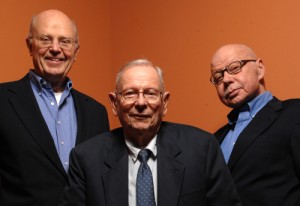
In 2012, M. Mack Gilkeson and two other HMC faculty members received the nation’s most prestigious engineering education award, the National Academy of Engineering’s Bernard M. Gordon Prize for Innovation in Engineering and Technology Education.
The Engineering Clinic was established in 1963 with initial funding from the Ford, U.S. Steel and Sloan foundations. The Mathematics Clinic began in 1973 with funding from a National Science Foundation grant. The Computer Science Clinic began in 1993, the Physics Clinic in 1996 and the Global Clinic component of the program began in 2005 with an endowment from the Vickery family.
Climate Clinic
In 2023–2024, Harvey Mudd College launched Climate Clinic in order to better equip our students as scientists to pursue research and technology toward solutions to the threats posed to society as a result of changes in the earth’s climate. In collaboration with the Hixon Center for Climate and the Environment, Climate Clinic is supported by a $1 million endowment from the Fletcher Jones Foundation, which allows the Hixon Center and Clinic Program faculty to support projects with organizations doing cutting edge research and development in climate solutions.
Global Clinic
Global Clinic, established in 2005, prepares students to engage in solving open, interdisciplinary problems in a global context as members of a team. Built upon the Harvey Mudd Clinic Program, the Global Clinic Program supports long-term, sponsored engineering, mathematics and science projects. Teams of Harvey Mudd students work on international projects with individuals from different countries, cultures and institutional backgrounds, with diverse disciplinary interests and languages, but with a common purpose and shared goals. As part of the college’s Clinic program, Global Clinic students deliver a series of presentations and submit written progress reports throughout the year, honing their technical writing and public speaking skills.
The Global Clinic serves as the ultimate capstone for our engineering and computer science majors, challenging them to operate as professional consultants in an international arena. These teams don’t just work on projects; they navigate the complexities of different institutional backgrounds and cultural nuances to achieve a common, unifying technical goal.
Since its inception, the footprint of the Global Clinic has reached nearly every corner of the map:
- Africa: Empowering communities in Kenya and Uganda.
- Asia and Oceania: Driving innovation in Japan and Singapore.
- Middle East and Europe: Partnering with leaders in Israel, Iceland, and Ireland.
- The Americas: Solving critical challenges in Mexico and Puerto Rico.
Global Clinic is supported by company sponsors and a generous $1 million endowment from the Robert and Joan Vickery family to honor the visionary passion of John Vickery ’90/91, whose legacy continues to redefine the boundaries of a Harvey Mudd education.
Social Justice Clinics
In 2018, the college launched a program to support Social Justice Clinics each year to provide technical support to community-based organizations working in areas including educational, environmental, economic and social justice. These Clinic projects expand the scope of Clinic to help student understand how their work can impact non-profit and community-based organizations working toward social justice.