CS Colloquium– “From Prompts to Silicon: Security and Privacy Threats Across the LLM Stack,” Nael Abu-Ghazaleh
September 25, 2026 11 a.m.–12 p.m.
 Add to Calendar
Location
Galileo Hall, Pryne
240 Platt Blvd.
Claremont, CA 91711
Contact
Morgan McArdle
mmcardle@g.hmc.edu
909.607.0299
Details
Large language models are now trusted with sensitive data, embedded in consequential decision pipelines, and are hosted on shared, expensive hardware. These factors make them an increasingly attractive target, and not just at the level of what you type into a chat box. In this talk, we'll go on a tour of LLM security and privacy threats, organized around a simple question, looking at different classes of attacks based on attackers' access points.
Nael Abu-Ghazaleh starts where most people think LLM security lives: at the prompt itself, showing how attackers with malicious intent can bypass the model’s safety training. A second group of attacks targets training time, where an attacker who controls even a small slice of a model's training data can plant hidden behaviors that surface only later, including those that enable leaking private information or undermining the safety alignment of the model. Finally, Abu-Ghazaleh goes below the model entirely, to the hardware it runs on: his recent work shows the GPU infrastructure powering today’s LLMs leaks information across users who are supposed to be strongly isolated from each other. Taken together, these attacks show that LLM security isn’t one problem but several, spread across different layers of the stack, including inference time, training time, and hardware and system vulnerabilities. Abu-Ghazaleh closes with where he thinks the most promising defenses lie, and the open questions.
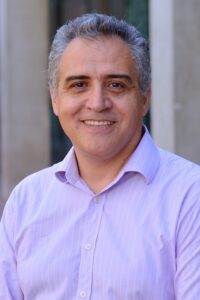
Speaker
Nael Abu-Ghazaleh is a professor in the Computer Science and Engineering Department at the University of California, Riverside. His research is in architecture and system security, and security for emerging systems. He has published over 250 papers in these areas, several of which have been recognized with best paper awards or nominations. His offensive security research has resulted in the discovery of several new attacks on CPUs and GPUs that have been disclosed to companies including Intel, AMD, ARM, Apple, Microsoft, Google and Nvidia, and resulted in patches and modifications to products, and coverage from technical news outlets. He is a member of the Micro Hall of Fame, an ACM distinguished member, an IEEE distinguished speaker and an IEEE Computer Society Distinguished Contributor.
This event is for: faculty, staff, students
faculty, staff, studentsCommunity Connections events provide opportunities for HMC faculty, students and staff to cultivate community, foster open conversations and share important information as together we live out our mission and shape the future of the College.
Calendars
Kickstart your career journey by joining us each week for the OCS career and professional development series! From expert panels to hands-on workshops and presentations, each session dives into a new topic designed to help you build skills and confidence for your future.
This faculty panel will explore “dangerous questions” from a variety of disciplines to understand and respond to challenges facing American universities. The discussion will address the erosion of knowledge and expertise, as well as political forces that may attempt to limit intellectual inquiry and creativity.
Ambereen Dadabhoy, asssociate professor of literature, “What Would Shakespeare Say?”
Anup Gampa, assistant professor of psychology, “Invasive Species: Blaming Dysregulated Plant Neighbors Is a ‘Settler Move’ to Innocence”
Rachel Mayeri, artist and professor of media studies, “What Can Art Do During a Fascist Takeover?”
David K. Seitz, associate professor of cultural geography, “Geography Against Immediacy”
Paul Steinberg, professor of political science and environmental policy, “Creative Politics as a Strategic Response to Authoritarianism”
David Wilson, assistant professor of music, “Sounding (Anti-)Authoritarian: A Few Vignettes”
The K-12 through college CS pipeline is full of barriers and those barriers prevent broader participation in the field. I’ll describe some of my research to try to identify or remove some of those barriers. I hope you will learn a bit more about CS education research and how you can advocate for policies and practices that can broaden participation in CS!
“We don’t want to live in a society in turmoil. In the U.S., 93 percent of people want to reduce divisiveness, and 86 percent believe it’s possible to disagree in a healthy way. Yet with increasing political and social fragmentation, many of us don’t know how to move past our differences. Civil rights scholar john a. powell presents an actionable path through ‘bridging’ that helps us communicate, coexist and imagine a new story for our shared future where we all belong.” (description courtesy of Othering and Belonging Institute)
The Office of Civic and Community Engagement (OCCE) will be hosting a guilt-free book club this fall semester on john a. powell’s book The Power of Bridging: How to Build a World Where We All Belong. Our first gathering is on Friday, Oct. 3.
This learning community is for everyone, from those who are already experienced in community engagement to those who are curious about learning more about this high-impact educational practice. Faculty participants will discuss readings, meet with outside speakers, share ideas, and think collaboratively about implementing community engagement into the 5C students’ experience.
Welcome to HMC’s Community Conversations for the fall 2025.
HMC Community Conversations* use conversation guides with a structured format to help people with different viewpoints and experiences build understanding. There will be 3–5 other people in a table group. It is not a debate, and the goal is not to change one another’s opinions. There are Conversation Agreements like “Listen and Be Curious” and “Show Respect and Suspend Judgement” that create the framework for diving into the questions. The questions are designed to draw out our personal experiences rather than opinions around the topic.
The overall purpose is to learn more about the experiences others have around the topic and build a sense of community.
Community Conversations will take place on Tuesdays from 11 a.m. to noon in Shanahan 1480; and each gathering will be on a separate topic. Gatherings will be in person only.
Kickstart your career journey by joining us each week for the OCS career and professional development series! From expert panels to hands-on workshops and presentations, each session dives into a new topic designed to help you build skills and confidence for your future.
Learn about HMC’s approved study abroad programs and how to study abroad your junior year.
The Great ShakeOut is an opportunity for our community to practice what to do during an earthquake (drop, cover, and hold on). In the event of a real earthquake, a notification will be sent via Mudd Alert containing important information and instructions.
In most situations, if you feel shaking or receive an earthquake alert, you should immediately:
Drop where you are, onto your hands and knees. This position protects you from being knocked down and reduces your chances of being hit by falling or flying objects.
Cover your head and neck with one arm and hand. If a sturdy table or desk is nearby, crawl underneath for shelter. If no shelter is nearby, crawl next to an interior wall. Stay on your knees; bend over to protect vital organs.
Hold on until the shaking stops. If you’re under shelter, hold on to it with one hand and be ready to move with your shelter if it shifts. If you are not under shelter, cover your head and neck with both arms and hands.
For the purpose of this exercise, we encourage community members to practice these steps for one minute upon receiving the Mudd Alert notification. Thank you for your time and participation in this important emergency preparedness exercise.
“We don’t want to live in a society in turmoil. In the US, 93 percent of people want to reduce divisiveness, and 86 percent believe it’s possible to disagree in a healthy way. Yet with increasing political and social fragmentation, many of us don’t know how to move past our differences. Civil rights scholar john a. powell presents an actionable path through “bridging” that helps us communicate, coexist, and imagine a new story for our shared future where we all belong.” (taken from Othering and Belonging Institute)
The Office of Civic & Community Engagement (OCCE) will be hosting a guilt-free book club this fall semester on john a. powell’s book The Power of Bridging: How to Build a World Where We All Belong. Our first gathering is on Friday, October 3rd.
This learning community is for everyone, from those who are already experienced in community engagement to those who are curious about learning more about this high-impact educational practice. Faculty participants will discuss readings, meet with outside speakers, share ideas, and think collaboratively about implementing community engagement into the 5C students’ experience.
Welcome to HMC’s Community Conversations for the fall 2025.
HMC Community Conversations* use conversation guides with a structured format to help people with different viewpoints and experiences build understanding. There will be 3–5 other people in a table group. It is not a debate, and the goal is not to change one another’s opinions. There are Conversation Agreements like “Listen and Be Curious” and “Show Respect and Suspend Judgement” that create the framework for diving into the questions. The questions are designed to draw out our personal experiences rather than opinions around the topic.
The overall purpose is to learn more about the experiences others have around the topic and build a sense of community.
Community Conversations will take place on Tuesdays from 11 a.m. to noon in Shanahan 1480; and each gathering will be on a separate topic. Gatherings will be in person only.
Kickstart your career journey by joining us each week for the OCS career and professional development series! From expert panels to hands-on workshops and presentations, each session dives into a new topic designed to help you build skills and confidence for your future.
Professor Paul Steinberg teaches the popular course Public Speaking for Science and Citizenship. In this workshop, he’ll share insights on public speaking and lead a fun and easy Audience-ology™ exercise.
Steinberg is professor of political science and environmental policy in the Department of Humanities, Social Sciences, and the Arts, where he holds the Malcolm Lewis Chair in Sustainability and Society. The author of three books and recipient of the International Studies Association’s Deborah Gerner Award for Innovation Teaching, Steinberg runs the firm PS Public Speaking.
The Cabinet is hosting informal coffee breaks in fall 2025 for students, faculty, and staff. These coffee breaks will be attended by most of the Cabinet team and will provide an opportunity for the community to share ideas, express concerns, and highlight successes.
All are welcome to stop by as schedules allow.
“We don’t want to live in a society in turmoil. In the US, 93 percent of people want to reduce divisiveness, and 86 percent believe it’s possible to disagree in a healthy way. Yet with increasing political and social fragmentation, many of us don’t know how to move past our differences. Civil rights scholar john a. powell presents an actionable path through “bridging” that helps us communicate, coexist, and imagine a new story for our shared future where we all belong.” (taken from Othering and Belonging Institute)
The Office of Civic & Community Engagement (OCCE) will be hosting a guilt-free book club this fall semester on john a. powell’s book The Power of Bridging: How to Build a World Where We All Belong. Our first gathering is on Friday, October 3rd.
Submit an Event
Use the Submit Events form to add Mudd community events to the calendar.