Harvey Mudd Students Win Hackathon With Media Literacy Game
November 12, 2026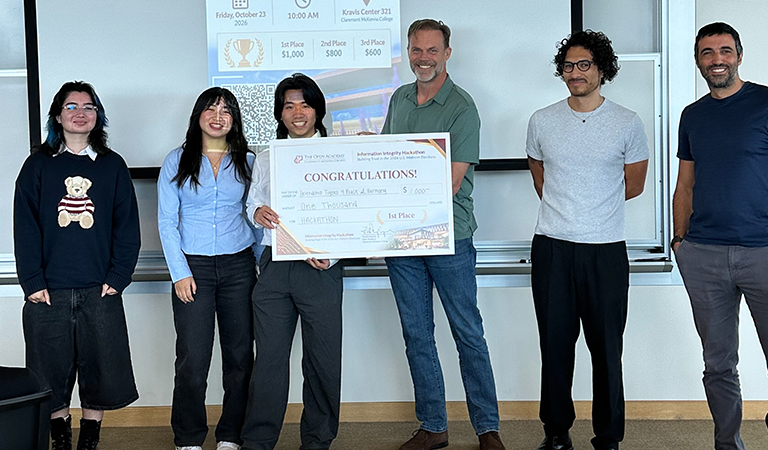
The first Information Integrity Hackathon: Building Trust in the 2026 U.S. Midterm Elections challenged students at The Claremont Colleges to develop innovative, evidence-based solutions to address election misinformation among college students.
The grand prize of $1,000 went to Harvey Mudd students Leah Uriarte ’28, Nathan Nguyen ’28 and Sophie Wang ’28 for a project that gamifies media literacy.
Organized by The Open Academy at Claremont McKenna College and led by Piyush Prakash, visiting lecturer of leadership and director of research and evaluation at the Constructive Dialogue Program, the hackathon challenged students to find solutions to this question: How can we help college students identify, navigate and overcome election misinformation?
Eight student teams registered to design practical interventions addressing the individual, social and technological drivers of misinformation. Proposed solutions ranged from digital tools and behavioral nudges to campus-wide educational campaigns.
Before pitching to hackathon judges, participants attended a panel discussion moderated by Terril Jones, visiting lecturer of government at Claremont McKenna College and veteran journalist for Reuters, the Los Angeles Times, Forbes and Associated Press. Panelists Randy Stein, professor of marketing at Cal Poly Pomona; Neil Chase, chief executive officer of CalMatters; and Sarah Marzen, associate professor of physics, Department of Natural Sciences (Pitzer and Scripps colleges), offered insight to help students understand the nuances of election misinformation from individual, social and algorithmic perspectives, providing a foundation for developing their solutions.
Mudders Uriarte, Nguyen and Wang, competing as Friendship Tigers 4 Peace and Harmony, earned first place with Read the Room, an interactive media literacy project. Drawing inspiration from daily puzzles like Wordle, the game challenges players to score points by judging true-or-false claims, assessing their own confidence and accurately predicting broader public consensus.
“We knew people love quick daily games and that a main driver of misinformation is low engagement,” said Nguyen. “We wanted to make evaluating news fun rather than tedious.”
Inspired by panelist Neil Chase’s insights on sustaining user engagement, the team designed Read the Room to combat confirmation bias. “By pushing players to evaluate claims and reflect on their own confidence, it forces them to ‘read the room’ and recognize how easily they—and others—can be tricked by common misinformation,” Nguyen said.
Nguyen credited Harvey Mudd’s collaborative culture, rigorous computer science course work and interdisciplinary HSA curriculum for helping the team turn their idea into a winning solution. He said the HSA coursework provided space to reflect on personal experiences with misinformation, helping the team examine the root causes that make false claims so pervasive among their generation.
The Open Academy plans to help the winning teams further develop and pilot their solutions.
Mudd Magazine