Professor Designs “AI-proof,” Hands-On Engineering Course
November 4, 2026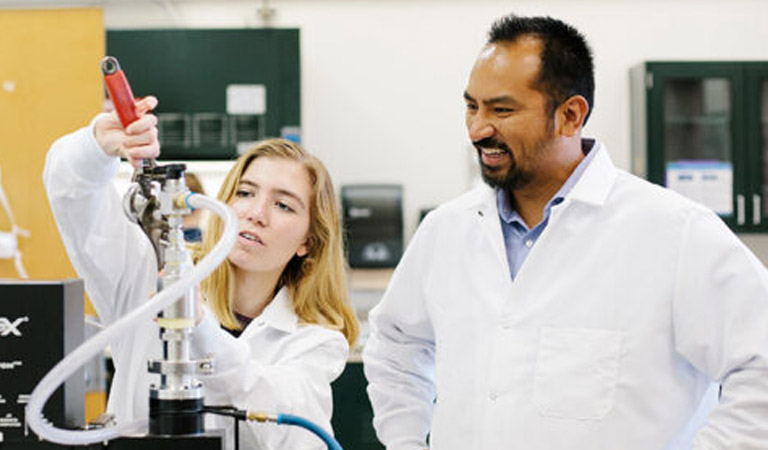
Harvey Mudd College Professor of Engineering and Associate Director of the Engineering Clinic Program Albert Dato has designed an “AI-proof” hands-on laboratory course that deepens students’ knowledge of polymers and composites.
Bringing the course The Science and Engineering of Polymers and Composites to life took a lot of prototyping, Dato says. “I have been piloting each lab myself, making and testing specimens, troubleshooting equipment and procedures and writing step-by-step guides so that students can work through each module safely and successfully. It has been a lot of work, but it is incredibly rewarding to watch students generate real data from materials they made themselves.”
Mudders in this course experience the structure-processing-properties relationships of polymers and composites, which tend to show up in every facet of their work at the College, like research projects, Clinic prototypes and personal projects in the makerspace. After completing safety training and a series of qualifying labs on the classroom equipment, small student teams work through three modules.
Thermoplastics, 3D and Elastomers
In the thermoplastics module, students make injection-molded polyethylene and thermoplastic elastomer specimens. After a durability test, broken specimens are shredded and re-molded so students can observe how recycling changes the material.
In the 3D printing module, students print tensile specimens using both filament-based and resin-based printers in different build orientations to discover how a single printing decision can make the same material weaker or stronger.
Lastly, in the elastomers module, students cast their own silicone rubber, cut specimens from commercial rubbers and measure both the mechanical and electrical properties of conductive silicone.
“Every week, students are fabricating specimens, putting them to the test and watching them stretch, yield and break,” Dato says. “This gives students real experience choosing, processing and testing these materials, so that they can approach those projects with confidence.“
Skill Building
These skills in injection molding, additive manufacturing, elastomer fabrication, polymer recycling, standardized mechanical testing and data analysis provide Mudders with a competitive edge in summer internships, graduate programs and jobs in polymer science and engineering.
Dato is a past fellow of the AI Experimentation Lab (AXL), a project of the College’s Innovation Accelerator Laboratory for Artificial Intelligence, is creating communities of practice that explore how the College teaches AI and how it helps students critically examine AI’s broader ethical and societal implications.
“Becoming an AXL Fellow changed how I think about teaching,” Data says. “As I incorporated AI into my courses and saw how capable these models have become, I realized that AI is changing, and will continue to change, the landscape of undergraduate education. The traditional model of lectures, problem sets and exams may not be the best way to prepare students for a future where AI can do much of that work for them.”
Dato designed the course to be “AI-proof” by focusing on the hands-on experiences that AI has yet to achieve, like injection molding, curing silicone rubber and tensile tests that meet American Society for Testing and Materials standards.
“Students are welcome to use AI in the course to help them learn concepts and analyze their data,” Dato says, “but the core of the learning happens with their hands in the lab. The skills they build are entirely their own.”
Dato created Science and Engineering of Polymers and Composites with support from the College, its Department of Engineering and a National Science Foundation (NSF) Faculty Early Career Development (CAREER) grant.
“I proposed this course in my CAREER proposal, and the award supported its conceptualization and funded the brand-new 3D printers that the students are using,” Dato says. “Many of the experiments in the course are the same ones students have been doing in my NSF-funded research. Mudders supported by the CAREER grant established many of these methods, so I went into the semester already confident that the experiments would work.
“It has been especially meaningful to see methods created by Mudders in the research lab now being used by their peers in the classroom,” Dato says. “I am so grateful to our first cohort of students, whose enthusiasm and hard work have made the first run of this course so much fun.”
Mudd Magazine