McFadden Joins Deep-Sea Biodiversity Expedition
July 8, 2026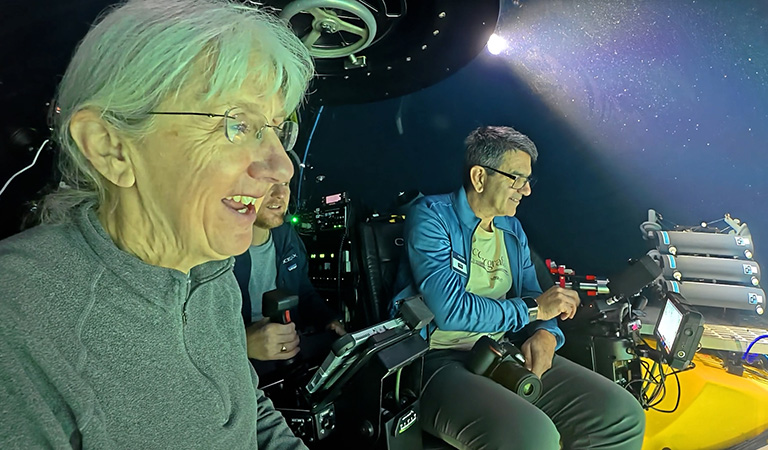
Despite increasing technological capabilities, scientists have always had limited access to study the deep ocean. Much of the biodiversity in the world’s oceans remains unknown.
This made a recent deep-sea expedition off the coast of Palau especially exciting for Cathy McFadden, Vivian and D. Kenneth Baker Professor in the Life Sciences at Harvey Mudd College.
McFadden joined a team of scientists aboard the OceanXplorer, a high-tech research vessel equipped with two remotely operated vehicles (ROVs), a submersible, and a helicopter. Organized by the nonprofit OceanX, the expedition brought together three groups of scientists to conduct simultaneous research in three areas: One team documented megafauna such as whales and sharks, one team focused on collecting environmental DNA (eDNA) from seawater to survey fish species in the area, and one team conducted a “bioblitz,” a large-scale biodiversity census aimed at collecting and cataloging as many different species as possible in a given area. McFadden was part of the bioblitz team.
“It was a great experience overall,” says McFadden. “The ship has so many assets, there was stuff going on all the time. You’re in the ROV command room guiding the pilots on what to collect, and there were days when both the ROV and the submersible went down, doing double duty. The megafauna team was out in the helicopter every day and often collaborating with the eDNA team when whales or dolphins or schools of fish were spotted.”
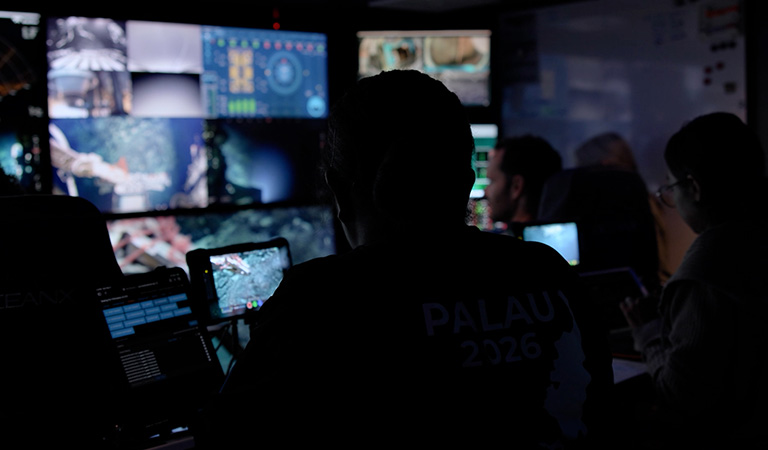
The bioblitz team spent most of its time working in areas around 500–1,500 meters with the ROV, which can reach up to 6,000 meters depth. The group had expertise in different organisms, including corals, shrimp, worms, starfish and more, and everyone was interested in getting specimens in their area. This made for a lively atmosphere in the onboard command room, where the scientists spent 10 hours a day viewing video coming from the multiple cameras of the ROV and telling the pilots which organisms to collect with the robotic arms.
“It can sound like a bit of a free-for-all sometimes, with everyone excitedly calling out ‘ooh, can you get me that?’ or ‘ooh I want that!’” McFadden says. The group organized the process with a command structure, rotating each day through the roles of gathering the requests, communicating with the pilots, and logging each organism in real time.
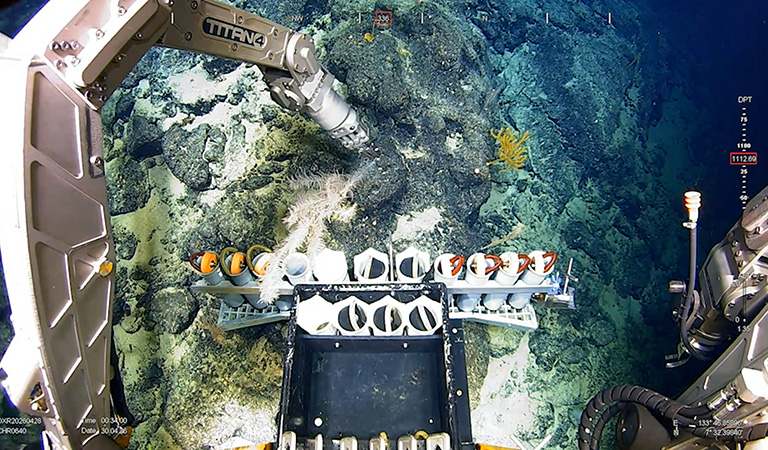
“It can take a while to collect a specimen. You’ve got this robotic claw that’s trying to grab something or suck something up that’s moving along in the water. The number of minutes devoted to chasing around a shrimp that does not want to be sucked up or to trying to manipulate a delicate coral and get it into a box … or you collect something big and it’s buoyant and you have to stuff it into a box and there’s currents that want to blow it out of the box. You’re standing there for like 20 minutes, watching this arm trying to stuff something into the box.”
In addition to the general bioblitz, the team focused on collecting organisms associated specifically with corals. In the deep ocean, McFadden explained, corals function as the structural backbone of entire ecosystems, similar to the role trees play in a forest. Scientists have called them marine animal forests, she explained, and while there’s been a lot of work done on corals, less work has been done on all the little things living on and around them, such as shrimp, sea stars, comb jellies, worms and barnacles. The team often didn’t know what associated organisms they had until they brought the specimens up to the surface.
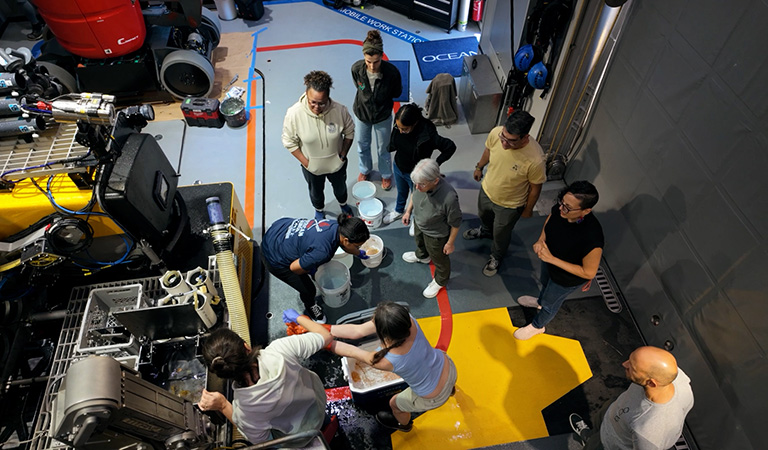
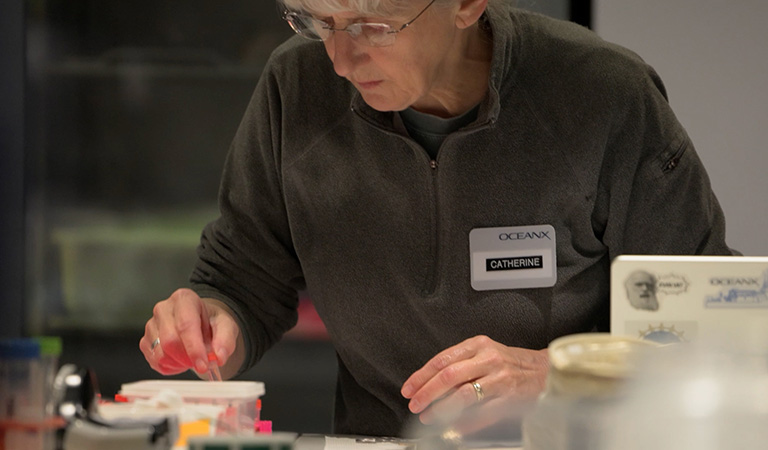
“The ROV came up usually right at dinner time, with containers full of animals that are very temperature sensitive, and you have to be there on deck when the ROV comes up to pull all the animals off as quickly as possible, get them into a cold room, try to sort of stabilize them, so that they don’t die right away,” explains McFadden. The team would photograph them in the lab, preserve them appropriately, and take samples for DNA, often working late into the night until every organism was examined and preserved.
One of the team’s most striking finds was a group of comb jellies living attached to surfaces at around 500 meters depth that team members believe may represent an entirely new family or order. McFadden also collected a soft coral she cannot yet identify.
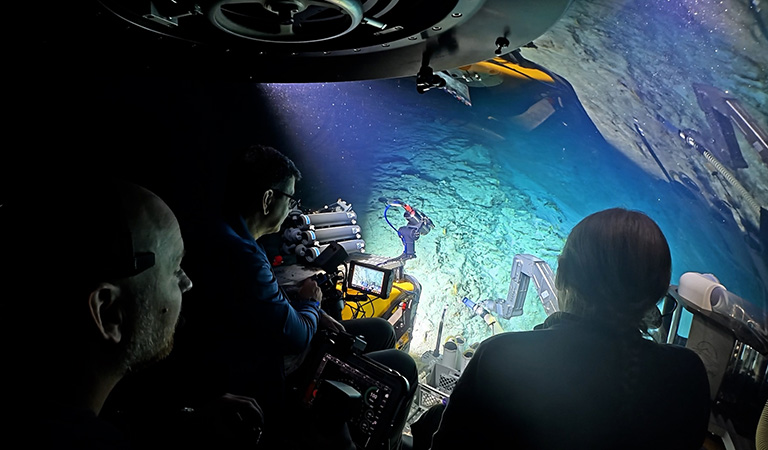
Another highlight of the expedition was the chance for McFadden to take a trip in the OceanX submersible. Her previous submersible experiences had been in NOAA’s Alvin, a titanium sphere in which the scientist either lies on her back and views a monitor, or lies face down and looks through a four-inch porthole. In contrast, the OceanX submersible was a giant glass bubble, with a comfortable armchair, and a 360-degree view.
“The strangest sensation for me was that you don’t see the glass,” says McFadden. “It’s completely transparent, you can’t tell that there’s glass between you and what you’re seeing, and these fish would swim right up, and you had the sensation that the fish were in there with you.”
While the submersible’s robotic arms presented the same challenges in terms of gathering the desired specimens, the view made up for the frustration.
After the vessel docked, McFadden helped prepare the team’s specimens for shipping to the University of Florida, where they will be housed for long-term study. McFadden retained samples for her own research, including 150 DNA samples she is now preparing for sequencing. And at least one unidentified soft coral species.
“As water temperatures rise, it’s unclear what’s going to happen in the deeper parts of the ocean. Deep sea organisms have adapted to live at very cold temperatures. They may be more impacted when temperatures rise, even just a little, compared to organisms in shallow water that are more used to variations in surface temperatures.”
“The ultimate goal of these kinds of expeditions is to document as many species as possible while we still can,” says McFadden.
Mudd Magazine