Lucas Bang Receives CRA Undergraduate Research Mentoring Award
February 18, 2026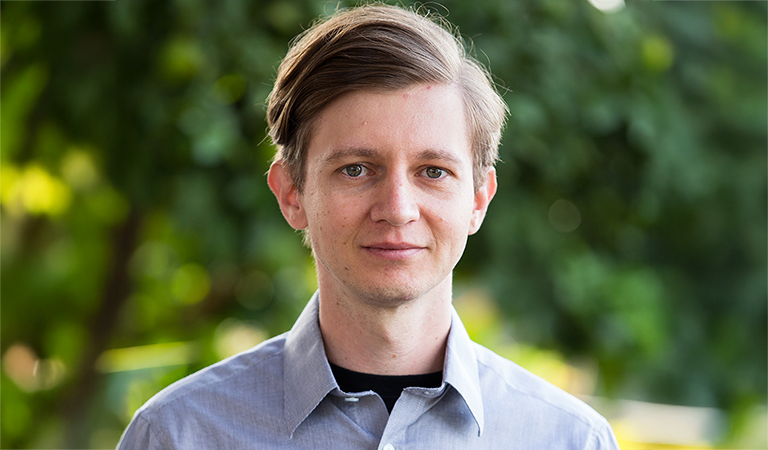
Lucas Bang, associate professor of computer science at Harvey Mudd College, has received the 2025 Undergraduate Research Faculty Mentoring Award from the Computing Research Association’s Education Committee (CRA-E) for his exceptional work with undergraduate students, including mentorship, research and graduate school guidance.
“This award is deeply meaningful to me because it reflects many years of shared work with students,” said Bang. “I have been fortunate to mentor large research groups, advise students applying to graduate school and help organize mentoring programs, like the Programming Languages Mentoring Workshop, that create welcoming entry points into research communities. The recognition belongs as much to the students who took on these projects as to me. Seeing them grow, succeed and go on to support others is the most rewarding outcome, and this award affirms the value of investing time and care into that process.”
The citation for the CRA-E mentoring award described Bang as “deeply committed to undergraduate research mentorship at an institution without a graduate program, where undergraduates serve as the primary drivers and lead authors of research projects.” Over the past seven years, Bang has mentored more than 65 students across a wide range of computing, mathematical and interdisciplinary topics, resulting in 12 undergraduate lead-authored papers, 23 undergraduate co-authors and multiple undergraduate student research awards. His mentees have gone on to pursue PhD and M.S. programs at top institutions and research-oriented industry roles.
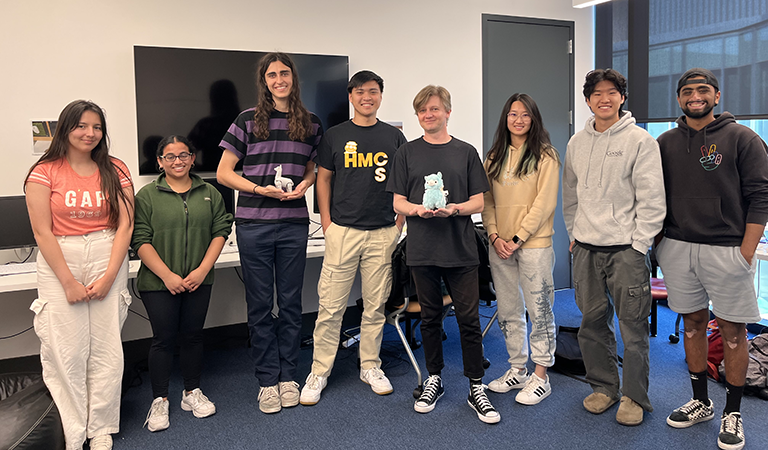
In 2025, Bang was awarded a three-year, $45,000 grant from the National Science Foundation that funds travel, lodging and registration costs for up to 10 students per year to attend international workshops in programming languages research.
“Research has a large hidden curriculum,” said Bang. “Knowing how to ask questions, handle uncertainty, recover from failure and communicate ideas is rarely obvious, especially for first-generation students or those without prior exposure to research environments. Mentorship helps make those expectations visible and accessible to students from all backgrounds. It also gives them a chance to learn whether research is a good fit for them. Even students who ultimately choose other careers benefit from the experience because they gain problem-solving skills, independence and confidence that transfer broadly.”
Bang specializes in programming languages, and in addition to teaching computer science courses, he has conducted research with students in program analysis, software testing and verification, and the quantitative study of program complexity. His primary scholarship with students focuses on developing mathematical and algorithmic tools to measure and reason about the structure of programs, including the invention of the asymptotic path complexity metric. He also pursues interdisciplinary work at the intersections of computation, art, philosophy and literature.
“What I enjoy most is watching students grow,” Bang said. “At the beginning, many are unsure of themselves or hesitant to try difficult things. Over time, they develop confidence, persistence, communication skills and the ability to collaborate. Whether they continue into research or choose another path, they leave with a stronger sense of what they can do and how to tackle challenges. I value being able to support that process and help create opportunities where students can stretch themselves, discover new interests and carry those skills into whatever they pursue next.”
Mudd Magazine