Harvey Mudd Partners with Universities on Interdisciplinary Fellowship
October 9, 2026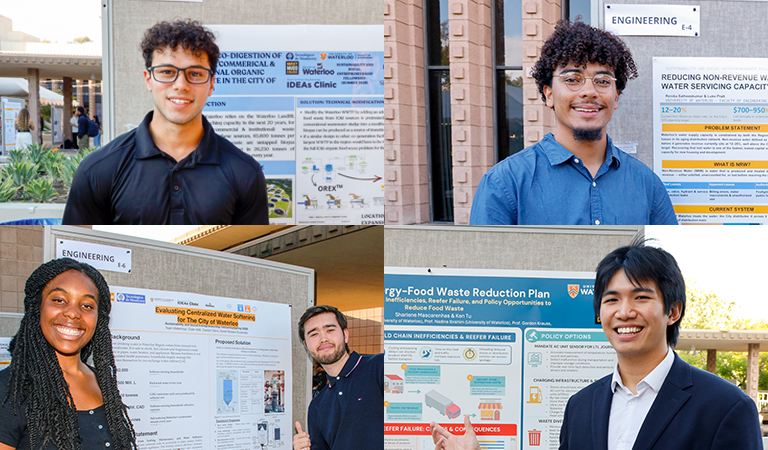
Engineering designers need new models of collaboration as they work to solve some of the world’s biggest problems. It is with this interdisciplinary thinking in mind that the Sustainability and Social Entrepreneurship Fellowship (SSEF) was created to offer a transformative, cross-border experience for engineering students.
The initiative originated through conversations on design, pedagogy and sustainability between Gordon Krauss, professor of engineering at Harvey Mudd College, and Sanjeev Bedi, professor and founding director of the Pearl Sullivan Engineering IDEAs Clinic at the University of Waterloo. Together with early organizers, including Chris Rennick, associate director of the IDEAs Clinic; Nadine Ibrahim, Turkstra Chair in Urban Engineering; and Nancy Nelson, engineering education developer, Krauss built a program that unites students across different countries, disciplines and educational traditions.
“Cross-cultural cooperation is a central part of the fellowship,” Krauss said. “We believe in more international engagement, not less. Students learn about people from other countries and cultures by talking with them, working alongside them, and solving problems together. They also discover that they can accomplish far more together than they ever could alone. Each student brings something different, including their disciplinary training, educational experiences, culture, perspective and context, and those differences help teams ask better questions, challenge assumptions and ultimately develop better solutions.”
The fellowship is powered by a network of leaders and institutions. The University of Waterloo’s IDEAs Clinic, under the leadership of Rennick and Director Simar Saini, provides essential infrastructure, space, project guidance, field visits and industry connections at no cost to students. Waterloo’s commitment is further bolstered by Dean of Engineering Mary Wells and Professor Derrick Rayside, who enrich the curriculum through co-op connections and urban infrastructure tours of Toronto.
From its inception, SSEF was designed as a global partnership rather than a regional one. Tecnológico de Monterrey joined early on, sending both students and teaching faculty to Waterloo, and SSEF regularly welcomes participants from the United Arab Emirates and other international institutions.
Krauss helps organize the fellowship, exploring pathways to expand participation to additional schools and countries. He also teaches SSEF courses on-site at Waterloo each summer. To ensure the fellowship is financially accessible to Harvey Mudd students, support has been provided by professor emeritus Kash Gokli and Harvey Mudd’s Office of Civic and Community Engagement (OCCE).
This year, engineering students from Harvey Mudd, Tecnológico de Monterrey and the University of Waterloo collaborated with municipal representatives to address real-world challenges surrounding the region’s water-energy-food nexus.
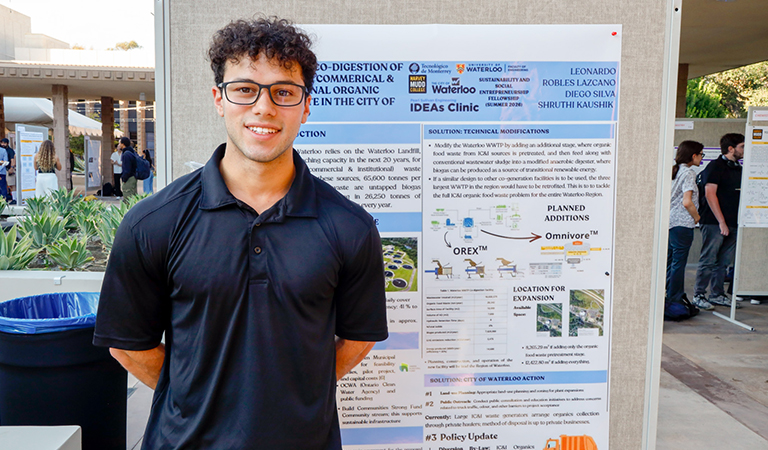
Anaerobic Co-Digestion of Industrial, Commercial and Institutional Organic Food Waste in the City of Waterloo
Diego Silva ’28 (Harvey Mudd), Shruthi Kaushik (University of Waterloo) and Leonardo Robles (Tecnológico de Monterrey)
To address the Waterloo landfill’s projected capacity limits within the next 18 to 22 years, Silva, Kaushik and Robles pitched a conceptual $13.72 million CAD retrofit to the Waterloo Wastewater Treatment Plant. The solution co-digests commercial organic food waste alongside municipal wastewater sludge. Benchmarking similar facilities in California, Singapore, and South Korea, the team estimated that processing 25,000 tons of food waste annually could yield 14.6 million kilowatt-hours of clean energy. Through electricity generation and tipping fees, their model projects $2.2 million in annual net operating income with a 6.3-year payback period.
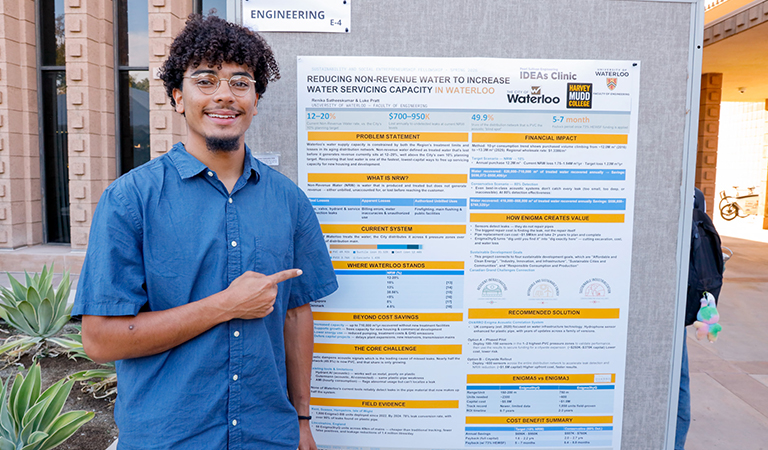
Reducing Non-Revenue Water to Increase Water Servicing Capacity in Waterloo
Luke Pratt ’28 (Harvey Mudd) and Renika Satheeskumar (University of Waterloo)
Targeting supply constraints caused by aging infrastructure and an elevated non-revenue water loss rate of 12% to 20%, Pratt and Satheeskumar proposed a technology-driven system to expand Waterloo’s water servicing capacity. The pair identified PVC plastic pipes, which make up nearly half of the city’s network and severely dampen acoustic leak signals, as a primary monitoring blind spot. They proposed deploying Ovarro’s Enigma 3 HYQ (Enigma3hyQ) hydrophone sensors, estimating that a $1.5 million CAD deployment of 600 units could recover up to 710,000 cubic meters of lost water annually. This would save Waterloo up to $950,000 per year in wholesale water costs, yielding a capital payback period as short as two years
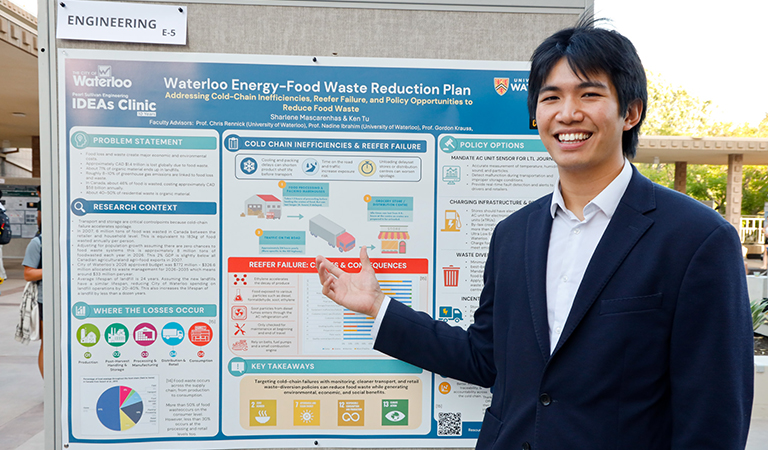
City of Waterloo Energy-Food Waste Reduction Policy Plan
Sharlene Mascarenhas (University of Waterloo) and Ken Tu ’27 (Harvey Mudd)
Mascarenhas and Tu confronted Canada’s food waste crisis through strategic policy interventions across Waterloo. Highlighting that over half of Canadian food produce is wasted, frequently during temperature-controlled cold chain transport and extended driver idling, the team set out to cut local food waste by 40% and transport idling emissions by up to 30%. Their plan outlines four key policies: mandating real-time AC fault-detection sensors on delivery trucks, enforcing anti-idling bylaws alongside charging infrastructure for refrigerated trailers, banning commercial disposal of edible food with pay-as-you-throw smart bins and providing incentives to accelerate electric delivery fleet adoption.
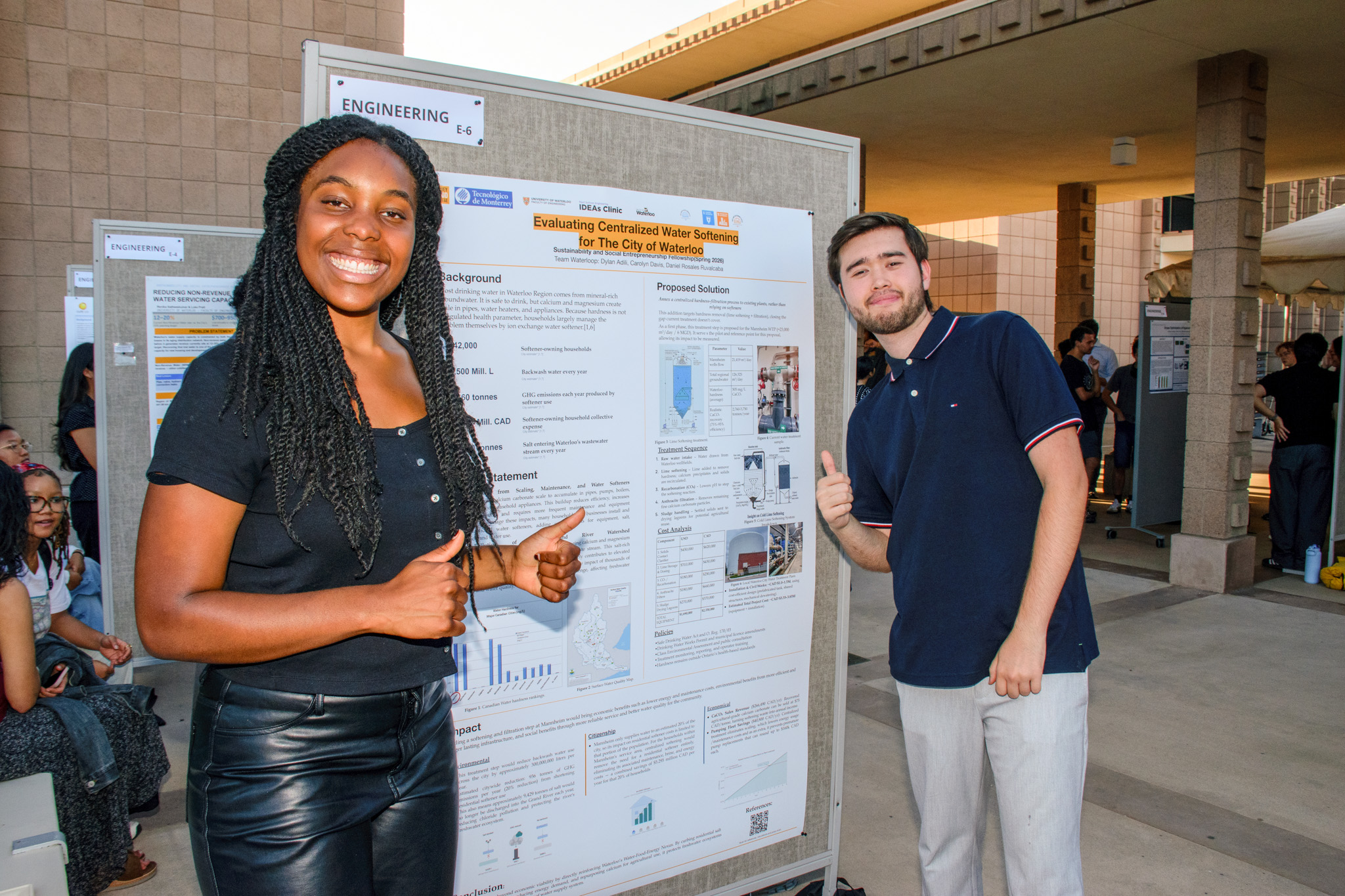
Waterloo Centralized Water Softening Proposal
Dylan Adili ’28 (Harvey Mudd), Carolyn Davis ’28 (Harvey Mudd) and Daniel Rosales Ruvalcaba (Tecnológico de Monterrey)
Adili, Davis and Rosales Ruvalcaba tackled Waterloo’s severe hard water issue, which forces reliance on home softeners that flush 1.5 billion liters of salty backwash water into regional sewers annually. To eliminate this environmental damage, the team proposed a $3.3 million to $3.8 million CAD retrofit at the Mannheim Water Treatment Plant using a centralized lime-softening and filtration process. Their model projects that centralized softening would eliminate over 8,000 tons of river salt pollution per year, save local households $4.5 million annually and generate up to $266,000 in revenue by selling recovered calcium carbonate as an agricultural byproduct.
Mudd Magazine