Beckman Scholars Help Drive Research at Harvey Mudd
October 9, 2026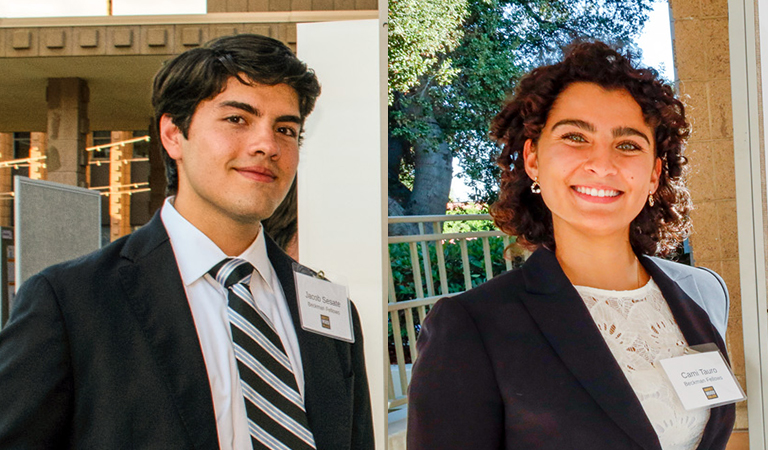
A three-year grant from the Arnold and Mabel Beckman Foundation launched the Beckman Scholars Program (BSP) at Harvey Mudd College in summer 2026. Supporting six undergraduate researchers through 2029, the program offers each scholar a $26,000 award package for student stipends, faculty mentorship and institutional resources over a 15-month commitment, spanning two full-time summer terms and academic year research.
The 2026 Beckman Scholars are Jacob Sesate ’27, mentored by Lisette de Pillis, Norman F. Sprague Jr. Professor of Life Sciences and professor of mathematics, and Cami Tauro ’29, mentored by Maduka Ogba, assistant professor of chemistry.
Throughout the program, scholars engage in regular check-ins with their mentors to develop their research, gain presentation and communication skills and access professional resources. The program highlights Harvey Mudd’s commitment to a high-touch environment where students work directly alongside faculty on meaningful scientific discovery.
Tauro’s project, titled “Origins of substoichiometric loading of calcium bistriflimide in sulfur-fluoride exchange (SuFEx),” uses computational chemistry to investigate a high-yielding, environmentally friendly reaction. She and her fellow lab member Oliver Spaulding ’29 are using density functional theory to evaluate different potential reaction pathways, and their goal is to determine the operative mechanism. Pinpointing this will provide helpful insights, allowing for reaction optimization and establishing this reaction as reliable for synthesizing essential compounds for the pharmaceutical industry.
For Tauro, having early research experience at a level typically reserved for graduate students is building critical skills and expanding future career paths. “Mudd is genuinely so unique. As students, we are the ones driving the research throughout the entire process,” Tauro said. “My labmate and I … lead everything, from initial background research to forming hypotheses, conducting experiments and interpreting our results.”
Tauro also emphasized how much Ogba’s mentorship has shaped her plans. “The chemistry community is very collaborative, and being involved in this research has allowed me to meet mentors and build lasting connections,” she said. “I’ve been able to reach out to faculty to learn more about their work, access additional resources and discover what different academic and industry environments look like.”
Sesate’s research on “A Validated Mathematical Model of ICI Therapy” introduces a streamlined, mathematical model of immune checkpoint inhibitor therapy. Designed to better evaluate both single and combination immunotherapies, the model offers a lightweight tool for researchers, biotech firms and clinical trial designers. It allows teams to simulate drug interactions, optimize dosing schedules and test mechanistic hypotheses before moving into human trials.
For seniors, the program serves as a launching pad to apply advanced coursework to real-world problems.
“All of the research I had done prior to this didn’t involve mathematics in the same way,” Sesate explained. “I decided I wanted hands-on experience applying the math I had learned in my classes. While I knew I liked research, I hadn’t yet had the chance to implement it in such a formal project. This program allowed me to put those skills into practice under guided mentorship. My mentor, Professor Lisette de Pillis, even helped me secure an opportunity to present at a conference in Arizona. Getting those kinds of opportunities is difficult without that level of support.”
Sesate and Tauro will continue their research through summer 2027. Alongside their lab work, the pair is also organizing the Beckman Scholars Program Seminar Series set for spring 2027.
Mudd Magazine