Shuve Receives RCSA Bridge Award to Accelerate Dark Matter Discovery
January 16, 2026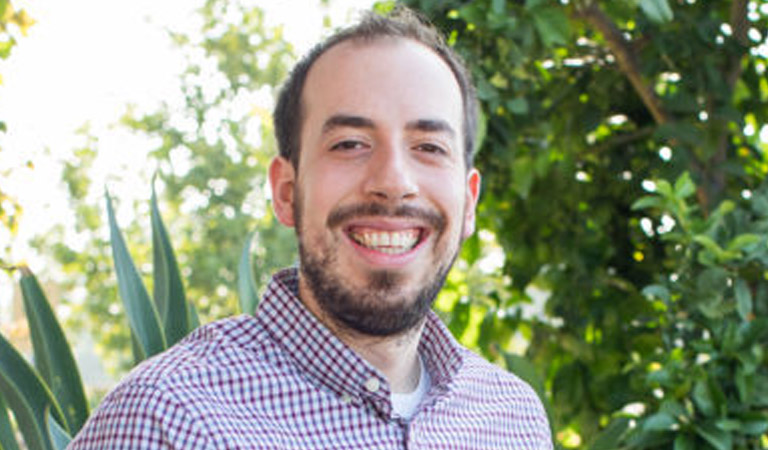
Brian Shuve, associate professor of physics at Harvey Mudd College, has received an RCSA Bridge Award from the Research Corporation for Science Advancement.
The Bridge Award is a prestigious follow-on grant designed to catalyze the continued research and leadership of outstanding teacher-scholars. This first-time emergency initiative by the RCSA is intended to help stabilize strong research programs that have experienced disruptions due to abrupt changes to their federal funding. Shuve is one of only 11 Cottrell Scholars nationwide to receive this recognition, marking a significant milestone in a trajectory that began when he was first named a Cottrell Scholar in 2021. Harvey Mudd College, a recent recipient of the Carnegie Classification for “Research Colleges and Universities,” is the only undergraduate-only institution and one of two non-R1 institutions to receive this grant (R1 institutions are those with the highest level of research [at least $50 million each year]).
Advancing the Search for Dark Matter
The 2021 Cottrell Scholar Award supported Shuve’s foundational project, “Matter-Antimatter Asymmetry from Dark Matter Freeze-In,” which addresses dark matter and matter-antimatter asymmetry. The project is based on an idea that Shuve developed with David Tucker-Smith at Williams College in which the production and scattering of dark matter shortly after the Big Bang has a back-reaction effect that can generate an excess of matter over antimatter and hence explains why humans are made of particles and not anti-particles. Shuve identified a number of new theoretical and experimental studies that will provide a more complete picture of how scientists can test theories of dark matter and the matter-antimatter asymmetry.
The new RCSA Bridge Award will allow Shuve and his students to expand this research, further investigating new ways in which current and future experiments can test the mechanisms of dark matter and other theoretical models. Shuve’s work is highly collaborative, integrating undergraduate researchers into high-level computational modeling and theoretical analysis.
“This award will support my group’s ongoing work to uncover possible signatures of dark matter or other particles that may be hiding in the debris of high-energy atom smashers,” said Shuve, a faculty member since 2016. “In one case, we are studying ways in which the Higgs boson, the most recently discovered but one of the least understood elementary particles, could be hiding interesting new particles amongst its decays. This research will be done by HMC students, including summer students who will be supported by the award. The award will also allow us to deepen collaborations with experimentalists working at CERN or other labs, and provide travel funding for students to present their work at conferences and connect with members of our broader research community.”
Beyond his theoretical research, Shuve’s 2021 grant supported an educational initiative to bridge the gap between introductory concepts and high-level abstraction in the course Theoretical Mechanics. By developing interactive digital applets, Shuve provided students with a way to visualize and manipulate the complex mathematical objects used to solve advanced problems in gravity and mechanics. These tools allow students to connect abstract theoretical methods with familiar physical concepts like force and acceleration, creating a vital resource for advanced physics pedagogy both at Harvey Mudd and peer institutions.
STEM for a Better World
The receipt of this award comes at a pivotal moment as the College implements its strategic plan, STEM for a Better World—HMC Strategy 2025-2035. The Bridge Award directly supports the College’s commitment to being a “distinguished institution that enforces a creative interplay of STEM and the liberal arts to graduate problem solvers for some of the world’s most pressing challenges.”
By pushing the boundaries of fundamental science, Shuve’s lab embodies the strategic goal of “impactful research and discovery.” His work instills curiosity about the universe while training students in high-performance computing, critical thinking, communication and complex problem-solving—all necessary to help tackle the “global challenges” outlined in the College’s strategic plan.
Continuing a Legacy of Excellence
Since 1994, RCSA has honored teacher-scholars who demonstrate excellence in both original research and institutional leadership. Shuve’s 2021 award included both a research component and an educational initiative to improve physics pedagogy. The 2026 Bridge Award ensures that this dual commitment to discovery and education continues to thrive at Harvey Mudd, contributing to the “climate of innovation” that is a hallmark of the Harvey Mudd community.
Mudd Magazine