Neighborhood Potluck
Neighborhood Potluck
Amanda Kitrell
mixed media, foam, wood
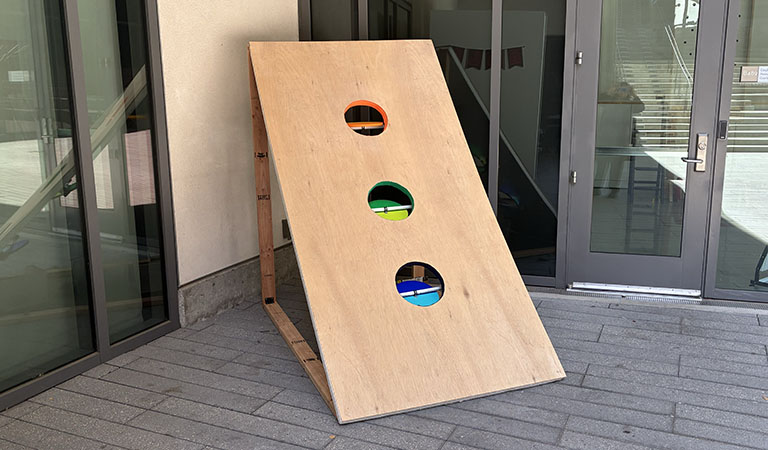
Artist Amanda Kitrell (American, b. 2005) reimagines democratic participation through Neighborhood Potluck, an interactive sculpture modeled after the familiar childhood game of cornhole. Enlarged and redesigned for group play, the work transforms a traditionally two-player game into a shared experience where many people participate on one board.
Kitrell’s work begins from a central problem in contemporary democracy, the feeling that political systems fail to represent the people they claim to serve. Low participation, distrust, and the belief that individual action does not matter can create a cycle of disengagement. Neighborhood Potluck responds to this issue by making participation physical, social, and approachable. Drawing from Mary Flanagan’s notion of meaningful play, the piece uses a recognizable game to invite people into a collective activity that feels less intimidating than formal political participation.
How it works:
- Showing up. Visitors gather around a single cornhole board and take turns throwing bean bags.
- Shared Space. Instead of separating players into a standard two-person game, the piece bring multiple participants into one shared playing space.
- Collective Movement. Three rotating panels respond to the impact of the bean bags, making each throw visible through motion. The board becomes a site where individual actions are folded into a large group experience.
By adapting cornhole, a game associated with childhood, neighborhoods, families, and casual gathering, Kitrell connects democracy to the everyday rituals through which people learn cooperation, competition, and belonging. The work does not ask viewers to approach democracy as an abstract system. Instead, it is something practiced through presence, movement, and interaction with others.
Neighborhood Potluck asks viewers to consider how play can build community. How does shared participation create a sense of belonging? And if democracy depends on people showing up, can play help us imagine new ways of entering the system together?