Course Description – The Game of Democracy
The Game of Democracy: Art, Engineering, Chance, Choice, and Civic Life
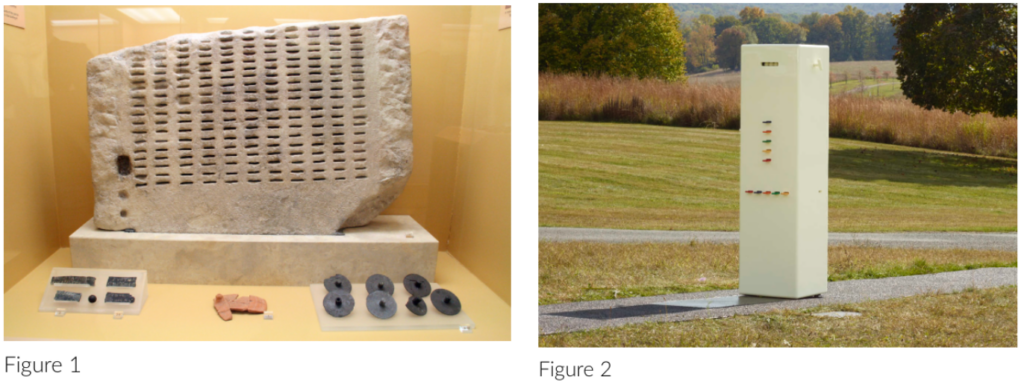
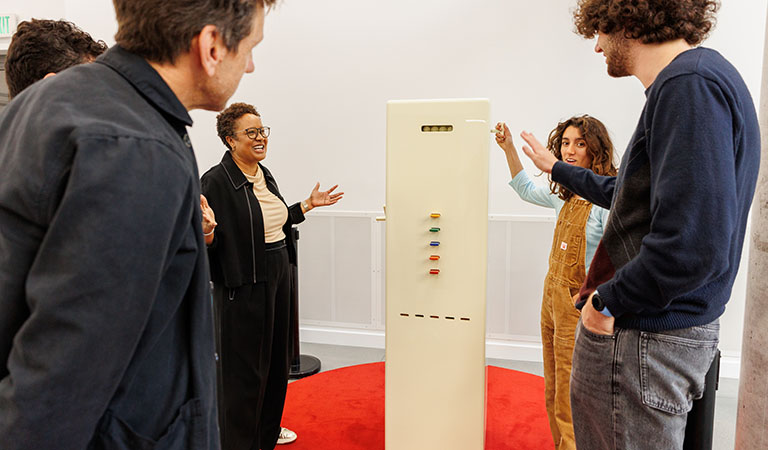
Figure 1. An ancient Kleroterion in the Museum of Athens. Figure 2. Taryn Simon’s Kleroterion (2024)
The Course
What happens when democracy is treated as a design challenge? Can the intersection of fairness, randomness, engineering, and art inform or even inspire our sense of agency as a citizen?
At the dawn of Athenian democracy 2,500 years ago, the Kleroterion (Fig 1) served as a sortition device to randomly select citizens for public offices and juries. In 2024, artist Taryn Simon reimagined this ancient tool as a modern sculpture (Fig 2) to spark dialogue about contemporary democracy.
This semester, Harvey Mudd College has transformed that dialogue into a unique interdisciplinary course: The Game of Democracy: Art, Engineering Chance, Choice, and Civic Life (ID049). Led by Harriet Nembhard, President and professor of engineering, and Ken Fandell, Michael G. Wilson professor of art, the course uses Simon’s sculpture as an organizing metaphor and learning object to explore how aesthetics and engineering shape—and could reshape—democratic life.
In Conversation with World-Class Guest Speakers
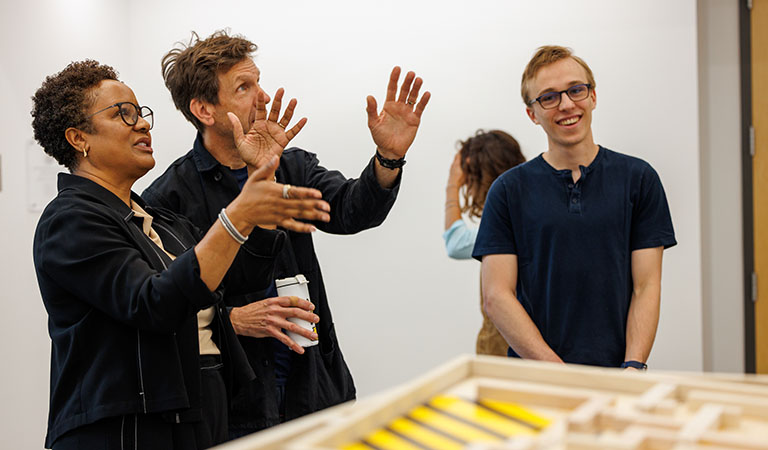
Special guest speakers have expanded the conversation and brought expertise from engineering, design, mathematics, and political science. They offered creative and critical insights that challenge us to imagine new architectures of fairness and participation in democratic life. Professor David Nembhard discussed how core design principles can be pivoted towards the Kleroterion.
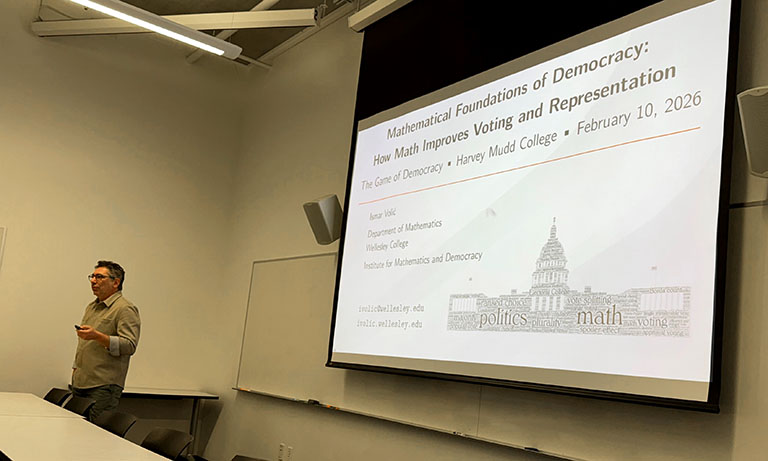
Professor Ismar Volić, Wellesley College, addressed some of the mathematics that underpins citizenship. Professor Mary Flanagan, Dartmouth College, showed us how games—physical, digital, or social—can be tools for imagining alternative political structures. Professor Danielle Allen, Harvard University, engaged us in a robust conversation about solving the students biggest concerns with democracy by redesigning systems with a lens on transparency and justice. Col. Eric Swenson, U.S. Army, discussed the role of science diplomacy and the Army Corps of Engineers in supporting the physical foundations of our communities.
Designing “Devices of Democracy”
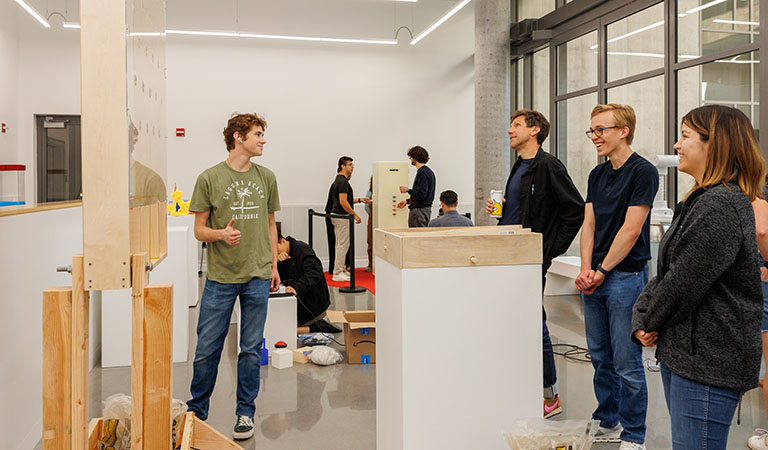
The culminating course project is the students’ creation of their own “devices of democracy” as a set of tools or systems meant to foster more just civic processes. The goal is working physical artifacts inspired by the Kleroterion. The Makerspace has become a hub of activity as students bring their ideas to life.
Public Exhibition
The interactive exhibit is scheduled for April 27 through July 31 in Sprague Gallery. We are thrilled to have the opportunity to borrow Simon’s Kleroterion from the Almine Gallery to anchor the exhibition.
The Bigger Picture
President Nembhard represents Harvey Mudd as a member of the College Presidents for Civic Preparedness (facilitated by the Institute for Citizens and Scholars), a national initiative dedicated to fostering free expression and civil discourse on campus. To ground this commitment in the HMC student experience, she and Prof. Fandell envisioned this interdisciplinary course as a way to provide a uniquely Mudd-like expression of civic engagement.
Syllabus Information
Instructors
Harriet B. Nembhard, President and professor of engineering, harriet@hmc.edu
Ken Fandell, Michael G. Wilson professor of art, kfandell@hmc.edu
Reading/Media List
1. Historical Precedents of Sortition
Exploring the ancient Athenian device used to randomly select citizens for public office, challenging modern notions of representation.
- Manin, Bernard. The Principles of Representative Government (selections on sortition in ancient Athens).
- Simon, Taryn. Artist Statement regarding Kleroterion (2024).
- Taryn Simon introduces ‘Kleroterion’ (2024); How to play Taryn Simon’s Kleroterion
2. Democracy as a Designed System
Treating governance as an engineered system that can be modeled, critiqued, and redesigned for higher operational efficiency and equity.
- American Academy of Arts and Sciences. Habits of Heart and Mind: How to Fortify Civic Culture.
- American Academy of Arts and Sciences. Our Common Purpose: Reinventing American Democracy for the 21st Century.
- Allen, Danielle. Justice by Means of Democracy (selections).
3. Critical Play and Civic Imagination
Games and design for political, aesthetic, and social critique.
- Flanagan, Mary. Critical Play: Radical Game Design (selections).
- Dunne, Anthony, and Raby, Fiona. Speculative Everything: Design, Fiction, and Social Dreaming.
4. Quantitative Fairness and Mathematical Reasoning
Using probability, algorithms, and visualization to dissect concepts of justice and improve voting systems and electoral mapping.
- Volić, Ismar. Making Democracy Count: How Mathematics Improves Voting, Electoral Maps, and Representation.
- Volić, Ismar. Americans agree politics is broken − here are 5 ideas for fixing key problems.
5. STEM in Global Civic Arenas
Examining the role of technical expertise in diplomacy, infrastructure, and crisis response.
- Nye, Joseph. Soft Power.
- Rucker, Justus. Case Study: U.S. Army Corps of Engineers.