Democracy Plinko
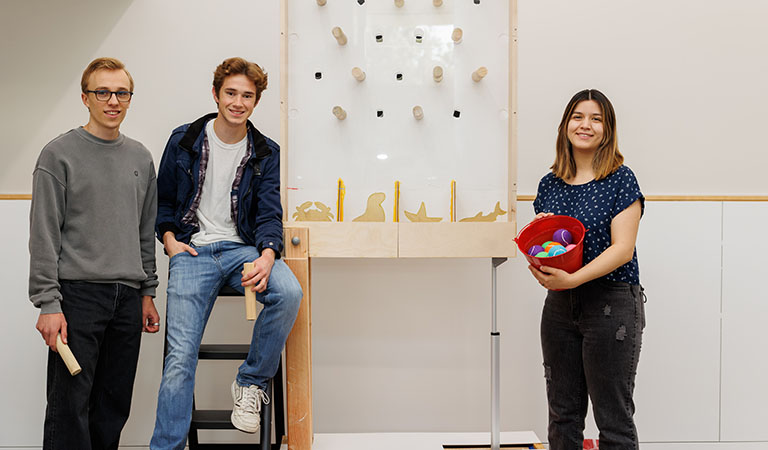
Democracy Plinko (2026)
Cameron Hernandez, Miranda Brandt, Theo Rode
Medium: wood, acrylic
Engineers Cameron Hernandez, Miranda Brandt, and Theo Rode consider the fragile foundations of American democracy and the ways it can be influenced through the interactive kinetic sculpture Democracy Plinko.
At first glance, this imposing 11-foot structure presents itself as a familiar game of chance: a supersized, Plinko-style board. Users are invited to place pegs as they wish, either embracing randomness or attempting to engineer a path that guides the ball toward a desired outcome at the bottom.
However, the system is not as neutral as it appears. Once a design is set and the button is pressed, the board physically tilts, altering the odds that the ball ends up in the various outcome slots. The rotation shifts the ball’s path to produce the machine’s intended outcome, rendering the user’s choice irrelevant. This mechanical betrayal provides direct commentary on the systems that govern American democracy. The user was given control, however just as the population may vote against those in charge, the machine betrayed their desired outcome.
Yet, the user has the ability to engineer the board to their benefit: arranging the pegs to suit their desired outcome rather than the will of the board. As the United States is grappling with efforts like Proposition 50 in California, following similar efforts in Texas, to redraw congressional districts in a partisan manner, Democracy Plinko encourages the user to break the system and to engineer victory.
The physical presence of the sculpture is as critical as its mechanics. Towering over the viewer, it projects an aura of institutional authority and permanence. Yet, it feels fundamentally unstable: the rotation and the unsettling thin support for the massive board give pause. The sculpture is visibly constructed from crude wood and screws, and a single bolt holds up the weight of the board. As the board rotates, unsettling creaks fill the air.
These design decisions ask us to look closely at the underlying systems that govern our civic life. How secure are the institutions we rely on? When a system is designed to bend the rules to sustain itself, is it projecting strength, or is it merely telegraphing its own inevitable collapse?