Harvey Mudd Clinic Team Partners with Union of Concerned Scientists on Educational Video Game
September 12, 2026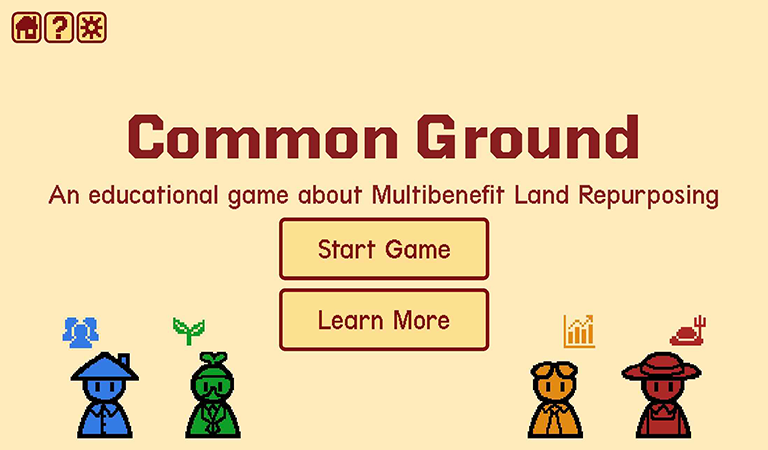
A team of Harvey Mudd College students has developed Common Ground, a multiplayer strategy video game designed to teach players about cropland repurposing in California’s Central Valley, in partnership with the Union of Concerned Scientists (UCS). The game was publicly released this month on UCS’s website.
The project was completed through Harvey Mudd’s Clinic Program, which pairs student teams with outside organizations to solve real-world technical problems. The 2025-26 team Laura Vairus ’26, Nicole Kerschner ’26, Vibhu Krishnan ’26, Mia Mirabelli ’26 and Ria Rajasekar ’26, worked with their advisor Lynn Kirabo, Maria M. Klawe Assistant Professor of Climate and Computer Science, over the academic year to translate cropland-transition science into game mechanics.
“Common Ground is a playful, creative complement to our liaisons’ work on multi-benefit land repurposing,” said Kirabo. “The students grounded the game design in existing literature on the topic, created custom designs for several game elements and used multiple rounds of prototyping and playtesting to improve their game mechanics.”
The game is set in the fictional Central Valley town of Townsville and gives its four required players a community role consisting of community leader, environmentalist, green economist or local farmer. The players work together to address water insecurity and poor air quality caused by unsustainable agricultural practices. Players propose and vote on land-repurposing projects while managing four shifting metrics: community well-being, environment, economy and land value and contending with random weather events such as droughts, floods and heat waves. A full game consists of four rounds and takes 30 to 45 minutes to complete.
UCS Western States Program Analyst Erin Woolley, who served as one of the three liaisons on the project, wrote in a UCS blog post that the student team learned about cropland transition science and “took on the task of adapting these scientific concepts into game mechanics.” The students tested the game with peers and UCS staff throughout the year and traveled to Sacramento to demonstrate an early version to state agency staff working on groundwater sustainability and cropland transition.
California is undertaking a major cropland transition as the state works to meet groundwater sustainability goals, with more than 500,000 acres of irrigated cropland potentially repurposed in the San Joaquin Valley alone. UCS developed the game as a tool to help the public understand the trade-offs involved in that process.
Common Ground is free to play online and requires three to four participants and an internet connection and can be accessed here: https://common-ground-game.netlify.app/
Mudd Magazine