Two Harvey Mudd Seniors Win Watson Fellowships
April 15, 2026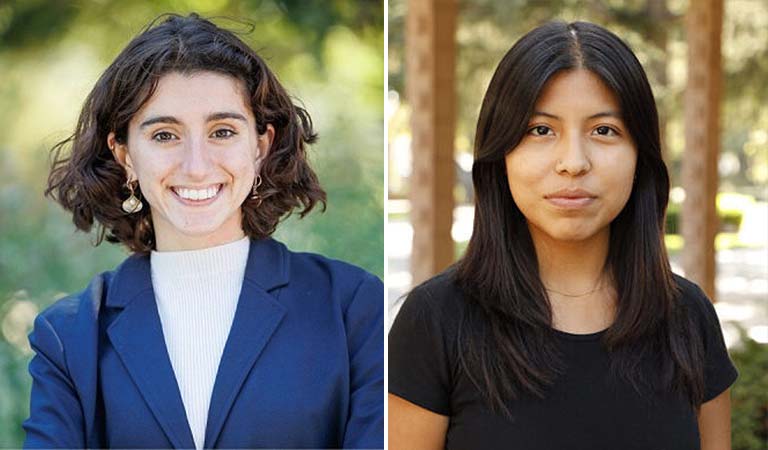
Two Harvey Mudd College seniors have been selected for the prestigious Thomas J. Watson Foundation Fellowship, joining the 58th class of Watson Fellows. This year’s cohort reflects a wide range of disciplines, backgrounds and project themes, with fellows traveling to 71 countries to pursue independent, yearlong projects spanning topics from the arts to global health and environmental sustainability.
Leilani Elkaslasy, an engineering major with an emphasis in environmental analysis, will pursue a project titled “Designing Inclusion.” Traveling to Argentina, Brazil, Kenya, Egypt and Thailand, and guided by the question, “What does it mean to be disabled, and how can small adaptations help people thrive?” she will work with communities and organizations serving people with disabilities to explore how adaptive design can foster inclusion and improve quality of life. She will then co-create assistive technologies tailored to local needs.
Her work will span a wide range of contexts—from collaborating with an inclusion-focused nonprofit in Buenos Aires, Argentina, to engaging with special education programs in Brazil to supporting mobility aid fabrication efforts in rural Kenya to helping design an accessible, community-run coffee shop in Cairo. She plans to conclude her travels in Thailand, working with rural communities to develop tools that improve access to education for children with disabilities.
Her approach emphasizes relationship-building and collaboration, using adaptive design as a way to better understand the lived experiences of individuals and the cultural contexts that shape inclusion. By working closely with community members, she aims to develop sustainable solutions and share knowledge that can continue beyond her time in each location.
On campus, Elkaslasy founded and grew Harvey Mudd’s Adaptive Design club, partnering with organizations such as AbilityFirst, Pilgrim Place and The Danbury School, to create assistive technologies. She is also involved in SALSA Mudd and the Society of Women Engineers. Her research experience spans water sustainability in the Bahena Lab and materials science in the Krauss Tribology Lab.
Miski Nopo, a mathematics and physics major, will explore the relationship between mountain regions and the people that inhabit them. Her project, “Mountain Communities,” will take her to China, Bhutan, Japan, Morocco and New Zealand, where she will examine how cultural, spiritual and environmental perspectives shape human connections to mountainous landscapes.
Nopo’s project is inspired by her upbringing in Peru and her connection to the Andean cosmovision, in which mountains—known as Apus—are regarded as living spiritual beings that protect and guide surrounding communities. This perspective contrasts with Western views of mountains as barriers and informs her interest in how different cultures understand and relate to the natural world. Through her Watson year, Nopo aims to learn from diverse communities and explore what these relationships reveal about conservation, connection and social development.
At Harvey Mudd, Nopo has combined rigorous scientific research with campus leadership and mentorship. She serves as director of the Committee for Activities Planning on the Associated Students of Harvey Mudd College Executive Board and has supported student life through additional roles, including as a mentor, academic excellence facilitator and president of the Minoritized Genders across Physics Club. Her research spans multiple institutions and disciplines, including work in biology professor Danae Schulz’s Lab, collaborations with faculty at Harvey Mudd and Pomona College and international research at CERN, applying machine learning to astrophysical models. Her senior thesis, advised by HMC physics professor Brian Shuve, focuses on dark matter interactions, and she has also conducted research in nuclear physics using deep learning at Texas A&M, presenting her work at the American Physical Society Division of Nuclear Physics.
Nopo and Elkaslasy, who plan to begin their travels in July, exemplify the curiosity, initiative and global perspective that define Watson Fellows, using their year abroad to pursue work with both intellectual depth and meaningful human impact.
Mudd Magazine