Boerkoel Joins CRA for Congressional Visit Day
March 11, 2026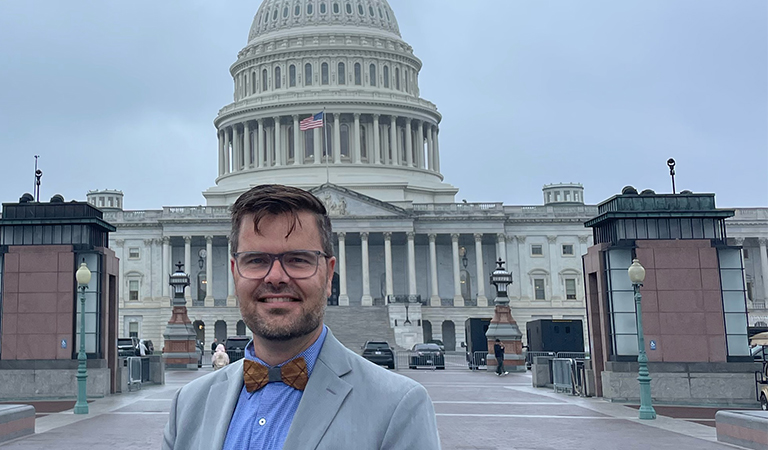
In September 2025, Jim Boerkoel and other scientists representing leading computing and information technology organizations traveled to Washington for the Computing Research Association’s (CRA) Congressional Visit Day to urge members of Congress to safeguard the nation’s research enterprise.
Recent executive actions, including funding freezes, proposed budget cuts and unprecedented layoffs at agencies like the National Science Foundation (NSF), National Institute of Standards and Technology (NIST), National Aeronautics and Space Administration (NASA) and the National Institutes of Health (NIH), threaten the country’s standing as a global leader in innovation.
Boerkoel and his California CRA colleagues met with the staff of four congressional reps and one state senator to highlight critical risks posed by proposed reductions in science and technology investment, including economic impact, national security and workforce instability. The meetings were also a chance for the scientists to not only share information as experts in their fields but also to build relationships with the senate and congressional members of their respective constituencies.
“We gave them information about how early research, typically funded by agencies like the NSF, will often come about long before industry starts investing in research,” Boerkoel says. “That research then becomes a product. We wanted them to see that, even if they aren’t interested in the science part of it, early stage research sparks entire industries and markets.”
In early 2026, congress passed a bipartisan, veto-proof omnibus package that rejected the Trump Administration’s proposed deep cuts (for example, a proposed 56% cut to the $9 billion NSF budget as well as a 73% reduction in staff and fellowships). The legislation protected funding for the NIH, NSF, NASA and the Department of Energy. In the end, funding was reduced by about 3% overall. “One disappointing thing is that, while 3% reduction in budget is much better than the originally proposed cuts, a disproportionate amount of the cuts ended up being in the areas of STEM education and climate science,” says Boerkoel.
He notes that NSF and other federal government agency grants are the largest share of external support for faculty research at HMC, so, “while federal support for day-to-day operations wasn’t affected by the cuts, federal support for research was,” he says. “The CS Department is now exploring other avenues, such as corporate outreach and university relations programs, to ensure a more robust portfolio of funding options to ensure we can continue to offer impactful research experiences to students of all backgrounds and experiences.”
Mudd Magazine