Shuve Wins National American Physical Society Research Prize
November 18, 2026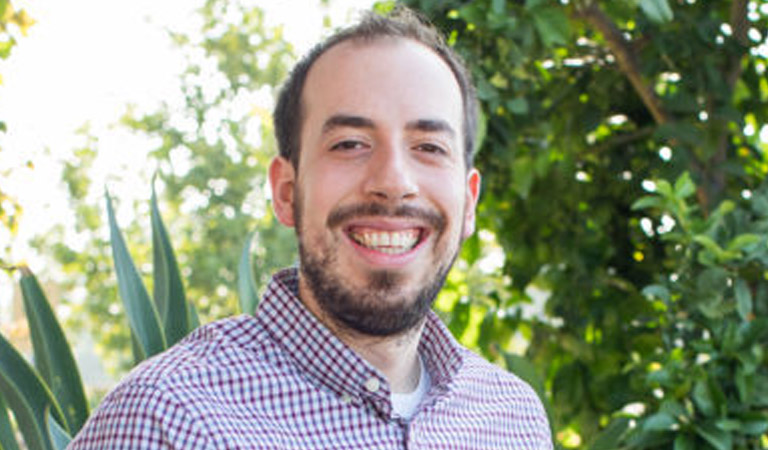
Harvey Mudd College Associate Professor of Physics Brian Shuve has been awarded the 2027 American Physical Society (APS) Prize for a Faculty Member for Research in an Undergraduate Institution. The prestigious national honor recognizes physicists whose research at undergraduate institutions has achieved wide recognition while contributing substantially to the professional development of undergraduate physics students.
Established in 1984 by a grant from the Research Corporation for Science Advancement, the annual prize includes a $5,000 stipend for the recipient, an unrestricted $5,000 research grant for the College, and travel support for the APS meeting ceremony.
Shuve’s award citation recognizes him “for research contributions in theoretical particle physics, matter-antimatter asymmetry, dark matter and hidden sectors, and collider phenomenology; for the practical analysis and interpretation of experimental searches; and for engaging, mentoring and publishing with undergraduate students.”
A member of the Harvey Mudd faculty since 2017, Shuve focuses on uncovering answers to some of the most fundamental questions in particle physics, including the nature of dark matter and why the universe contains far more matter than antimatter.
Building on foundational work supported by a 2021 Cottrell Scholar Award—developed in collaboration with Williams College physicist David Tucker-Smith—Shuve and student researchers explore how the production and scattering of dark matter shortly after the Big Bang may have generated an excess of matter over antimatter, explaining why our universe is composed of particles rather than antiparticles. Shuve identified several new theoretical and experimental studies that will provide a more complete picture of how scientists can test theories of dark matter and the matter-antimatter asymmetry.
Shuve and his research team are also investigating possible signatures of dark matter or other particles that may be hiding in the debris of high-energy atom smashers. “In one case, we are studying ways in which the Higgs boson, the most recently discovered but one of the least understood elementary particles, could be hiding interesting new particles amongst its decays,” he said. “We are also using data from the BABAR experiment consisting of high energy collisions at the Stanford Linear Accelerator Center to look for new particles and phenomena.”
Collaboration with students sits at the heart of Shuve’s work. He regularly integrates student researchers into high-level computational and theoretical modeling, and analysis of experimental data, co-authoring publications with Mudd students and connecting them with the broader international physics community, including collaborations with experimentalists working at CERN and other labs.
Beyond his research group, Shuve is dedicated to innovating physics pedagogy. Through his previous grant work, he developed interactive digital applets for his Theoretical Mechanics course that enable students to visualize and manipulate abstract mathematical concepts in mechanics and connect them to more familiar physical intuition—tools that will serve as valuable educational resources at Harvey Mudd and peer institutions.
Shuve joins fellow Harvey Mudd faculty member James Eckert, professor of physics, who received the APS Prize for a Faculty Member for Research in an Undergraduate Institution in 2009. Eckert, now in his 46th year at the College, was honored “for the significant contributions he has made to the understanding of the complex exchange biasing mechanism crucial to spin-valve sensors used in the read-write heads of hard disks and for his skilled and enthusiastic inclusion of undergraduates in physics research.”
Mudd Magazine