Harvey Mudd First-Years Take Top Honors in Inaugural Innovation Sprint
October 6, 2026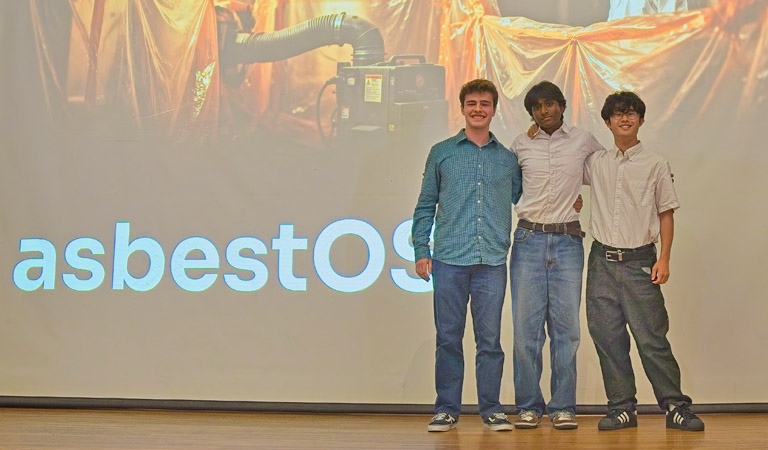
A nine-day test of rapid venture building brought together 71 students from across the Claremont Colleges for the inaugural Randall Lewis Center for Innovation and Entrepreneurship (RLCIE) Innovation Sprint. When the 22 competing teams presented their ventures before a panel of judges and alumni Sept. 26, teams of Harvey Mudd College first-year students claimed both first and third places.
Taking the top prize was asbestOS, developed by Harvey Mudd students Mohan Atkuri, Arlen Noguchi and Owen Prioreschi. Their browser-based assistant helps small asbestos-removal contractors manage the extensive compliance paperwork required for each job.
Asbestos removal is highly regulated, requiring contractors to complete multiple federal and state filings, often without the benefit of administrative staff. The asbestOS team designed a tool that turns contractors’ rough jobsite notes into drafts of required documents, tracks filing deadlines and flags potential errors before submission. Contractors retain responsibility for reviewing and approving all paperwork.
The idea emerged from one of the most important lessons of the Sprint: Before building a product, understand the problem.
“We spent a big chunk of the sprint week cold-emailing and cold-calling contractors around California instead of heads-down building,” said Atkuri. “We got through 54 of them, and 14 agreed to walk us through their filing workflow in detail.”
Those conversations changed the team’s understanding of the problem. They initially assumed contractors struggled primarily with understanding the paperwork. Instead, they learned that most contractors knew what they needed to write. The problem was the time required to do it, often after a full day on the job.
“That turned out to be the pitch prep,” Atkuri said. “Every slide we ended up with came out of those calls.”
The team also credited mentors with challenging their assumptions and helping them prepare for the questions judges would ask like: “If contractors have managed this process for decades, what are they using now, and why would they switch?”
“We were careful about what we didn’t claim,” said Atkuri. “It’s tempting in a pitch competition to say the AI handles everything. We said the opposite: The contractor has the final say, and the tool is there to save them the first draft.”
Prioreschi said the experience reinforced the value of learning through experimentation. “I think what separated us is that we spent the most time of any group thinking of ideas,” he said. “In the age of AI, making a good-enough mockup of a product is practically free, so the real differentiating factor is the strength of the idea and having a deep knowledge of the field that you choose.”
The team plans to put their idea to a more practical test next. They hope to get asbestOS into the hands of several contractors they interviewed and see whether they would use it for an actual filing.
“That’s the honest test,” Atkuri said. “We’ll know a lot more in a couple of months.”
Creative carpooling
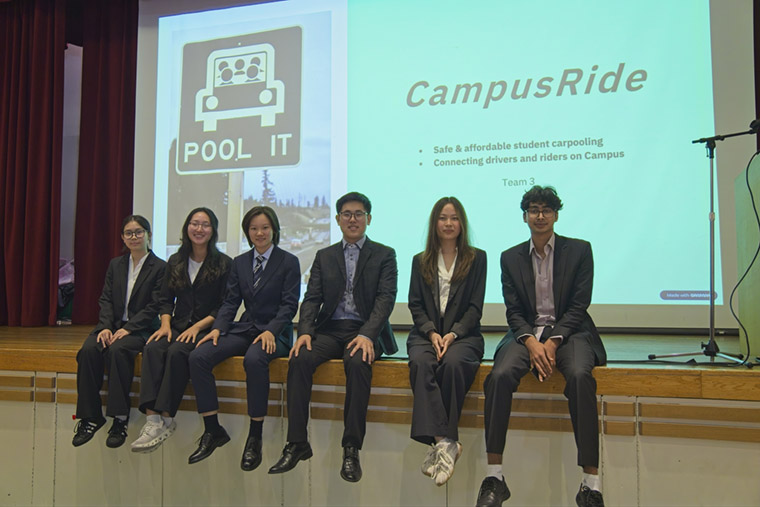
Third place went to CampusRide, a carpooling platform developed by Harvey Mudd students Kelly Chen, Fan Fei, Emma (Yixuan) Fu, Leah Jeong and Ryan Wang and Claremont McKenna College student Aditya Raj.
CampusRide is designed to connect students who have cars with students who need rides, helping them find others traveling to the same destination, share transportation costs and save money.
The team’s success came in part from the work they did outside of Sprint’s scheduled sessions. “Unofficial gatherings gave us the time to do deeper research, refine our presentation slides and practice our speaking roles,” said Fei.
The team plans to launch CampusRide in December and hopes to continue developing the platform with guidance and support of the RLCIE Fellows program.
From problem to pitch in nine days
The Innovation Sprint was designed to demystify the process of creating a startup by giving students a structured, hands-on experience in moving from an initial problem to a potential venture.
Participants began Sept. 18 by learning how to research and validate real-world problems, identify target customer personas and develop effective user interview guides. The following day, teams used the SCAMPER brainstorming framework to generate more than 25 potential solutions to each problem before selecting one concept to develop.
AI-powered prototyping tools allowed students to turn their ideas into working product concepts without requiring prior coding experience. After a week of refining their offerings, teams returned Sept. 25 to develop business models, establish pricing strategies, create go-to-market plans and build their pitch decks.
The Sprint culminated Sept. 26 with live presentations before RLCIE judges and alumni, including Harvey Mudd alumnus Josh Jones ’98. Teams competed for cash prizes and program honors.
Students who completed the program earned candidate status as RLCIE Fellows, recognizing Claremont Colleges students who engage deeply with experiential innovation programming alongside their regular academic coursework.
For Harvey Mudd students, the Sprint is one of several opportunities to explore entrepreneurship and innovation across The Claremont Colleges. In addition to RLCIE, Mudders can pursue entrepreneurial and creative projects through the Harvey Mudd College Entrepreneur Network (HMCEN), HMC INQ and Harvey’s Angels; The Rick and Susan Sontag Center for Collaborative Creativity (The Hive), StoryHouse Ventures and consortium cross-registration opportunities.
Together, these programs give students opportunities to test ideas, work across disciplines, connect with mentors and turn problems they care about into potential solutions—while learning to approach innovation with curiosity and responsibility.
Mudd Magazine