Meet the Artemis II CAPCOM: Stan Love ’87
August 10, 2026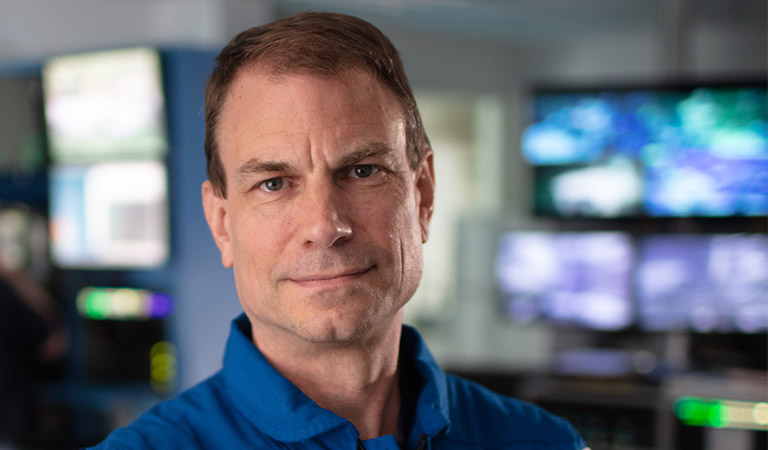
Physics alumnus and veteran astronaut Stan Love was the lead capsule communicator (CAPCOM) for NASA’s historic Artemis II lunar mission. Operating from Johnson Space Center, Love used his deep physics background to manage critical data and communications between ground teams and the Orion spacecraft. Love discusses his CAPCOM role, his long history with the Artemis II project and more in this Q-and-A.
How did you prepare for the mission?
I prepared the same way all astronauts and flight controllers prepare: practice, practice, practice. I came into the Artemis capcom role with over a decade of experience as a Shuttle and ISS capcom. I began attending Artemis I simulations in 2020. That mission flew without a crew, so a capcom wasn’t technically needed. (I like to joke that Artemis I was the only mission I supported in which I made no bad calls!) But each sim, and the 2022 flight that followed them, was an opportunity to learn the spacecraft systems and the roles of the other flight controllers. I was CAPCOM for Artemis II “mini-sims” when the full-up simulator wasn’t ready yet, then participated in real sims with the assigned crew from the very beginning. When the mission finally flew, I had over 100 half- and full-day Artemis CAPCOM shifts under my belt.
Were you involved with any aspects of the project other than the capcom role?
Yes. I have been deeply involved in Orion since its inception almost 20 years ago. I served on the NASA team that originally selected Lockheed to build the spacecraft. I was part of the team that devised its trajectories around the Earth and Moon. I was a test subject in the effort to design the new orange launch-and-entry suit the crew wore on the mission. For six years, I was the astronaut office representative on the engineering team that designed and built the SLS rocket that carried Orion into space. For about the same length of time, I served in the same role for Orion itself. For nine years, I’ve co-led the design of the switches, hand controllers, pushbuttons and electronic displays the Orion crew uses to control the vehicle. For five years, I represented the astronaut office on the teams that developed flight rules and operational techniques for the spacecraft once its design was complete. I’ve spoken extensively in public about the Artemis program. Three Orion program managers have come and gone while I did all this work. Serving as CAPCOM was sort of the cherry on top of a very large sundae.
Given your experience as an astronaut, was it hard to be the one on the ground instead of being in space?
Nope. Serving as CAPCOM is 80% of the fun of flying in space and 0% of the risk. So it’s a good tradeoff. Also, astronauts are taught to flex their role in an undertaking depending on the needs of the team at any moment. In this case, my role was in a crucial position in Mission Control.
What is something about your experience with the mission that you’d like readers to know?
CAPCOM is a strange job. It’s all about correct, concise, timely communication based on a deep understanding of the crew’s situation, needs and personalities. My B.S. in physics from HMC has no relationship to the work. But the fundamental value of a Harvey Mudd education—learning how to examine a tough problem, then gaining new skills to solve it—served me well. All Mudders should realize the capability they’ve forged and use it with confidence.
Mudd Magazine