Leah Mendelson Named Director of Harvey Mudd Makerspace
July 27, 2026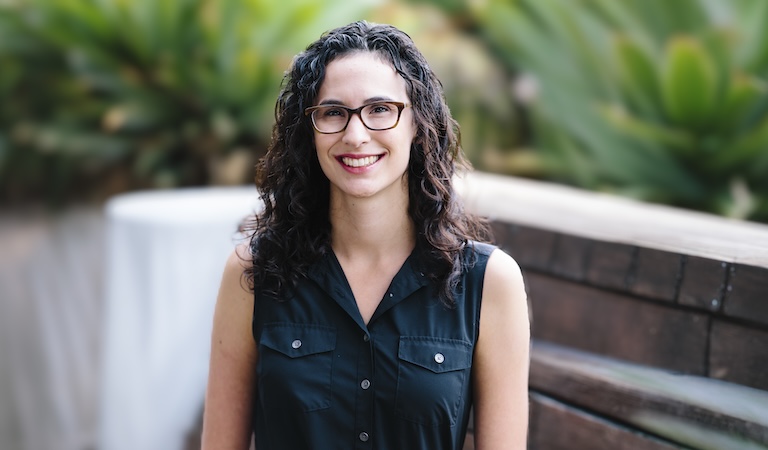
Located on the first floor of the Scott A. McGregor Computer Science Center at Harvey Mudd College, the makerspace fosters inclusive excellence on campus while creating new educational and community engagement opportunities.
“I’ve been a longtime friend and fan of the space,” says engineering professor Leah Mendelson, who started her assignment as director of the 8,000-square-foot facility on July 1. A hub of student creativity, the makerspace at Harvey Mudd is dedicated to being a place where everyone feels comfortable working on a variety of projects.
“There’s something really joyful about being in a space where maybe you’re working on something for an engineering class project and someone else, who’s in the space at the same time, is working on an art project, while another person is making a birthday present for a friend,” Mendelson says. “You learn so much when you see people using the same resources for drastically different things.”
Mendelson came to Harvey Mudd after finishing her doctorate in mechanical engineering at the Massachusetts Institute of Technology. “While earning my PhD, I was heavily involved in teaching a course that was similar to Mudd’s Clinic program,” Mendelson says. “But it’s the teaching and mentoring that happens at small, student-centered schools that I’ve always valued.”
As director, Mendelson will also oversee the makerspace stewards. These employed students from across The Claremont Colleges oversee and run the makerspace. They are experienced with the types of tools and machinery found in the makerspace, support peers in their making endeavors, foster a culture of collaboration and curiosity and ensure a safe and welcoming environment.
“I’m excited to work closely with our stewards and the makerspace manager Elissa Avelar,” Mendelson says. “I think our makerspace is really unique, being strongly student-run, and I’m excited for the collaboration aspects of that. I’m also looking forward to seeing our stewards really be the leaders in that space and to support them.”
One of Mendelson’s goals is to get the makerspace in a good spot to foster an even broader community. She noted that the makerspace has recently experienced a strong period of rapid growth in its user base as well as in collaboration requests from campus partners.
“We want to keep growing, but we also have to make sure that we can do that without becoming shells of ourselves because we’re stretched too thin or have no time to foster that organic community,” Mendelson says. “Continuing to grow, thrive and be a space that we want to be in is very important.”
As the College enters a comprehensive capital campaign, Mendelson looks forward to promoting philanthropic support for the makerspace.
“It’s so important because the campaign will allow us to do everything we want to do with the space and create those high-impact, interdisciplinary and community-focused learning opportunities for our students,” Mendelson says. “We’re a maturing organization, and things are old enough that we need to start having regular maintenance cycles with repair and replacement plans. Startup funding is winding down and we need to move into operating and sustaining a well-funded organization so that we can continue to offer all of the resources and tools that we do.”
Mendelson continues, “I think the community will support our philanthropic goals because the work we do here is something that will resonate both with our donors and our supporters.”
The makerspace is particularly special to Mendelson because she sees that a lot of what people do in the space is create something that they themselves have conceptualized and designed.
“You’re not just making something that someone else has told you to make,” Mendelson says. “You’re actually going through that whole process from dreaming it up to the finished product. The makerspace helps students be holistic, creative people, which both enriches life on campus and fosters this mindset in their long-term futures.”
During her tenure, Mendelson plans to create makerspace connections outside of the 7Cs. “I want to see us build unity in the broader Claremont community, regionally in the Los Angeles area, the maker-creative ecosystem, the academic makerspace community,” Mendelson says. “I believe we have an interesting perspective to offer these other communities and organizations, and we would also learn a lot by being engaged in those different partnerships.”
Mudd Magazine