Venkatachalam ’26 Awarded Fulbright to Study Physics-informed Machine Learning in Germany
May 8, 2026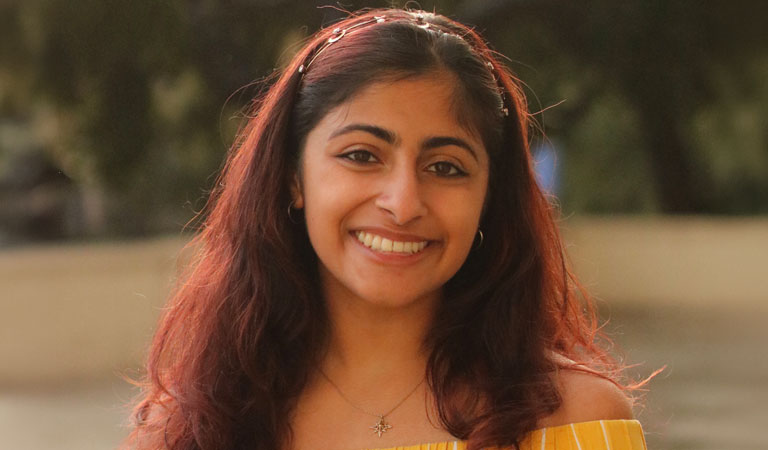
Harvey Mudd College senior Ananya Venkatachalam was awarded a Fulbright U.S. Student Program grant to conduct research on liquid–liquid phase separation using physics-informed machine learning at Heidelberg University in Germany.
Venkatachalam, a joint physics and mathematics major with a linguistics concentration, will pursue an Open Study/Research Award focused on liquid–liquid phase separation, a process in which mixtures spontaneously separate into distinct liquid phases. Understanding this behavior is critical for advancing research in areas such as biological systems and materials science.
While working in Heidelberg’s physics department, Venkatachalam aims to develop a physics-informed generative machine learning model to better predict how these systems behave under different conditions.
“I’m really looking forward to making connections in Germany, both through my research and through campus and community outreach,” said Venkatachalam. “One of the things that drew me to Fulbright is the chance to engage in meaningful conversations across diverse backgrounds and experiences, to share my perspective while learning about others.”
She will be building upon her research in hard and soft condensed matter physics that she conducted at Harvey Mudd College, California Institute of Technology, University of Pennsylvania and the University of Chicago. Her work has resulted in multiple co-authored publications and presentations at national conferences, including the American Physical Society Global Physics Summit.
In addition to her research, Venkatachalam is engaged in teaching and outreach. She serves as a facilitator for HMC’s Academic Excellence program in Core mathematics courses and has supported peers across physics and math through tutoring and grading roles since her sophomore year. She is also co-president of Minoritized Genders across Physics and leads STEM outreach initiatives that bring hands-on science programming to younger students, including the annual Science Day event for local elementary schools.
“I’ve been very fortunate to have access to mentors and opportunities that helped me imagine a future in science, and I want to help make that path more visible and accessible for others,” she said.
Following the grant, Venkatachalam will pursue a PhD in theoretical chemical physics, where she hopes to explore how fundamental physics can be used to understand and predict complex chemical systems.
“I hope my Fulbright year helps me become a better scientist, mentor and advocate,” said Venkatachalam. “I want my research experience to be an opportunity for exchange, not just in terms of technical skills, but also in learning how different communities approach science, education and inclusion.”
The Fulbright Program, sponsored by the U.S. Department of State, is the nation’s flagship international educational exchange initiative, promoting mutual understanding through academic and cultural exchange. In partnership with more than 140 countries, the Fulbright U.S. Student Program supports academic and professional development while fostering cross-cultural collaboration to address global challenges.
Mudd Magazine