Harvey Mudd Clinic Team Publishes Cancer Research in ACS Omega
December 15, 2025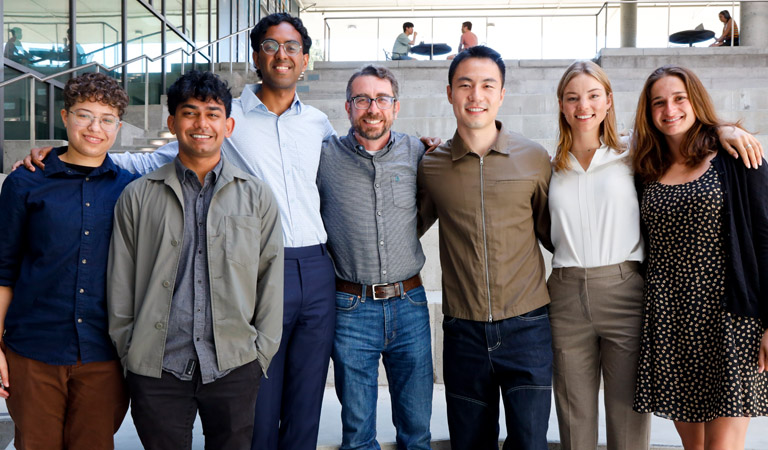
The Harvey Mudd College–Lawrence Livermore National Laboratory (LLNL) Clinic team has published its research in ACS Omega, marking a significant achievement for the students and their collaborators. The publication stems from the team’s 2024–2025 Clinic project focused on improving the accessibility of advanced molecular-scale cancer simulations.
The team—Bryce Tu Chi ’25, Stephanie Fulcar ’25, Jonathan Ipe ’25, Olivia Schleifer ’25, Rohan Subramanian ’25 and Claire Vlases CMC ’25—was advised by adjunct Professor of Computer Science Naim Matasci. Their work supports a Department of Energy (DOE) and National Cancer Institute initiative aimed at understanding how RAS–RAF protein interactions drive nearly 30% of human cancers.
The project focused on expanding access to MuMMI (multiscale machine-learned modeling infrastructure), a powerful simulation framework originally designed for DOE supercomputers, such as LLNL’s El Capitan—the most powerful supercomputer in the world. The Clinic team reengineered key components of the software to make it usable by a broader community of researchers and incorporated advanced AI algorithms to improve performance and accuracy.
Student Researchers Motivated
Olivia Schleifer says seeing the work published has been “incredibly rewarding,” marking the culmination of close collaboration between the Clinic team and LLNL scientists. “For many of us, this was our first experience taking a research project from idea to publication,” she says. “It’s given us a deeper appreciation for both the scientific process and the teamwork behind impactful research.” She hopes the machine-learning methods they developed will “help accelerate the design of new therapeutics” by potentially improving the speed and precision of computational drug-discovery pipelines.
Claire Vlases enjoyed the opportunity to use one of the world’s most powerful supercomputers and contribute to meaningful cancer research, “something most students only dream about.” The publication, she says, “shows us that we can do it. It’s motivating in a really deep way.” She says the team’s approach has the potential to lower computational barriers for researchers exploring mechanisms behind RAS-driven cancers, ultimately supporting new discoveries and potential treatments.
Project Goals Met
Matasci explains that the Clinic project filled a critical need in the national ADMIRRAL initiative (AI-Driven Multiscale Investigation of the RAS/RAF Activation Lifecycle). “Not everyone has access to DOE supercomputing resources and the expertise of the computational scientists who designed these tools,” he says. “The goal of the project, and the focus of this publication, was to make MUMMI accessible to the broader community of computational cancer researchers. The software is now available for download for everyone.”
He adds that publication was a stretch goal, one the students achieved through exceptional dedication and the mentorship of their LLNL partners. “The article’s inclusion in a special ACS collection highlighting undergraduate research ‘as the stimulus for scientific progress in the USA’ is incredibly fitting.”
The team’s accomplishment showcases the strength of Harvey Mudd’s Clinic Program which provides students with opportunities to contribute to high-impact scientific projects that advance both research and society.
Find the ACS Omega published paper here: “Integrating Ultra-Coarse-Grained Protein Models into Accessible Workflows for Multiscale Molecular Dynamics”
Mudd Magazine