Adam Johnson Co-authors Chemistry Textbook Bridging Coursework and Research
February 16, 2026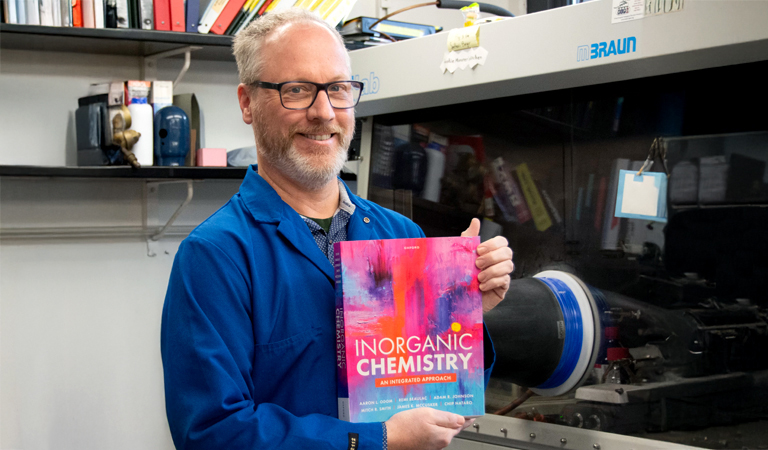
Advanced undergraduate and first-year graduate students now have a modern pathway into high-level inorganic chemistry via the recently published textbook Inorganic Chemistry: An Integrated Approach, co-authored by Adam R. Johnson, a chemistry professor at Harvey Mudd College.
Co-authors Johnson, Aaron L. Odom, Remi Beaulac, Mitch R. Smith, James K. McCusker and Chip Nataro designed the textbook to fill a longstanding gap in chemistry education: a single, cohesive resource that goes beyond introductory inorganic texts while remaining more accessible and pedagogically grounded than highly specialized graduate monographs.
“This book was designed to fill a niche where there haven’t been many options,” said Johnson, Ray and Mary Ingwersen Professor of Chemistry and chair of Harvey Mudd’s Department of Chemistry. “There are good introductory inorganic books, and there are good, advanced topic books, but not an advanced, comprehensive textbook that prepares students for research.”
A Decade-Long Collaboration Rooted in the Chemistry Community
The origins of the book trace back to an American Chemical Society (ACS) national meeting in San Diego 10 years ago, when Johnson was first approached by co-author and former graduate school colleague Aaron Odom about joining the project.
Johnson said, “We felt that having authors from both R1 and primarily undergraduate institutions would be a strong selling point for the text.”
Over time, the author list expanded to include leaders across multiple subdisciplines of inorganic chemistry. Johnson’s longtime collaborator Chip Nataro joined the project as well, building on nearly two decades of shared work on the teaching resource website ionicviper.org.
Research-driven, Current and Pedagogically Grounded
Johnson began researching his chapters shortly after that initial ACS meeting, with the bulk of the writing completed during the COVID-19 pandemic. He authored the chapters on organometallic chemistry, his primary research area, as well as bioinorganic chemistry, a field he worked in during his postdoctoral training at UC Berkeley.
“Relearning bioinorganic chemistry at a deeper level allowed me to see the similarities between the two fields,” Johnson said. “It really highlighted the importance of the local structure around a metal atom in dictating its reactivity. We have a lot to learn from biology, and these naturally evolved proteins improve our own ability to have such strong control over reactivity in a laboratory-synthesized metal complex.”
Across all chapters, the authors prioritized currency and connection to the primary literature. Johnson’s chapters include references through 2024—“as current as a textbook can be,” he noted. “We wanted students to see what inorganic chemistry actually looks like today.”
Bridging Coursework and Research
The book emphasizes the development of bonding theories that go beyond introductory chemistry, including ligand field theory and symmetry concepts taught alongside group theory and projection operators.
“This level of theory is important to explain chemical reactivity, structure and spectroscopy of metal complexes, which is what the majority of inorganic chemists study,” Johnson said. “But we also outline current research efforts across the discipline, from making new materials for gas separations, to catalysts to make pharmaceuticals, to understanding how platinum anticancer drugs work.”
Johnson particularly enjoyed writing about one of his favorite topics: molecular orbital theory. “This textbook has several chapters that build on knowledge from first-year chemistry to develop molecular orbital theory such that it can be applied to more complex systems. Then, the book uses this theory extensively to explain observed reactivity and spectroscopy.”
To support both instructors and students, the textbook includes advanced optional topics, extensive worked examples, end-of-chapter problems tied to the primary literature and a full answer key.
A Teaching Perspective Informed by PUI and R1 Faculty
Johnson believes the mix of perspectives among the authors is one of the book’s greatest strengths.
“Faculty at primarily undergraduate institutions tend to think deeply about teaching and pedagogy—how material is presented and received by students,” he said. “R1 faculty often focus more on research opportunities and pushing the frontiers of science. Having both perspectives in one book allows more breadth of how the material will be presented.”
Mudd Magazine