Harvey Mudd Students Build Ameriflux Tower in Los Angeles County to Track Carbon, Water and Heat
February 11, 2026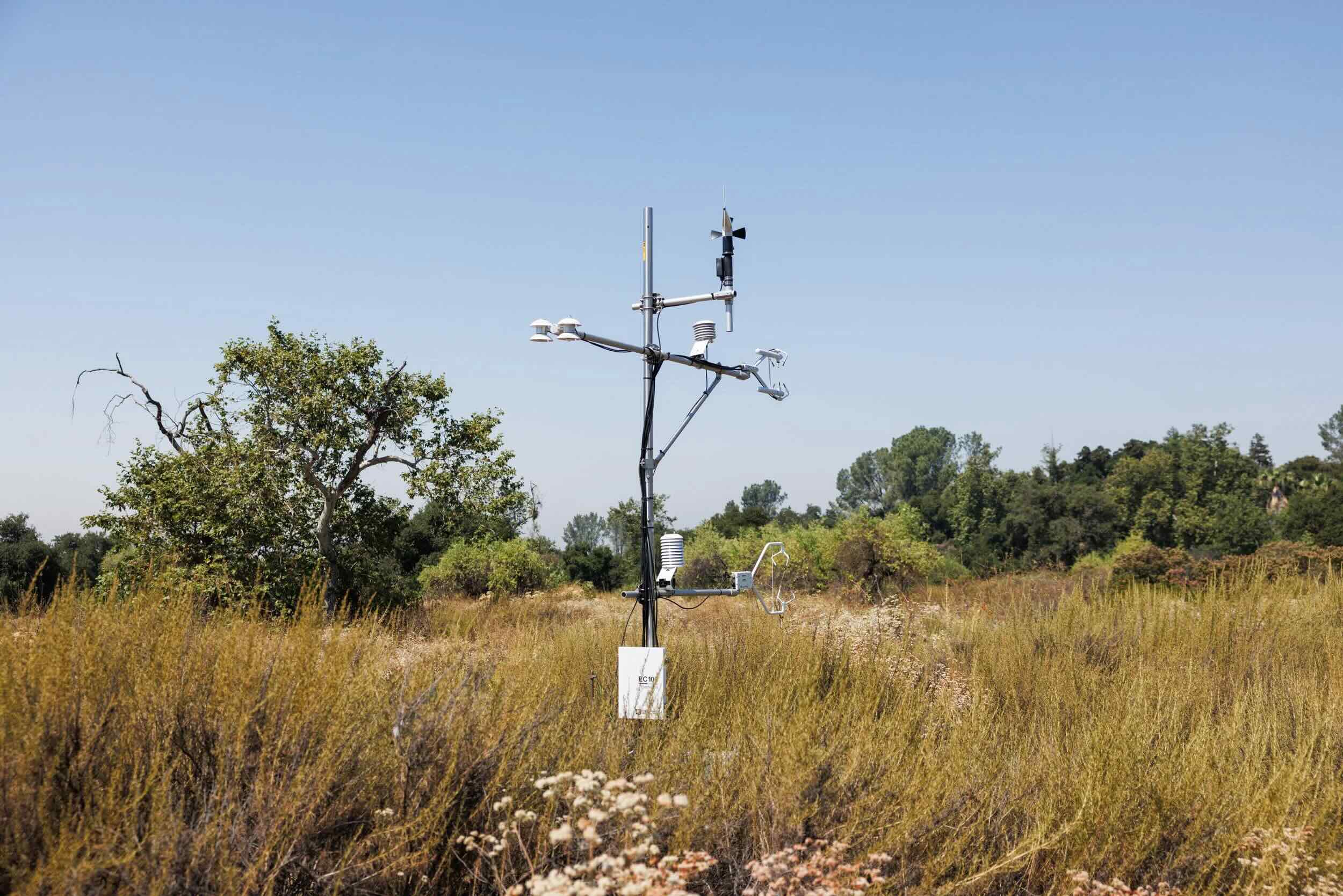
A student-built monitoring tower known as US-BFS is helping Harvey Mudd College students answer some of Southern California’s most pressing climate questions, while also contributing data to a global network of environmental research sites.
Located at Robert J. Bernard Field Station in Claremont, California, the US-BFS tower continuously tracks the daily exchange of carbon dioxide, water vapor and energy between the Field Station’s native coastal sage scrub ecosystem and the surrounding Los Angeles atmosphere. The tower offers rare, year-round insights into how a drought-adapted, urban ecosystem “breathes” across seasons, including heat waves and dry spells.
The tower is part of AmeriFlux, a network of sites that measure ecosystem CO₂, water, energy fluxes and other climate-related data in North, Central and South America. The network connects research on field sites, all of which represent major climate and ecological biomes. Prior to the US-BFS’s establishment, there were no active monitoring sites of this kind in all of Los Angeles County. This gap meant scientists lacked continuous, reliable data on whether native coastal sage scrub in an urban setting function as a carbon sink or if it can transform to becoming a carbon source under extreme heat and drought. Researchers say determining the answer is critical for improving climate models and understanding how much carbon the Earth’s surface can realistically remove from the atmosphere.
The tower measures three main categories of data: ecosystem fluxes, which capture how much carbon dioxide, water vapor and heat move between plants, soil and air; basic meteorology, including wind, temperature, humidity, sunlight and soil moisture; and local air-quality indicators such as particulate matter and gases like ozone. Together, these measurements allow students and collaborators to link ecosystem behavior directly to changing environmental conditions.
US-BFS is distinctive as it is the only of its kind in Los Angeles County as well as for the leading role students played in building and maintaining it.
“This is all a story of student accomplishments,” said Professor of Climate and Chemistry Sarah Kavassalis. “They turned instruments into a community resource.”
During the 2023–2024 academic year, Helen Chen ’24 designed the entire site as part of her undergraduate chemistry thesis, where she determined where the tower should be placed and how the instruments should be arranged. Before heading into the field, Chen and Sorin Jayaweera ’27 tested and validated the full system in the lab to ensure it could collect reliable data.
In summer 2024, Chen led a team of students (Mia Mirabelli ’26, Anna Figge ’27 and Matthew Simpson ’27), which installed the tower at the Field Station and connected the tower online.
After Chen graduated, Simpson took over as the project’s lead and wrote the site’s data-processing code from scratch, producing the first publishable US-BFS dataset. This dataset was a milestone that made the measurements accessible to the wider scientific community.
“Most of my research involves processing the data from the flux tower,” said Simpson. “Understanding whether our local ecosystem is a carbon source or sink could better inform scientific modelers and policymakers when they calculate our carbon budget. Having accurate, ground-based measurements is important to verify climate models and satellite data products.”
In summer 2025, Simpson led another student team, including Figge, Stephanie Fulcar ’25, Kennetta Roebuck ’26 and Tzaara Jauhar ’27, to relocate the tower within the Field Station to an even more optimal location. The team adapted their processing tools to make them more user-friendly for outside researchers.
“I have learned so much about atmospheric chemistry, especially the eddy covariance method, which is the technique we use to measure fluxes and surface-level atmospheric dynamics,” said Simpson. “There has also been a lot that’s gone wrong along the way. The tower’s generator was stolen one winter, and we had to move the tower during the summer of 2025 to get better measurements. This taught me that scientific research is a very nonlinear process. It is reassuring to see that research can still produce interesting and impactful results despite the difficulties that researchers often face.”
The result is a site that functions as both a research platform and a community resource for researchers. Because the data is archived and shared through the AmeriFlux network, the US-BFS’s data is now part of a global system of ecosystem monitoring stations that supports climate and environmental science worldwide.
US-BFS was designed to serve as a long-term monitoring site. The team is building a multiyear record capable of capturing climate variability and extreme conditions, while actively maintaining and continuously updating the public dataset. New multiyear research funding from a grant by the Seaver Foundation will also support the expansion of complementary measurements at the site.
Interest in the data is already growing. Researchers at The Claremont Colleges are developing projects that build on the tower’s footprint, including studies of plant water stress and soil greenhouse-gas fluxes. US-BFS was also selected as a participating site in a soil hydrology project led by Indiana University, Bloomington, and faculty from other higher education institutions have reached out about potential collaborations.
The project’s hands-on research of interdisciplinary learning and societal impact of science and engineering was a key focus. Students involved in US-BFS bring together chemistry, atmospheric science, ecology, engineering and data science, designing field instrumentation, writing and validating code and interpreting how carbon, water, and energy move through a vulnerable native ecosystem. AmeriFlux’s sharing and archiving system also allows students to learn best practices in open data science while contributing a community resource used well beyond campus.
The experience is already shaping students’ academic paths. Two project alumni took paths in graduate studies involving atmospheric chemistry, carrying their field and data-science training into the next stage of their research careers. For Simpson, the project is preparing him for his pursuit of a career as a university professor, which he anticipates will include substantial scientific research.
“It’s been exciting to be positioned in an understudied environment so I can investigate the instrumental and data processing mechanisms that are often less emphasized in other research groups,” said Simpson. “I was part of the team that first set up the tower in the summer of 2024, so it has been satisfying to see how far we have come with the project since then.”
The establishment of the US-BFS tower also opens doors to future grants and partnerships through the AmeriFlux network. The network provides shared tools and scientific visibility that connect researchers working across climate, ecology, biology and Earth systems science.
The tower functions as a major contribution to scientific research. The US-BFS transformed a patch of native landscape into a living, “breathing” laboratory, resulting in a worldwide effort to understand a changing planet.
Mudd Magazine