Grant for Solar Expansion is a Major Renewable Energy Milestone at Harvey Mudd
January 20, 2026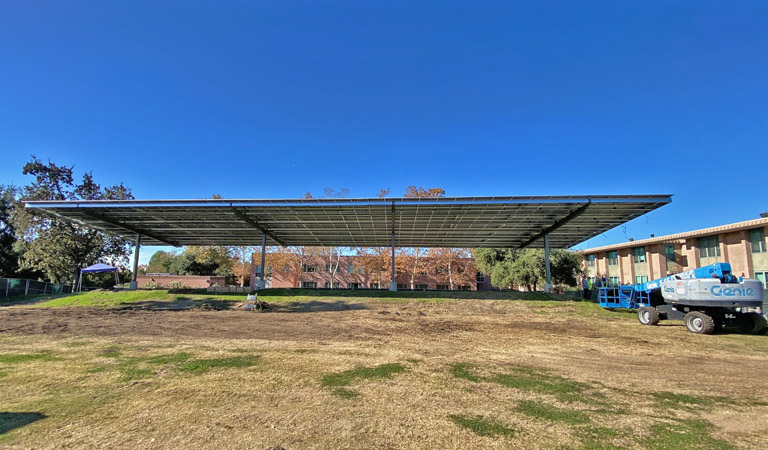
Harvey Mudd College has moved a significant step closer to its goal of embedding sustainability into the fabric of its campus operations. Thanks to a generous $500,000 grant from a private foundation, the College is launching the second phase of its solar panel installation project, which will nearly double its renewable energy capacity.
The project involves the installation of high-capacity solar photovoltaic arrays on the Linde Activity Center, Linde and South residence halls and a new shade structure at Linde Field. Once complete, the expansion will increase the College’s renewable energy capacity from 18% to 30%, placing Harvey Mudd at the forefront of green power usage among peer institutions.
Aligning Infrastructure with Instruction
The initiative is a cornerstone of the College’s new strategic plan, STEM for a Better World (2025–2035). By modernizing its physical infrastructure, the College aims to “walk the talk” of its rigorous climate curriculum.
“As we teach our students to be responsible stewards of the planet, we recognize the need to embody that commitment in our physical spaces,” said Harvey Mudd President Harriet Nembhard. “This project is an anchor in our broader climate campaign. We are integrating sustainability into every aspect of our systems, from the classroom to our residence halls.”
A Holistic Approach to Climate Challenges
The solar expansion works in tandem with the Hixon Center for Climate and the Environment, which recently introduced joint majors and faculty appointments dedicated to environmental scholarship.
Lelia Hawkins, director of the Hixon Center for Climate and the Environment and Hixon Professor of Climate Studies, noted that the visible presence of solar arrays on campus serves as a powerful pedagogical tool.
“Our curriculum integrates natural and mathematical sciences with engineering and with the humanities, social sciences and the arts to address global environmental challenges through an interdisciplinary lens,” Hawkins said. “Making a substantial increase to 30% renewable energy demonstrates to our students and the world that Harvey Mudd is not just studying the climate crisis, we are actively participating in the solution. And, it’s optimistic. This infrastructure directly supports the actions that our scholarship tells us are necessary, proving that high-performance STEM education and environmental responsibility can, and must, coexist.”
Engineering a Sustainable Future
Beyond the environmental impact, the project is a sound fiscal and operational investment. The new panels are projected to yield net annual energy savings of approximately $105,000 over their 25-year lifespan. Crucially, the added capacity will alleviate the strain on the regional electrical grid during peak summer months when laboratory and classroom cooling needs are at their highest.
Construction is managed by SunGreen Systems, with completion expected by end of February 2026. This initiative joins a suite of recent successes in the College’s climate campaign, which includes climate-focused professorships, joint majors and climate-focused projects in HMC’s flagship Clinic Program.
Mudd Magazine