I met Mrs. C at the Bates Open House for freshmen in 1972; I didn’t know if my myopia would preclude being in the program but I’d dreamt of flying for years and had to find out and was pleasantly suprised it didn’t bar me from the program or from flying ever since. Thank you, Mrs. C, for the gift of flight. And Mr. C and of course, Shirley Froyd, who all successfully kept me from killing myself or bending Cessna 42G.
After my wife Teri Cahill (Math ’78) passed away in 2000, after a time I had a chance to rekindle a relationship with a woman (from Pomona College) I had dated as an undergrad and I shared with her some of Mrs. C’s accomplishments… she rejected the story as implausible… no one could do all those things. Be all those people. At those levels.
Mrs. C could.
She will be missed. She is missed.
Beth Platt Garrow
HMC Family
Sending love to Sandy, Robin and their family. Iris and Critch were so much a part of the Platt family, and I have fond memories of them while growing up and again, later in life. Iris would email me after seeing me at an HMC event well after her 100th year and was always curious about what we were up to. Our last visit with her was in 2023 which lasted well over an hour. She was still swimming many laps in her pool, sharp as ever, and deeply proud of all the HMC students she taught over the years. Such an amazing life and one that was so giving and humble. We miss her!
Leticia Calderon
Ad admirer
I’m fairly new to HMC so I did not have the pleasure of meeting you. I was, however, amazed to read of your many accomplishments and the legacy you left behind. You paved the way for women like myself, the students at HMC, and the 7Cs. You make me proud to be a woman. May you rest in everlasting peace.
Josh Slater ’06
Student
I’ll never forget Iris. Though the Bates program had long ended by my time, she was there every step of the way through my aviation journey, from my first flight in 42G as a freshman, to my PPL checkride prep after college, and my most memorable flying experience of all with her, Mike Magras and several others on a California tour from POC all the way up to PML. What an adventure! I’ll always treasure the memories and a legacy she has instilled in me and so many others along the way. You will be missed, Iris.
Jon Jacobsen
Colleague
In fourth grade, my daughter became interested in Amelia Earhart. When I mentioned that Iris had known her, Reya immediately asked if she could interview Iris. They met and had an inspiring conversation—no surprise to anyone who knew Iris.
At the end of their chat, Iris turned to Reya and asked if she wanted to try flying. Reya’s face lit up with excitement. Within a week or two, I found myself in the back of Iris’s plane. We had spent a significant amount of time going through the pre-flight routine and safety checks, with Iris teaching Reya every step of the way. Once we were in the air, I assumed Iris would handle the flying and bring us back—how naive of me.
Once we were settled, Iris turned to Reya and said, “Okay, your turn.” And just like that, we were off. “Turn left,” she instructed, and the next thing I knew, Reya was at the controls, guiding the plane. Sitting in the back, I was in absolute awe—watching my daughter experience the thrill of flying and seeing Iris in her element, teaching and sharing her knowledge and passion. It was incredible.
This was just one small example of Iris’s remarkable generosity and willingness to share the joy of flight with others. I was fortunate to get to work with Iris over the years with the Aero Scholarship and other endeavors and will miss her dearly.
Madineh Sarvestani ’05
Iris made a huge impression on me, as a Freshman student trying to figure out my place in the world. She took me, and several other students, out on flights. She made flight, and other big feats, seem small and possible. I think about her often and I’m grateful I got to meet her. What a force.
Bruce Worster ’64
Iris’s passing is a watershed event in my estimation. She was an American treasure: Olympic athlete, pioneering aviator, patriot, parent, and teacher. Over the past 63 years, it has been my privilege to know her, learn from her, help her where I could, and to be counted as her friend. It was her passion to teach people to fly, and she excelled most profoundly in this, her chosen vocation.
I met Iris when the Bates Aeronautics program came to Harvey Mudd College in 1962. I managed to qualify for the program and Iris taught me to fly in 1962-64. Many years later, whenever I was flying, particularly solo, I would find myself listening to a voice in my head, reminding myself what I needed to do next, critiquing my execution, and evaluating the weather conditions ahead. It finally occurred to me that I was channeling Iris and she was with me whenever I flew.
In World War II, Iris flew for the Ferry Command, piloting some of America’s foremost fighter planes across the country, including the legendary P51. Around her 95th birthday, she had the opportunity to fly a tandem version of that aircraft. “I was able to manage it with no problem,” she said. “The controls were exactly the same as they were in 1944.” She then promptly put the hottest propeller aircraft ever built through an eight-point roll.
Iris was, of course, the last surviving member of the 1936 Olympic team and the American titleholder in the 200m breaststroke. Eight years ago, Susan and I celebrated our fiftieth wedding anniversary at the Biltmore Hotel in Santa Barbara, an elegant location which included an Olympic-sized beachside pool. Iris and Sandie were among the guests and our daughter Sara asked Iris if she had ever been to the location. “Oh yes”, Iris replied. “I defended my American title here in 1938!”
David Sonner ’80
Friend
Iris was a wonderful friend. I met her when I was a freshman at Mudd, almost half a century ago. I was interested in learning how to fly in the Bates program. At that time, I talked with her at length about that program, and she even took me on a flight, but in the end, I did not apply. That was because Mudd was very hard for me. I was surrounded by lots of brilliant high-achieving Mudders and I was worried that I was having a hard enough time measuring up in my regular Mudd classes without adding the extra work of learning how to fly.
Through that experience, though, I found a friend in Iris. We kept in touch, and over the years, we had lots of long conversations. In some of those conversations, Iris later chided me that, if I had joined the Bates program when I was a student, I would have found Mudd easier, not harder.
That was counterintuitive, but through many stories that she later told me, I came to understand why she was right. To share just one such story, Iris once explained to me that small mistakes are inevitable in the process of learning. Early on in the Bates program, in the 1960s, she and her husband Critch noticed that Mudd students tended to be especially anxious about their mistakes. It was easy for Mudders mistakenly to believe that other high-achieving Mudders were not making similar mistakes in the cockpit. Many worried they might not measure-up or belong.
To deal with that, Iris and Critch created Herman Glutz, a fictional First World War German pilot with a soft spot for student pilots. With good humor, Herman (usually played by Bruce Worster ’64 sporting a German accent) would present every Bates student with an award at the annual Glutz banquet making light of a small mistake, gently showing that everyone made mistakes and that everyone belonged. It was an important life lesson for Bates students. Those kinds of life lessons also helped with many other things at Mudd, and afterwards, in life.
Iris was a great teacher and created an extended family among her many students, myself included, even though I hadn’t joined the Bates program.
Iris had an extraordinary life, including as an athlete at the 1936 Olympics and as a ferry pilot during the Second World War. Unfortunately, sometimes some people would try to exploit her life story, which would hurt her. After Mudd, I became a lawyer, and as a result, I often had long conversations with her about some of the details of her life story. She wanted to talk about protecting her life story from exploitation. In those conversations, although I had known her for decades, I often learned new and amazing things about her past life, and the prominent people she knew. As is typical for many members of our Mudd community, she had been modest over the years.
The last time I saw Iris in person was at the Bates reception for Alumni Weekend in 2024. I drove her to that reception and saw her brighten up when she saw her extended family of former students and friends. Although she was 103 yeas old, her energy and memory were impressive.
The last time I talked with her was on the telephone on her 104th birthday on December 21, 2024, a little over a month ago. I am grateful that she was still mentally sharp on that call.
I was privileged to have Iris as a friend for almost half a century. She will live on in my memory.
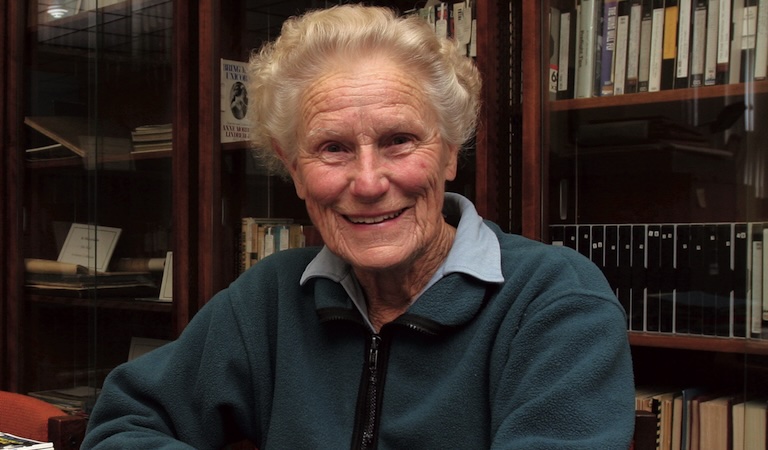
Memories of Iris, Page 5
« Return to obituary
Greg Goodknight ’77
Student, Aero I & II
I met Mrs. C at the Bates Open House for freshmen in 1972; I didn’t know if my myopia would preclude being in the program but I’d dreamt of flying for years and had to find out and was pleasantly suprised it didn’t bar me from the program or from flying ever since. Thank you, Mrs. C, for the gift of flight. And Mr. C and of course, Shirley Froyd, who all successfully kept me from killing myself or bending Cessna 42G.
After my wife Teri Cahill (Math ’78) passed away in 2000, after a time I had a chance to rekindle a relationship with a woman (from Pomona College) I had dated as an undergrad and I shared with her some of Mrs. C’s accomplishments… she rejected the story as implausible… no one could do all those things. Be all those people. At those levels.
Mrs. C could.
She will be missed. She is missed.
Beth Platt Garrow
HMC Family
Sending love to Sandy, Robin and their family. Iris and Critch were so much a part of the Platt family, and I have fond memories of them while growing up and again, later in life. Iris would email me after seeing me at an HMC event well after her 100th year and was always curious about what we were up to. Our last visit with her was in 2023 which lasted well over an hour. She was still swimming many laps in her pool, sharp as ever, and deeply proud of all the HMC students she taught over the years. Such an amazing life and one that was so giving and humble. We miss her!
Leticia Calderon
Ad admirer
I’m fairly new to HMC so I did not have the pleasure of meeting you. I was, however, amazed to read of your many accomplishments and the legacy you left behind. You paved the way for women like myself, the students at HMC, and the 7Cs. You make me proud to be a woman. May you rest in everlasting peace.
Josh Slater ’06
Student
I’ll never forget Iris. Though the Bates program had long ended by my time, she was there every step of the way through my aviation journey, from my first flight in 42G as a freshman, to my PPL checkride prep after college, and my most memorable flying experience of all with her, Mike Magras and several others on a California tour from POC all the way up to PML. What an adventure! I’ll always treasure the memories and a legacy she has instilled in me and so many others along the way. You will be missed, Iris.
Jon Jacobsen
Colleague
In fourth grade, my daughter became interested in Amelia Earhart. When I mentioned that Iris had known her, Reya immediately asked if she could interview Iris. They met and had an inspiring conversation—no surprise to anyone who knew Iris.
At the end of their chat, Iris turned to Reya and asked if she wanted to try flying. Reya’s face lit up with excitement. Within a week or two, I found myself in the back of Iris’s plane. We had spent a significant amount of time going through the pre-flight routine and safety checks, with Iris teaching Reya every step of the way. Once we were in the air, I assumed Iris would handle the flying and bring us back—how naive of me.
Once we were settled, Iris turned to Reya and said, “Okay, your turn.” And just like that, we were off. “Turn left,” she instructed, and the next thing I knew, Reya was at the controls, guiding the plane. Sitting in the back, I was in absolute awe—watching my daughter experience the thrill of flying and seeing Iris in her element, teaching and sharing her knowledge and passion. It was incredible.
This was just one small example of Iris’s remarkable generosity and willingness to share the joy of flight with others. I was fortunate to get to work with Iris over the years with the Aero Scholarship and other endeavors and will miss her dearly.
Madineh Sarvestani ’05
Iris made a huge impression on me, as a Freshman student trying to figure out my place in the world. She took me, and several other students, out on flights. She made flight, and other big feats, seem small and possible. I think about her often and I’m grateful I got to meet her. What a force.
Bruce Worster ’64
Iris’s passing is a watershed event in my estimation. She was an American treasure: Olympic athlete, pioneering aviator, patriot, parent, and teacher. Over the past 63 years, it has been my privilege to know her, learn from her, help her where I could, and to be counted as her friend. It was her passion to teach people to fly, and she excelled most profoundly in this, her chosen vocation.
I met Iris when the Bates Aeronautics program came to Harvey Mudd College in 1962. I managed to qualify for the program and Iris taught me to fly in 1962-64. Many years later, whenever I was flying, particularly solo, I would find myself listening to a voice in my head, reminding myself what I needed to do next, critiquing my execution, and evaluating the weather conditions ahead. It finally occurred to me that I was channeling Iris and she was with me whenever I flew.
In World War II, Iris flew for the Ferry Command, piloting some of America’s foremost fighter planes across the country, including the legendary P51. Around her 95th birthday, she had the opportunity to fly a tandem version of that aircraft. “I was able to manage it with no problem,” she said. “The controls were exactly the same as they were in 1944.” She then promptly put the hottest propeller aircraft ever built through an eight-point roll.
Iris was, of course, the last surviving member of the 1936 Olympic team and the American titleholder in the 200m breaststroke. Eight years ago, Susan and I celebrated our fiftieth wedding anniversary at the Biltmore Hotel in Santa Barbara, an elegant location which included an Olympic-sized beachside pool. Iris and Sandie were among the guests and our daughter Sara asked Iris if she had ever been to the location. “Oh yes”, Iris replied. “I defended my American title here in 1938!”
David Sonner ’80
Friend
Iris was a wonderful friend. I met her when I was a freshman at Mudd, almost half a century ago. I was interested in learning how to fly in the Bates program. At that time, I talked with her at length about that program, and she even took me on a flight, but in the end, I did not apply. That was because Mudd was very hard for me. I was surrounded by lots of brilliant high-achieving Mudders and I was worried that I was having a hard enough time measuring up in my regular Mudd classes without adding the extra work of learning how to fly.
Through that experience, though, I found a friend in Iris. We kept in touch, and over the years, we had lots of long conversations. In some of those conversations, Iris later chided me that, if I had joined the Bates program when I was a student, I would have found Mudd easier, not harder.
That was counterintuitive, but through many stories that she later told me, I came to understand why she was right. To share just one such story, Iris once explained to me that small mistakes are inevitable in the process of learning. Early on in the Bates program, in the 1960s, she and her husband Critch noticed that Mudd students tended to be especially anxious about their mistakes. It was easy for Mudders mistakenly to believe that other high-achieving Mudders were not making similar mistakes in the cockpit. Many worried they might not measure-up or belong.
To deal with that, Iris and Critch created Herman Glutz, a fictional First World War German pilot with a soft spot for student pilots. With good humor, Herman (usually played by Bruce Worster ’64 sporting a German accent) would present every Bates student with an award at the annual Glutz banquet making light of a small mistake, gently showing that everyone made mistakes and that everyone belonged. It was an important life lesson for Bates students. Those kinds of life lessons also helped with many other things at Mudd, and afterwards, in life.
Iris was a great teacher and created an extended family among her many students, myself included, even though I hadn’t joined the Bates program.
Iris had an extraordinary life, including as an athlete at the 1936 Olympics and as a ferry pilot during the Second World War. Unfortunately, sometimes some people would try to exploit her life story, which would hurt her. After Mudd, I became a lawyer, and as a result, I often had long conversations with her about some of the details of her life story. She wanted to talk about protecting her life story from exploitation. In those conversations, although I had known her for decades, I often learned new and amazing things about her past life, and the prominent people she knew. As is typical for many members of our Mudd community, she had been modest over the years.
The last time I saw Iris in person was at the Bates reception for Alumni Weekend in 2024. I drove her to that reception and saw her brighten up when she saw her extended family of former students and friends. Although she was 103 yeas old, her energy and memory were impressive.
The last time I talked with her was on the telephone on her 104th birthday on December 21, 2024, a little over a month ago. I am grateful that she was still mentally sharp on that call.
I was privileged to have Iris as a friend for almost half a century. She will live on in my memory.