Iris Cummings Critchell, instructor of aeronautics emerita at Harvey Mudd College, pioneering female pilot in the Women’s Auxiliary Ferrying Squadron (WAFS), Olympic athlete and beloved mentor to students, passed away Jan. 24, 2025, in Claremont, California. Critchell was 104.
Born Dec. 21, 1920, in Los Angeles, Critchell began swimming at an early age and continued to enjoy it into her 103rd year. Her father, a well-known coach, M.D. and event official, taught her not only swimming and personal growth, but sportsmanship and the underlying concepts of the Olympic games. Critchell began swimming in the Pacific Ocean as a very young girl and at age 11 attended the 1932 Olympics in Los Angeles as a spectator with her father. She went on to win the U.S. National Championship in the 200-meter breaststroke in 1936. This put her on the U.S. Olympic team in the 1936 Berlin Olympics and she remained national champion for three years. She was the last living U.S. survivor of the games. Critchell spent the rest of her life epitomizing the Olympic ideals and shared her experiences and enthusiasm with countless admirers.
Critchell began flying in 1939 at Mines Field (now LAX) in Piper J-2 Cub planes while a sophomore at University of Southern California. She completed private pilot and advanced acrobatic courses in Waco bi-planes in 1939 and 1940 on the first civil pilot training program at USC, where she graduated with a bachelor’s degree with a concentration in physical sciences and mathematics in 1941.
In 1941, she was an instructor for the civil pilot training program at Brackett Field in La Verne, California, and, in 1942, for the Navy Cadet program for Stockton Junior College in Carson City, Nevada. In December 1942, she reported to Houston for Army Air Corps training and was then assigned to the WAFS, which later became known as the Women Airforce Service Pilots (WASPs).
Until December 1944, she served as a civilian ferry pilot with the Army Air Corps, Air Transport Command, 6th Ferrying Group at Long Beach. During this time, Critchell ferried more than 25 types of military airplanes as pilot in command, including each of the WWII trainers, P-47 Thunderbolt, P-40 War Hawk, P-39 Air Cobra, C-47 Transport, B-25 Mitchell, A-20 Havoc, and the most advanced aircraft such as the P-38 Lightning, P-51 Mustang and P-61 (the Black Widow).
From 1946 to 1948 at the University of Southern California College of Aeronautics at Santa Maria, Critchell developed the curriculum, taught the classes for primary, instrument, commercial and instructor courses and gave all the instrument flight instruction in Vultee BT-13 trainers. Beginning in 1950, she flew in the All-Woman Transcontinental Air Race (Powder Puff Derby) 15 times and placed first in two races and in the top 10 seven times.
In 1961, Critchell and her longtime pilot husband, Howard (a.k.a. “Critch”), were asked by Isabel Bates to establish a special aero program for the Bates Foundation for Aeronautical Education. Iris developed this unique program to use the airplane as a tool for enhancing the education of young people in junior high, high school and college. In 1962, Iris and Critch launched the Bates Aeronautics Program at Harvey Mudd College.
“Iris loved Harvey Mudd College, and along with her husband, Critch, was instrumental in inspiring generations of our students to love aeronautics and to appreciate the privilege of flight,” said HMC President Harriet B. Nembhard. “One of my fondest memories is of a conversation I had with her when I first joined the Harvey Mudd family as president in 2023. During our talk, she shared that ‘Harvey Mudd is a special place. It is worthy of special endeavors.’”
“Iris undertook many special endeavors in her long and amazing life, and her words proved inspiring to me,” Nembhard said.
From 1962 to 1990, Critchell served as director of the Bates Foundation’s Aeronautics Program at Harvey Mudd as a faculty lecturer in aeronautics and as chief flight instructor for the flight-training phase of the program. More than just a tool for enhancing science education, the program taught student pilots what Critchell called “the privilege of flight,” leadership, responsibility and self-reliance amid the demanding conditions of an airplane cockpit. The more than 250 Harvey Mudd alumni who participated in the Bates Program while students at Harvey Mudd now include many distinguished scientists, aero engineers, aerospace researchers and two astronauts, as well as other successful business leaders and entrepreneurs.
Bruce Worster ’64, a Bates alumnus, physicist and entrepreneur described her as a remarkable member of the aviation community whose energy and achievements amazed everyone.
After retirement, as a faculty emerita, Critchell taught aeronautics for six more semesters at Harvey Mudd and continued to assist with student aero projects and advise members of the Barnstormers student club. She also served as curator of the Aeronautical Library Special Collection at the College.
In 2015, in honor of her 76 years of contributions to the aviation community, Critchell was inducted into the California Aviation Hall of Fame at the Museum of Flying in Long Beach. She joined the ranks of inductees who shaped the growth of the aviation and aerospace industry in California.
The following year, the Harvey Mudd College Alumni Association awarded its second Van Hecke Prize to Critchell, who had received an Honorary Alumnus distinction in 1990 and a Lifetime Achievement award in 2007. Considered the highest honor given by the alumni association, the Van Hecke Prize is reserved for alumni who are synonymous with an extraordinary level of support for and commitment to the College, its students, its alumni and its mission.
Critchell’s other many honors include:
Ontario (CA) FAA District, Flight Instructor of the Year, 1972
National Association of Flight Instructors Hall of Fame, Oshkosh, Wisconsin, 2000
Wright Brothers Master Pilot Award, Federal Aviation Administration, 2006
Women in Aviation International Pioneer Hall of Fame, 2007
Honoree, USAF Air University Gathering of Eagles at Maxwell Field, 2008
Nile Gold Medal for contributions to aerospace education, Fédération Aéronautique Internationale, 2008
Honoree, Flight Path Learning Center Museum at LAX, 2013
Reflecting on her career at Harvey Mudd, Critchell once said, “I loved the opportunity to bring stories of sharing the privilege of flight with each generation of students and to follow their aero, space and life accomplishments.”
Critchell was preceded in death by her husband, Howard “Critch” Critchell. She is survived by a daughter, Sandie Clary SCR ’74, a son, Robin Critchell, three grandchildren and eight great-grandchildren.
The family requests that in lieu of flowers, gifts in honor of Iris Critchell may be made to Harvey Mudd College, Office of College Advancement, 301 Platt Blvd., Claremont, CA, 91711.
Memories of Iris
Steven C. Runo ’78
Grateful Bates student(Aero I &II)
Chris Miller and fIew with Mrs.C in a Bates plane to nearby Riverside airport for her
“check ride” to rent a Cessna 310 twin for HMC atmospheric sampling project over the Pacific Ocean. The aspiring airline pilot(confidentally building his flight hours) assigned to determine if Mrs.C was sufficiently qualifed to fly the 310 proudly gave the two Bates students a brief description of his aeronautical achievements while Mrs. did the walk-around checkout of the 310. Soon,he got in the right (passenger) side of the airplane and Mrs. C taxied out and took off, while we waited by a nearby hangar. Shortly, the airplane landed and taxied back to the same spot it had just departed from. When the engines were shut down, the check ride pilot spring from the plane and jogged over to us. He excitedly asked, “Who is that woman!?This was my first check-ride where I just sat back and watched in awe. I have never seen anyone handle an airplane that cooly and that well! I We just smiled and told him Mrs. C was headed up th Bates Aeronautics program Harvey Mudd Vollege in Claremont, and that we thoughtthe the FAA had occassionally sought her advice on flight training.
The check ride pilot noted,”i should not wonder and somewhat dejectedly wandered back to the rental office to finish the checkride paperwork and we heard him say to himself, “I hope I can fly that well someday.”
Within days, Mrs. C. was piloting the 310 over the Pacific at precise altitudes, as the onboard team took air quality samples.
Dan and Momi Ince
Long time family friends
My mother grew up with Iris in Redondo Beach and remained friends until my mother passed. As a young person, Iris’ mother became my surrogate grandmother and I used to spend many hours talking and listening to her. When I graduated from Redondo High, Iris and her mother gave me several hours of initial flight time as a graduation gift. One of the highlights of my flight time after I got my pilot’s license was flying Mrs. Cummings to Brackett Field to have lunch with Iris and then flying her back to Torrance. Over the years, our family were present for various celebrations where Iris was honored.
Connor Leeming
Student at the University of Southern California
While working on a school history project in the fall of 2023, I looked Mrs. Critchell up in the phone book and decided to call, not expecting an answer. To my surprise, she picked up! With her daughter Sandie by her side, she warmly offered guidance and shared her extraordinary experiences.
Even in our limited correspondence, her kindness, intellect, and unwavering passion for aviation and education were abundantly clear. Iris lived a remarkable life and also had a quiet generosity, like answering a call from a curious student at the age of 103 and emailing me afterward to see what else she could help with. She radiated energy and optimism, like so many of her fellow Greatest Generation veterans.
My heartfelt condolences to her family. I know she was 104, but some people just feel like they’ll always be with us. Thank you, Iris, for touching the lives of so many, including mine.
Charles Horton ’73
She and Howard taught me to fly,.
The Critchells, Howard and Iris, taught me to fly so very long ago.
They can never be replaced.
Dennis Rich ’66
Aero 63-64 and Very Appreciative Friend
Iris Critchell will be missed by so very, many people. I have known Iris for 63 years. Over that time, Iris was the most important positive influence in my life. She was, of course, my instructor in Bates and taught me how to fly. But she was so much more than my instructor. She was a teacher, counselor, confidante, mentor, fellow flight instructor, peer and, most of all, a very dear friend. I would like to share some of my meaningful history with Iris.
I enjoyed many special opportunities with Iris and the Bates community. I sincerely appreciate the fact that I learned I could pretty much do whatever I wanted to if I just set my mind to it. Thank you Iris (and Critch)!
The summer before I went to Harvey Mudd, I received a letter stating that an Aero Program was starting at HMC, asking if I was interested. I had only flown once in my hometown of Denver. That day, my friend Jim was being instructed by his Dad, a United Airlines Captain, in their Cessna. Jim landed at a little airport and pulled off the runway. His Dad and I got out and off went Jim on his first solo! I was hooked! However, I naively thought I would have to become an aeronautical engineer to fly, and I frankly didn’t know what I wanted to do in life, so I passed on the opportunity.
As a freshman, my good friend Mert Canady was a first year Bates student. I remember spending hours in dorm rooms listening to stories from him (and other Batesers) about learning to fly with his instructor, Critch, with Iris giving Stage Checks. All their stories about flight and learning stuck, and I applied in the spring, hoping that I would be accepted. I was! Iris invited me to attend the first Herman Glutz award banquet at her house on Miramar. I had never laughed so hard in my life and could hardly wait until the next year started.
Other Batesers have talked about their experiences of learning to fly. Iris was my instructor and Critch gave me Stage Checks. What I now know and appreciate was how much flying would mean to me throughout my life. It is SO true what Iris has eloquently written: There is a “Privilege of Flight.”
One training moment stands out. On the first day of our Bates team Cross Country around California, I flew the last leg and landed our “small” 172 on the main runway at SFO! Thrilled beyond description, I could hardly believe what I had done.
After passing my Private flight test with Iris, I rented the Bates planes and flew flights with other students before going home to Denver. There, I rented 172s and flew friends and family. It helped to have 3 more people to share costs! I also convinced 3 friends to consider going on a flight from Denver to NYC for the ‘64 World’s Fair. My parents weren’t sure I could manage such an endeavor, so I suggested we call Iris and see what she thought. Iris told my parents that I could most certainly do such a trip and, with planning, be safe. Off we went on Aug 30 for an 11 day trip. Along the way of that 24 leg flight, I could sense Iris with her all-knowing smile on my right, asking myself what she would have me doing to be safe. I LOVED flying and wanted more!
Other Batesers have mentioned the yellow Piper J-3 Cub that the Critchells bought themselves in the fall of ‘64 to augment the program with further training and to build flight time. The cost was only $3/hr including gas! Flights with Iris that fall were both Aero 2 instrument work and teaching me to fly the Cub. What fun!!
One Cub flight is noteworthy. During winter break in Jan 65, Marcus Bryan and I hoped we could team fly to Phoenix. Checking with Iris, we got the OK. That flight was fun, and we wanted to go on to Albuquerque. A call to Iris and a mutual check of the weather got her OK. We had to RON in Socorro, but made it the next day. Again, we called Iris and she had checked the weather ahead of us, agreeing it was OK to go to Denver. After a day with my folks, we called Iris and asked to go back over Wyoming west bound. This request resulted in a firm “NO!: fly back how you came.” Her years of ferrying military planes gave her a lot of experience with Wyoming winds and she knew a CUB in big winds was NOT a good idea. So back we went. A great mentor to have; we BOTH LOVED flying!
By that spring, I had flown over 200 hours. I had long conversations with Iris well into some evenings about working on more advanced ratings. (I did learn that I had to eventually be “rude” and tell her I had to leave to do school work but that never bothered her!) Iris gave me lots of advice, importantly to keep my grades up, and agreed to instruct me for my Commercial and Instrument ratings. Iris told me I could take both FAA check rides in one flight. I was quite worried but did just fine, visualizing her to my right with a wry smile and prodding me to always keep ahead of the airplane. Boy, I LOVED flying!
Back for my senior year in ‘65, I worked several hours with Iris on getting my Flight Instructors rating in the Cub. In November, I passed the CFI test with the FAA. During all this time, I comfortably began addressing Mrs. C as Iris, now my close friend and fellow instructor. I was now primed to LOVE both flying AND instructing.
Then, as a fellow instructor, Iris asked me train fellow Bates students in the Cub. Also, a Scripps student, Eileen Schock (Laspa), had been attending Bates ground school. Iris asked me if I would like to teach her how to fly as a Bates Program student. What an opportunity! Starting in a Cessna 150 and then the 172s, Eileen passed her private test with Iris by mid-June. I LOVED teaching.
Toward the end of my senior year, Iris helped me in getting my CFI-I Instrument rating. About this same time, Iris approached me with the fact that she and HMC had been asked to help start the Cal Tech flying club adhering to Bates standards. She needed help with the instructing. Since I was going to UCLA for grad school, I could be local for the summer and available in the fall. What a great opportunity again! I knew that I LOVED teaching and flying, and said yes.
The club had purchased a Cessna 150 and based it at Brackett. In mid-May, Iris and I began teaching many Tech students to learn to fly. After HMC graduation, Iris invited me to live at the Critchell home until the fall. I was treated as a member of their family. I remember getting to know Sandie and Robin and enjoyed playing every day with their Irish Setter, Kilkee. Iris cooked most dinners which were great, with the caveat that I got tired of eating squash almost every day! That summer and into the fall, I taught about 10 students to fly with Iris doing most Stage checks and their Private exams.
It was a pleasure to continue to work with her after finishing HMC. Over the next few years, she frequently invited me to help in teaching Bates students especially on team cross country flights and with night instrument training until I moved to Denver in 1974. I could go on and on about what a wonderful person Iris was and what she meant to me.
During the many years after I left CA, I would often fly out to HMC in my Bonanza (one year 7 times) to work with Iris, Critch and many others on continuing the Bates Program under the umbrella of the Bates Foundation. Financing the program and getting additional instructors, especially after Critch retired, took efforts by many people, notably Joe Platt. At one point, Iris encouraged me to take on the role of President of the Bates Foundation. I was happy to do that, but it should be noted that Iris herself would create the detailed agenda, and I would really be following her lead. I am proud that we were able to keep the Bates Program at HMC going for 28 years until 1990!
You all know Iris wasn’t done teaching starting with the Barnstormers and taking the aviation library under her wing. This great extended span of time benefited so many Harvey Mudders! Throughout those later years, it was my pleasure to help Iris with many of the Bates Reunions to, as Iris would say, help grads “keep in touch.” I also enjoyed dropping by to see Critch and Iris or calling Iris on many occasions to do just that! My most recent visit was last October. After that, I began sending pictures to Iris every few days from a trip my wife and I had taken to Iceland and Norway, as Iris and Critch had enjoyed 2 trips to Norway in retirement. This gave her something to look forward to daily, and she enjoyed that!
Iris, who lived a fabulous, very eventful life, deserves to be a human long remembered. To me, Iris was very, very special and a huge light in my life. My heart goes out to those that were closest to her and loved her. Let’s celebrate the life of Iris Critchell!
She will be missed.
Walt Foley ’69
Appreciative student
So many wonderful memories of Iris and the Bates program!
They began on my first day as an entering freshman when being interviewed for a slot in the Aero I class. Don’t recall if it was Iris, Critch, Gen. Marriott or Ed Musselman who asked me if I knew what made an airplane fly but a nervous, hopeful future pilot fumbled for an answer. Was it the propeller, the engine, the Bernoulli airflow over the wing or the 100LL in the tanks? Whatever I came up with must have convinced the interview team that I was a curious and worthy candidate for the program. Thus began a sixty-year growing experience that reflected everything Isabel Bates and the Critchells hoped to instill in young aspiring engineers and scientists through the “privilege of flight”.
The Bates program did indeed produce several astronauts and a few commercial pilots. The true impact, however, is how Iris and Critch, with their love and commitment over the many years to more than two hundred young Batesers, were able to employ the airplane as the instrument which ultimately enabled our personal and professional growth in the years after HMC. Although my real-world experiences after HMC were in entrepreneurial technical endeavors, the thrill and challenge of flight never faded. When preparation and good fortune met many years later in the form of an opportunity to command Gulfstream’s fastest and longest-range jet, I came to realize how significant Iris’ confidence in her young student pilots was. Returning from Asia at 45,000 feet in the middle of the night, above the weather across the vast Pacific many hours from land, I came to truly appreciate the intersection of a strong HMC technical education, a career in technology, the need to be conversant with the tools and procedures of the worldwide aviation environment, all with a commitment to meeting a corporate exec’s travel needs and a demanding schedule. This was the Bates vision realized for me. Iris made it possible and was always up there with me.
Thank you, Iris and Critch, for the many memories and for being such a significant influence in my life.
Charles Griffiths
Friend
Iris was a devoted supporter of the Claremont-Mudd-Scripps swimming and diving team. We named our women’s team’s most inspirational team member recognition the “Iris Critchell Award” in 2005. For many years, Iris would come to the team’s year-end banquet wearing her 1936 US Olympic Team jacket and help present the award. Iris would spend time getting to know the award winner, sharing her many Olympic stories. Iris’s accomplishments, energy, and engagement will continue to inspire us.
Karen Ford
Family friend
We are so grateful to have enjoyed a wonderful, lifelong and multi-generational friendship with Iris and her family. As a child, I thought of Mrs. Critchell as just another of my parents’ many good friends; it wasn’t until I grew older that it began to dawn on me what a remarkable person she was.
Iris and my dad (Paul Ford) were born within 10 days of each other in December of 1920, and met as young children growing up right on Redondo Beach. I’ve often heard stories of their running through the alleys and sand dunes to visit each other. I’m sure Iris wouldn’t mind if I shared these excerpts from an email I received from her in 2023:
Our growing-up years were so special and different from today’s settings! I remember that my parents Serena and “Doc” cultivated in me a wondrous appreciation for where we lived and the opportunities to make friends with a family like the Fords! My mother enjoyed many visits and conversations with Paul and Herbert’s mother. Paul and I went to the same elementary school just 3 blocks from their home! We lived only about 5 blocks apart and there were mostly empty lots and sand dunes in between their home on Avenue “C” and our house, which was alone on the sand dunes on Avenue “I”! Those were still the days of the wide-open spaces of sand dunes and very few houses south of Redondo Beach!
Happily, the friendship between Iris and Paul continued beyond their shared childhood and endured through all of life’s twists and turns: high school, the 1936 Olympics, World War II, several moves, and growing families. Over the years, we enjoyed many phone calls and visits, despite living two states apart! Memorable family vacations together include a chartered boat trip through the scenic San Juan Islands, during which Mrs. Critchell was the only one who kept her sea legs through a very rough stretch. I remember her being a great comfort to 12-year-old me, holding my shoulders as I heaved over the railing! Another vacation took place on the lush island of Kauai in 1980, staying at another friend’s beach house (long before the days of Airbnb!). I remember Mrs. Critchell was the most energetic of us all, squeezing in as much snorkeling, wind-surfing, hiking and (of course) swimming as she could! After they retired, my parents did a lot of worldwide traveling with the Critchells; these excursions quite often involved boats (and unsurprisingly!) small planes.
My husband Alan and I are grateful to have had a wonderful visit with Iris and her daughter Sandie in January of 2022, during which we shared many stories, photos, and family reminiscences. At the time, Iris was still swimming daily and walking quite easily, though she had just turned 101! We feel blessed to have had that last visit with this amazing woman.
Iris closed her 2023 email with these thought-provoking words:
Doesn’t it seem to you that a lot of fundamentals of life have changed? I look back and realize I lived through at least four periods of major changes in humanities! I am deeply concerned and sure hope you will live to see some good changes for the re-inspiration of mankind!
Wise words . . . and I hope she’s right!
Very fondly,
Karen Ford and Alan Potter
John Shockley ’82
Bates Student Aero I and II, co-founder Bates Bay Area Flyers
I see Iris’ photo and am reminded that she simply defied time. So many things have been written about her amazing accomplishments and life, as the last surviving member of the 1936 Olympics, a Ferry Command pilot, the founder with Critch of the Bates Program, and a world renown flight instructor. Each of these individually qualifies her as a legend.
For me, she was my teacher, and, for one year, my landlord. In my freshman year, I first learned of the Bates Program. That spring, 1979, I was extremely fortunate to have been selected to join Aero I in the fall. Before I learned that I had been accepted, however, my roommate, Dean Carson, and I learned that we had been accepted as tenants for that year in the Critchell apartment. Batesers we had met, said, “I guess you’re in.”
In the fall of 1979, Iris was my primary instructor. Much of what I have read here brings back so many memories. Like so many others, she didn’t just teach us how to fly, but in the true spirit of the Bates Program, she taught us how to live. Flying is a privilege; respect it. We’re not perfect; learn from it. We are a sort of family; we’re not only connected by a crazy desire to go into the air. I came to realize that, as a teacher, Iris had a way of caring deeply for all of her students, and that caring never ended. It also instilled a loyalty to her, Critch, and the program long into the future. As soon as I started working and had my own (one-bedroom) apartment, the first thing I wanted to do was host a Bateser during the spring cross-country to the Bay Area. Once Cris and I had a house, we could host more than one, and we did!
When the Bates Program ended in 1990, five Bates Alums (Dennis Holeman, Rob Johnson, Tom Norris, Clay Ross, and I) formed the Bates Bay Area Flyers (BBAF) and bought 7262Q, the blue C-172, from the Bates Program. It started when two of us, Rob and I, were invited by Iris to come down to Claremont with the thought that we would spend many days at the Critchell Motel and see if we could even remember how to fly again. Little did we realize; Iris had other plans (as usual, she knew best).
She put us through an intensive recurrency course, complete with ground instruction, evening homework, and at least a few flights each every day. It was total, round-the-clock immersion as only Iris could provide. The day before we were due to return home, we learned of Iris’ true intent when she asked, “Well, you’re taking 62Q home with you aren’t you?” We flew it back to Hayward, where we were greeted by the others with a combination of giddy excitement and the thought, “We have an airplane!?!?”
62Q lived at Hayward for 30 years. Over that time, as members’ lives changed, the partnership members evolved to include other Bates alumni and friends, including Jeff Mitchell, Alan Bruno, and Fred Ziegler. During this time, we limited partners to the Bates family because we knew that every partner would have the same love, respect, and standards for flying that we did. We managed to get 62Q back home many times during the annual Bates Fly-ins, get-togethers, a photo-op with Iris in 42G and Clay in 62Q that hangs in the aviation room, and various Alumni Days (including one in which Cris and I flew down and needed Iris, who volunteered with a bum ankle, to bail us out flying IFR through the clouds to Apple Valley so we could get home. Good thing they didn’t give Glutz Alumni awards!) After 30 years, I had the task of ferrying it to Carson City to its new home with George Clary, another Bates Alum. With his recent untimely passing, 62Q is now back in southern California with Barb Filkins—still in the “family.”
In addition to all of this, Iris has meant a lot to me over the years. When our daughters were touring colleges, we went to Claremont, and there she was, always happy to meet us and talk with the kids. I am so grateful that they were able to meet with her. She spent a memorable lunch with our youngest talking about our daughter’s interests in engineering and competitive collegiate soccer—right up Iris’ alley. In July 2023, Cris and I arranged to meet with Iris at her home. At 102, Iris was still very active and giving advice but seemed particularly frustrated that her pool heater wasn’t working so she hadn’t been able to swim every day.
More recently, Iris entered my life in a most unexpected way. Five years ago, after a 35-yr engineering career, I found myself taking over 5 AP Physics classes at a local high school from a teacher who had unexpectedly passed away. Having never taught and now having to teach something I hadn’t really used in 40 years, I found myself instinctively going back to my Bates training and realized this kind of teaching was a lot like what I learned in the program: One had to be completely prepared before EVERY lesson (flight). (These were all very smart kids; they will keep you honest.) Though one had to be prepared, preparation was no guarantee of success; lack of preparation, however, was certain failure. The key overall was to develop a sense of caring and mutual respect for the people and the subject so that when things didn’t go perfectly well, the result was understanding, learning, and growing.
Before long, I realized I was trying to treat my students the way I felt Iris had treated us. She understood that we were all smart but were also going through a very tough curriculum at Mudd. (Nearly all of my students take 6 AP courses simultaneously and are under huge peer and parental pressure to get in to the “right” college.) We demanded a lot of ourselves, but she knew the bigger picture, and, most importantly, she knew how to get us through our current challenges. (Having worked as an engineer, I know what my students aspire to do and how I can help them get there.) Mostly, though, she showed how she cared for every one of us—something I aspire to do today.
Like she has done with so many of her students, Iris’ lessons are ingrained in me whenever I fly. What I realize now is that her lessons are also ingrained in me as a teacher.
Ken Lehmer ’81
Bates Program graduate
I first learned about the Bates Aeronautics program shortly after starting my freshman year at HMC in 1977. I eagerly attended an introductory flight they offered to incoming students and was quickly hooked on the experience. I hadn’t even met a pilot prior to that so the concept of flying yourself in a small aircraft was completely new to me. My father was a civil structural engineer so I grew up around large building job sites and my plans after graduating from HMC was to follow in his footsteps. Fortunately I was lucky enough to be accepted into the Bates program beginning my junior year and by graduation I new I wanted to work in my new passion of aviation. I ended up working at Northrop Grumman my entire career as an aircraft structures engineer (yup, still liking solid load paths). Iris Critchell and the Bates program were responsible for steering me towards a profession I loved.
I have continued to fly ever since. My wife and I met through mutual friends at our local airport and have enjoyed raising our two wonderful children in and around aviation. They were lucky enough to have known Iris personally and received a huge smile and hug upon each greeting from her.
Iris made sure that her students understood the importance of flying safely and responsibly and that being able to fly was not a right but a privilege. It has kept me safe and humble for over 40 years. I and my family owe so much to her. She will remain forever in our hearts and fond memories.
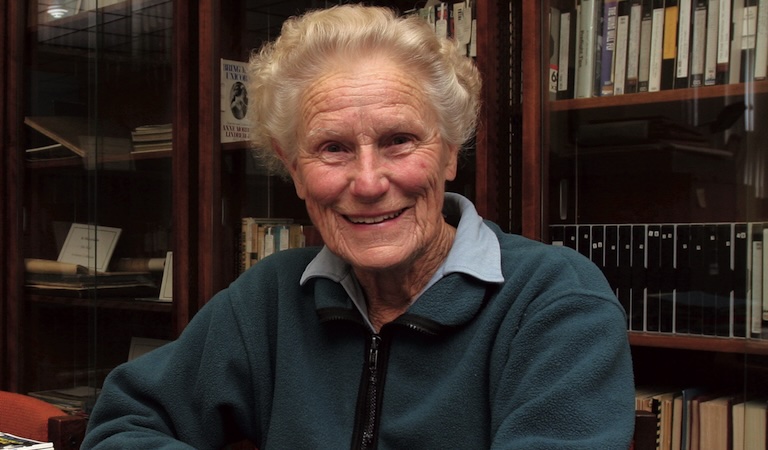
Iris Cummings Critchell, instructor of aeronautics emerita at Harvey Mudd College, pioneering female pilot in the Women’s Auxiliary Ferrying Squadron (WAFS), Olympic athlete and beloved mentor to students, passed away Jan. 24, 2025, in Claremont, California. Critchell was 104.
Born Dec. 21, 1920, in Los Angeles, Critchell began swimming at an early age and continued to enjoy it into her 103rd year. Her father, a well-known coach, M.D. and event official, taught her not only swimming and personal growth, but sportsmanship and the underlying concepts of the Olympic games. Critchell began swimming in the Pacific Ocean as a very young girl and at age 11 attended the 1932 Olympics in Los Angeles as a spectator with her father. She went on to win the U.S. National Championship in the 200-meter breaststroke in 1936. This put her on the U.S. Olympic team in the 1936 Berlin Olympics and she remained national champion for three years. She was the last living U.S. survivor of the games. Critchell spent the rest of her life epitomizing the Olympic ideals and shared her experiences and enthusiasm with countless admirers.
Critchell began flying in 1939 at Mines Field (now LAX) in Piper J-2 Cub planes while a sophomore at University of Southern California. She completed private pilot and advanced acrobatic courses in Waco bi-planes in 1939 and 1940 on the first civil pilot training program at USC, where she graduated with a bachelor’s degree with a concentration in physical sciences and mathematics in 1941.
In 1941, she was an instructor for the civil pilot training program at Brackett Field in La Verne, California, and, in 1942, for the Navy Cadet program for Stockton Junior College in Carson City, Nevada. In December 1942, she reported to Houston for Army Air Corps training and was then assigned to the WAFS, which later became known as the Women Airforce Service Pilots (WASPs).
Until December 1944, she served as a civilian ferry pilot with the Army Air Corps, Air Transport Command, 6th Ferrying Group at Long Beach. During this time, Critchell ferried more than 25 types of military airplanes as pilot in command, including each of the WWII trainers, P-47 Thunderbolt, P-40 War Hawk, P-39 Air Cobra, C-47 Transport, B-25 Mitchell, A-20 Havoc, and the most advanced aircraft such as the P-38 Lightning, P-51 Mustang and P-61 (the Black Widow).
From 1946 to 1948 at the University of Southern California College of Aeronautics at Santa Maria, Critchell developed the curriculum, taught the classes for primary, instrument, commercial and instructor courses and gave all the instrument flight instruction in Vultee BT-13 trainers. Beginning in 1950, she flew in the All-Woman Transcontinental Air Race (Powder Puff Derby) 15 times and placed first in two races and in the top 10 seven times.
In 1961, Critchell and her longtime pilot husband, Howard (a.k.a. “Critch”), were asked by Isabel Bates to establish a special aero program for the Bates Foundation for Aeronautical Education. Iris developed this unique program to use the airplane as a tool for enhancing the education of young people in junior high, high school and college. In 1962, Iris and Critch launched the Bates Aeronautics Program at Harvey Mudd College.
“Iris loved Harvey Mudd College, and along with her husband, Critch, was instrumental in inspiring generations of our students to love aeronautics and to appreciate the privilege of flight,” said HMC President Harriet B. Nembhard. “One of my fondest memories is of a conversation I had with her when I first joined the Harvey Mudd family as president in 2023. During our talk, she shared that ‘Harvey Mudd is a special place. It is worthy of special endeavors.’”
“Iris undertook many special endeavors in her long and amazing life, and her words proved inspiring to me,” Nembhard said.
From 1962 to 1990, Critchell served as director of the Bates Foundation’s Aeronautics Program at Harvey Mudd as a faculty lecturer in aeronautics and as chief flight instructor for the flight-training phase of the program. More than just a tool for enhancing science education, the program taught student pilots what Critchell called “the privilege of flight,” leadership, responsibility and self-reliance amid the demanding conditions of an airplane cockpit. The more than 250 Harvey Mudd alumni who participated in the Bates Program while students at Harvey Mudd now include many distinguished scientists, aero engineers, aerospace researchers and two astronauts, as well as other successful business leaders and entrepreneurs.
Bruce Worster ’64, a Bates alumnus, physicist and entrepreneur described her as a remarkable member of the aviation community whose energy and achievements amazed everyone.
After retirement, as a faculty emerita, Critchell taught aeronautics for six more semesters at Harvey Mudd and continued to assist with student aero projects and advise members of the Barnstormers student club. She also served as curator of the Aeronautical Library Special Collection at the College.
In 2015, in honor of her 76 years of contributions to the aviation community, Critchell was inducted into the California Aviation Hall of Fame at the Museum of Flying in Long Beach. She joined the ranks of inductees who shaped the growth of the aviation and aerospace industry in California.
The following year, the Harvey Mudd College Alumni Association awarded its second Van Hecke Prize to Critchell, who had received an Honorary Alumnus distinction in 1990 and a Lifetime Achievement award in 2007. Considered the highest honor given by the alumni association, the Van Hecke Prize is reserved for alumni who are synonymous with an extraordinary level of support for and commitment to the College, its students, its alumni and its mission.
Critchell’s other many honors include:
Reflecting on her career at Harvey Mudd, Critchell once said, “I loved the opportunity to bring stories of sharing the privilege of flight with each generation of students and to follow their aero, space and life accomplishments.”
Critchell was preceded in death by her husband, Howard “Critch” Critchell. She is survived by a daughter, Sandie Clary SCR ’74, a son, Robin Critchell, three grandchildren and eight great-grandchildren.
The family requests that in lieu of flowers, gifts in honor of Iris Critchell may be made to Harvey Mudd College, Office of College Advancement, 301 Platt Blvd., Claremont, CA, 91711.
Memories of Iris
Steven C. Runo ’78
Grateful Bates student(Aero I &II)
Chris Miller and fIew with Mrs.C in a Bates plane to nearby Riverside airport for her
“check ride” to rent a Cessna 310 twin for HMC atmospheric sampling project over the Pacific Ocean. The aspiring airline pilot(confidentally building his flight hours) assigned to determine if Mrs.C was sufficiently qualifed to fly the 310 proudly gave the two Bates students a brief description of his aeronautical achievements while Mrs. did the walk-around checkout of the 310. Soon,he got in the right (passenger) side of the airplane and Mrs. C taxied out and took off, while we waited by a nearby hangar. Shortly, the airplane landed and taxied back to the same spot it had just departed from. When the engines were shut down, the check ride pilot spring from the plane and jogged over to us. He excitedly asked, “Who is that woman!?This was my first check-ride where I just sat back and watched in awe. I have never seen anyone handle an airplane that cooly and that well! I We just smiled and told him Mrs. C was headed up th Bates Aeronautics program Harvey Mudd Vollege in Claremont, and that we thoughtthe the FAA had occassionally sought her advice on flight training.
The check ride pilot noted,”i should not wonder and somewhat dejectedly wandered back to the rental office to finish the checkride paperwork and we heard him say to himself, “I hope I can fly that well someday.”
Within days, Mrs. C. was piloting the 310 over the Pacific at precise altitudes, as the onboard team took air quality samples.
Dan and Momi Ince
Long time family friends
My mother grew up with Iris in Redondo Beach and remained friends until my mother passed. As a young person, Iris’ mother became my surrogate grandmother and I used to spend many hours talking and listening to her. When I graduated from Redondo High, Iris and her mother gave me several hours of initial flight time as a graduation gift. One of the highlights of my flight time after I got my pilot’s license was flying Mrs. Cummings to Brackett Field to have lunch with Iris and then flying her back to Torrance. Over the years, our family were present for various celebrations where Iris was honored.
Connor Leeming
Student at the University of Southern California
While working on a school history project in the fall of 2023, I looked Mrs. Critchell up in the phone book and decided to call, not expecting an answer. To my surprise, she picked up! With her daughter Sandie by her side, she warmly offered guidance and shared her extraordinary experiences.
Even in our limited correspondence, her kindness, intellect, and unwavering passion for aviation and education were abundantly clear. Iris lived a remarkable life and also had a quiet generosity, like answering a call from a curious student at the age of 103 and emailing me afterward to see what else she could help with. She radiated energy and optimism, like so many of her fellow Greatest Generation veterans.
My heartfelt condolences to her family. I know she was 104, but some people just feel like they’ll always be with us. Thank you, Iris, for touching the lives of so many, including mine.
Charles Horton ’73
She and Howard taught me to fly,.
The Critchells, Howard and Iris, taught me to fly so very long ago.
They can never be replaced.
Dennis Rich ’66
Aero 63-64 and Very Appreciative Friend
Iris Critchell will be missed by so very, many people. I have known Iris for 63 years. Over that time, Iris was the most important positive influence in my life. She was, of course, my instructor in Bates and taught me how to fly. But she was so much more than my instructor. She was a teacher, counselor, confidante, mentor, fellow flight instructor, peer and, most of all, a very dear friend. I would like to share some of my meaningful history with Iris.
I enjoyed many special opportunities with Iris and the Bates community. I sincerely appreciate the fact that I learned I could pretty much do whatever I wanted to if I just set my mind to it. Thank you Iris (and Critch)!
The summer before I went to Harvey Mudd, I received a letter stating that an Aero Program was starting at HMC, asking if I was interested. I had only flown once in my hometown of Denver. That day, my friend Jim was being instructed by his Dad, a United Airlines Captain, in their Cessna. Jim landed at a little airport and pulled off the runway. His Dad and I got out and off went Jim on his first solo! I was hooked! However, I naively thought I would have to become an aeronautical engineer to fly, and I frankly didn’t know what I wanted to do in life, so I passed on the opportunity.
As a freshman, my good friend Mert Canady was a first year Bates student. I remember spending hours in dorm rooms listening to stories from him (and other Batesers) about learning to fly with his instructor, Critch, with Iris giving Stage Checks. All their stories about flight and learning stuck, and I applied in the spring, hoping that I would be accepted. I was! Iris invited me to attend the first Herman Glutz award banquet at her house on Miramar. I had never laughed so hard in my life and could hardly wait until the next year started.
Other Batesers have talked about their experiences of learning to fly. Iris was my instructor and Critch gave me Stage Checks. What I now know and appreciate was how much flying would mean to me throughout my life. It is SO true what Iris has eloquently written: There is a “Privilege of Flight.”
One training moment stands out. On the first day of our Bates team Cross Country around California, I flew the last leg and landed our “small” 172 on the main runway at SFO! Thrilled beyond description, I could hardly believe what I had done.
After passing my Private flight test with Iris, I rented the Bates planes and flew flights with other students before going home to Denver. There, I rented 172s and flew friends and family. It helped to have 3 more people to share costs! I also convinced 3 friends to consider going on a flight from Denver to NYC for the ‘64 World’s Fair. My parents weren’t sure I could manage such an endeavor, so I suggested we call Iris and see what she thought. Iris told my parents that I could most certainly do such a trip and, with planning, be safe. Off we went on Aug 30 for an 11 day trip. Along the way of that 24 leg flight, I could sense Iris with her all-knowing smile on my right, asking myself what she would have me doing to be safe. I LOVED flying and wanted more!
Other Batesers have mentioned the yellow Piper J-3 Cub that the Critchells bought themselves in the fall of ‘64 to augment the program with further training and to build flight time. The cost was only $3/hr including gas! Flights with Iris that fall were both Aero 2 instrument work and teaching me to fly the Cub. What fun!!
One Cub flight is noteworthy. During winter break in Jan 65, Marcus Bryan and I hoped we could team fly to Phoenix. Checking with Iris, we got the OK. That flight was fun, and we wanted to go on to Albuquerque. A call to Iris and a mutual check of the weather got her OK. We had to RON in Socorro, but made it the next day. Again, we called Iris and she had checked the weather ahead of us, agreeing it was OK to go to Denver. After a day with my folks, we called Iris and asked to go back over Wyoming west bound. This request resulted in a firm “NO!: fly back how you came.” Her years of ferrying military planes gave her a lot of experience with Wyoming winds and she knew a CUB in big winds was NOT a good idea. So back we went. A great mentor to have; we BOTH LOVED flying!
By that spring, I had flown over 200 hours. I had long conversations with Iris well into some evenings about working on more advanced ratings. (I did learn that I had to eventually be “rude” and tell her I had to leave to do school work but that never bothered her!) Iris gave me lots of advice, importantly to keep my grades up, and agreed to instruct me for my Commercial and Instrument ratings. Iris told me I could take both FAA check rides in one flight. I was quite worried but did just fine, visualizing her to my right with a wry smile and prodding me to always keep ahead of the airplane. Boy, I LOVED flying!
Back for my senior year in ‘65, I worked several hours with Iris on getting my Flight Instructors rating in the Cub. In November, I passed the CFI test with the FAA. During all this time, I comfortably began addressing Mrs. C as Iris, now my close friend and fellow instructor. I was now primed to LOVE both flying AND instructing.
Then, as a fellow instructor, Iris asked me train fellow Bates students in the Cub. Also, a Scripps student, Eileen Schock (Laspa), had been attending Bates ground school. Iris asked me if I would like to teach her how to fly as a Bates Program student. What an opportunity! Starting in a Cessna 150 and then the 172s, Eileen passed her private test with Iris by mid-June. I LOVED teaching.
Toward the end of my senior year, Iris helped me in getting my CFI-I Instrument rating. About this same time, Iris approached me with the fact that she and HMC had been asked to help start the Cal Tech flying club adhering to Bates standards. She needed help with the instructing. Since I was going to UCLA for grad school, I could be local for the summer and available in the fall. What a great opportunity again! I knew that I LOVED teaching and flying, and said yes.
The club had purchased a Cessna 150 and based it at Brackett. In mid-May, Iris and I began teaching many Tech students to learn to fly. After HMC graduation, Iris invited me to live at the Critchell home until the fall. I was treated as a member of their family. I remember getting to know Sandie and Robin and enjoyed playing every day with their Irish Setter, Kilkee. Iris cooked most dinners which were great, with the caveat that I got tired of eating squash almost every day! That summer and into the fall, I taught about 10 students to fly with Iris doing most Stage checks and their Private exams.
It was a pleasure to continue to work with her after finishing HMC. Over the next few years, she frequently invited me to help in teaching Bates students especially on team cross country flights and with night instrument training until I moved to Denver in 1974. I could go on and on about what a wonderful person Iris was and what she meant to me.
During the many years after I left CA, I would often fly out to HMC in my Bonanza (one year 7 times) to work with Iris, Critch and many others on continuing the Bates Program under the umbrella of the Bates Foundation. Financing the program and getting additional instructors, especially after Critch retired, took efforts by many people, notably Joe Platt. At one point, Iris encouraged me to take on the role of President of the Bates Foundation. I was happy to do that, but it should be noted that Iris herself would create the detailed agenda, and I would really be following her lead. I am proud that we were able to keep the Bates Program at HMC going for 28 years until 1990!
You all know Iris wasn’t done teaching starting with the Barnstormers and taking the aviation library under her wing. This great extended span of time benefited so many Harvey Mudders! Throughout those later years, it was my pleasure to help Iris with many of the Bates Reunions to, as Iris would say, help grads “keep in touch.” I also enjoyed dropping by to see Critch and Iris or calling Iris on many occasions to do just that! My most recent visit was last October. After that, I began sending pictures to Iris every few days from a trip my wife and I had taken to Iceland and Norway, as Iris and Critch had enjoyed 2 trips to Norway in retirement. This gave her something to look forward to daily, and she enjoyed that!
Iris, who lived a fabulous, very eventful life, deserves to be a human long remembered. To me, Iris was very, very special and a huge light in my life. My heart goes out to those that were closest to her and loved her. Let’s celebrate the life of Iris Critchell!
She will be missed.
Walt Foley ’69
Appreciative student
So many wonderful memories of Iris and the Bates program!
They began on my first day as an entering freshman when being interviewed for a slot in the Aero I class. Don’t recall if it was Iris, Critch, Gen. Marriott or Ed Musselman who asked me if I knew what made an airplane fly but a nervous, hopeful future pilot fumbled for an answer. Was it the propeller, the engine, the Bernoulli airflow over the wing or the 100LL in the tanks? Whatever I came up with must have convinced the interview team that I was a curious and worthy candidate for the program. Thus began a sixty-year growing experience that reflected everything Isabel Bates and the Critchells hoped to instill in young aspiring engineers and scientists through the “privilege of flight”.
The Bates program did indeed produce several astronauts and a few commercial pilots. The true impact, however, is how Iris and Critch, with their love and commitment over the many years to more than two hundred young Batesers, were able to employ the airplane as the instrument which ultimately enabled our personal and professional growth in the years after HMC. Although my real-world experiences after HMC were in entrepreneurial technical endeavors, the thrill and challenge of flight never faded. When preparation and good fortune met many years later in the form of an opportunity to command Gulfstream’s fastest and longest-range jet, I came to realize how significant Iris’ confidence in her young student pilots was. Returning from Asia at 45,000 feet in the middle of the night, above the weather across the vast Pacific many hours from land, I came to truly appreciate the intersection of a strong HMC technical education, a career in technology, the need to be conversant with the tools and procedures of the worldwide aviation environment, all with a commitment to meeting a corporate exec’s travel needs and a demanding schedule. This was the Bates vision realized for me. Iris made it possible and was always up there with me.
Thank you, Iris and Critch, for the many memories and for being such a significant influence in my life.
Charles Griffiths
Friend
Iris was a devoted supporter of the Claremont-Mudd-Scripps swimming and diving team. We named our women’s team’s most inspirational team member recognition the “Iris Critchell Award” in 2005. For many years, Iris would come to the team’s year-end banquet wearing her 1936 US Olympic Team jacket and help present the award. Iris would spend time getting to know the award winner, sharing her many Olympic stories. Iris’s accomplishments, energy, and engagement will continue to inspire us.
Karen Ford
Family friend
We are so grateful to have enjoyed a wonderful, lifelong and multi-generational friendship with Iris and her family. As a child, I thought of Mrs. Critchell as just another of my parents’ many good friends; it wasn’t until I grew older that it began to dawn on me what a remarkable person she was.
Iris and my dad (Paul Ford) were born within 10 days of each other in December of 1920, and met as young children growing up right on Redondo Beach. I’ve often heard stories of their running through the alleys and sand dunes to visit each other. I’m sure Iris wouldn’t mind if I shared these excerpts from an email I received from her in 2023:
Our growing-up years were so special and different from today’s settings! I remember that my parents Serena and “Doc” cultivated in me a wondrous appreciation for where we lived and the opportunities to make friends with a family like the Fords! My mother enjoyed many visits and conversations with Paul and Herbert’s mother. Paul and I went to the same elementary school just 3 blocks from their home! We lived only about 5 blocks apart and there were mostly empty lots and sand dunes in between their home on Avenue “C” and our house, which was alone on the sand dunes on Avenue “I”! Those were still the days of the wide-open spaces of sand dunes and very few houses south of Redondo Beach!
Happily, the friendship between Iris and Paul continued beyond their shared childhood and endured through all of life’s twists and turns: high school, the 1936 Olympics, World War II, several moves, and growing families. Over the years, we enjoyed many phone calls and visits, despite living two states apart! Memorable family vacations together include a chartered boat trip through the scenic San Juan Islands, during which Mrs. Critchell was the only one who kept her sea legs through a very rough stretch. I remember her being a great comfort to 12-year-old me, holding my shoulders as I heaved over the railing! Another vacation took place on the lush island of Kauai in 1980, staying at another friend’s beach house (long before the days of Airbnb!). I remember Mrs. Critchell was the most energetic of us all, squeezing in as much snorkeling, wind-surfing, hiking and (of course) swimming as she could! After they retired, my parents did a lot of worldwide traveling with the Critchells; these excursions quite often involved boats (and unsurprisingly!) small planes.
My husband Alan and I are grateful to have had a wonderful visit with Iris and her daughter Sandie in January of 2022, during which we shared many stories, photos, and family reminiscences. At the time, Iris was still swimming daily and walking quite easily, though she had just turned 101! We feel blessed to have had that last visit with this amazing woman.
Iris closed her 2023 email with these thought-provoking words:
Doesn’t it seem to you that a lot of fundamentals of life have changed? I look back and realize I lived through at least four periods of major changes in humanities! I am deeply concerned and sure hope you will live to see some good changes for the re-inspiration of mankind!
Wise words . . . and I hope she’s right!
Very fondly,
Karen Ford and Alan Potter
John Shockley ’82
Bates Student Aero I and II, co-founder Bates Bay Area Flyers
I see Iris’ photo and am reminded that she simply defied time. So many things have been written about her amazing accomplishments and life, as the last surviving member of the 1936 Olympics, a Ferry Command pilot, the founder with Critch of the Bates Program, and a world renown flight instructor. Each of these individually qualifies her as a legend.
For me, she was my teacher, and, for one year, my landlord. In my freshman year, I first learned of the Bates Program. That spring, 1979, I was extremely fortunate to have been selected to join Aero I in the fall. Before I learned that I had been accepted, however, my roommate, Dean Carson, and I learned that we had been accepted as tenants for that year in the Critchell apartment. Batesers we had met, said, “I guess you’re in.”
In the fall of 1979, Iris was my primary instructor. Much of what I have read here brings back so many memories. Like so many others, she didn’t just teach us how to fly, but in the true spirit of the Bates Program, she taught us how to live. Flying is a privilege; respect it. We’re not perfect; learn from it. We are a sort of family; we’re not only connected by a crazy desire to go into the air. I came to realize that, as a teacher, Iris had a way of caring deeply for all of her students, and that caring never ended. It also instilled a loyalty to her, Critch, and the program long into the future. As soon as I started working and had my own (one-bedroom) apartment, the first thing I wanted to do was host a Bateser during the spring cross-country to the Bay Area. Once Cris and I had a house, we could host more than one, and we did!
When the Bates Program ended in 1990, five Bates Alums (Dennis Holeman, Rob Johnson, Tom Norris, Clay Ross, and I) formed the Bates Bay Area Flyers (BBAF) and bought 7262Q, the blue C-172, from the Bates Program. It started when two of us, Rob and I, were invited by Iris to come down to Claremont with the thought that we would spend many days at the Critchell Motel and see if we could even remember how to fly again. Little did we realize; Iris had other plans (as usual, she knew best).
She put us through an intensive recurrency course, complete with ground instruction, evening homework, and at least a few flights each every day. It was total, round-the-clock immersion as only Iris could provide. The day before we were due to return home, we learned of Iris’ true intent when she asked, “Well, you’re taking 62Q home with you aren’t you?” We flew it back to Hayward, where we were greeted by the others with a combination of giddy excitement and the thought, “We have an airplane!?!?”
62Q lived at Hayward for 30 years. Over that time, as members’ lives changed, the partnership members evolved to include other Bates alumni and friends, including Jeff Mitchell, Alan Bruno, and Fred Ziegler. During this time, we limited partners to the Bates family because we knew that every partner would have the same love, respect, and standards for flying that we did. We managed to get 62Q back home many times during the annual Bates Fly-ins, get-togethers, a photo-op with Iris in 42G and Clay in 62Q that hangs in the aviation room, and various Alumni Days (including one in which Cris and I flew down and needed Iris, who volunteered with a bum ankle, to bail us out flying IFR through the clouds to Apple Valley so we could get home. Good thing they didn’t give Glutz Alumni awards!) After 30 years, I had the task of ferrying it to Carson City to its new home with George Clary, another Bates Alum. With his recent untimely passing, 62Q is now back in southern California with Barb Filkins—still in the “family.”
In addition to all of this, Iris has meant a lot to me over the years. When our daughters were touring colleges, we went to Claremont, and there she was, always happy to meet us and talk with the kids. I am so grateful that they were able to meet with her. She spent a memorable lunch with our youngest talking about our daughter’s interests in engineering and competitive collegiate soccer—right up Iris’ alley. In July 2023, Cris and I arranged to meet with Iris at her home. At 102, Iris was still very active and giving advice but seemed particularly frustrated that her pool heater wasn’t working so she hadn’t been able to swim every day.
More recently, Iris entered my life in a most unexpected way. Five years ago, after a 35-yr engineering career, I found myself taking over 5 AP Physics classes at a local high school from a teacher who had unexpectedly passed away. Having never taught and now having to teach something I hadn’t really used in 40 years, I found myself instinctively going back to my Bates training and realized this kind of teaching was a lot like what I learned in the program: One had to be completely prepared before EVERY lesson (flight). (These were all very smart kids; they will keep you honest.) Though one had to be prepared, preparation was no guarantee of success; lack of preparation, however, was certain failure. The key overall was to develop a sense of caring and mutual respect for the people and the subject so that when things didn’t go perfectly well, the result was understanding, learning, and growing.
Before long, I realized I was trying to treat my students the way I felt Iris had treated us. She understood that we were all smart but were also going through a very tough curriculum at Mudd. (Nearly all of my students take 6 AP courses simultaneously and are under huge peer and parental pressure to get in to the “right” college.) We demanded a lot of ourselves, but she knew the bigger picture, and, most importantly, she knew how to get us through our current challenges. (Having worked as an engineer, I know what my students aspire to do and how I can help them get there.) Mostly, though, she showed how she cared for every one of us—something I aspire to do today.
Like she has done with so many of her students, Iris’ lessons are ingrained in me whenever I fly. What I realize now is that her lessons are also ingrained in me as a teacher.
Ken Lehmer ’81
Bates Program graduate
I first learned about the Bates Aeronautics program shortly after starting my freshman year at HMC in 1977. I eagerly attended an introductory flight they offered to incoming students and was quickly hooked on the experience. I hadn’t even met a pilot prior to that so the concept of flying yourself in a small aircraft was completely new to me. My father was a civil structural engineer so I grew up around large building job sites and my plans after graduating from HMC was to follow in his footsteps. Fortunately I was lucky enough to be accepted into the Bates program beginning my junior year and by graduation I new I wanted to work in my new passion of aviation. I ended up working at Northrop Grumman my entire career as an aircraft structures engineer (yup, still liking solid load paths). Iris Critchell and the Bates program were responsible for steering me towards a profession I loved.
I have continued to fly ever since. My wife and I met through mutual friends at our local airport and have enjoyed raising our two wonderful children in and around aviation. They were lucky enough to have known Iris personally and received a huge smile and hug upon each greeting from her.
Iris made sure that her students understood the importance of flying safely and responsibly and that being able to fly was not a right but a privilege. It has kept me safe and humble for over 40 years. I and my family owe so much to her. She will remain forever in our hearts and fond memories.
Read Memories
Share a Photo
Submit a photo of Iris Critchell to share with the HMC community.
Save the Date
A Celebration of Life for Iris Cummings Critchell
Sunday, May 4 at 2 p.m.
Harvey Mudd College campus.